
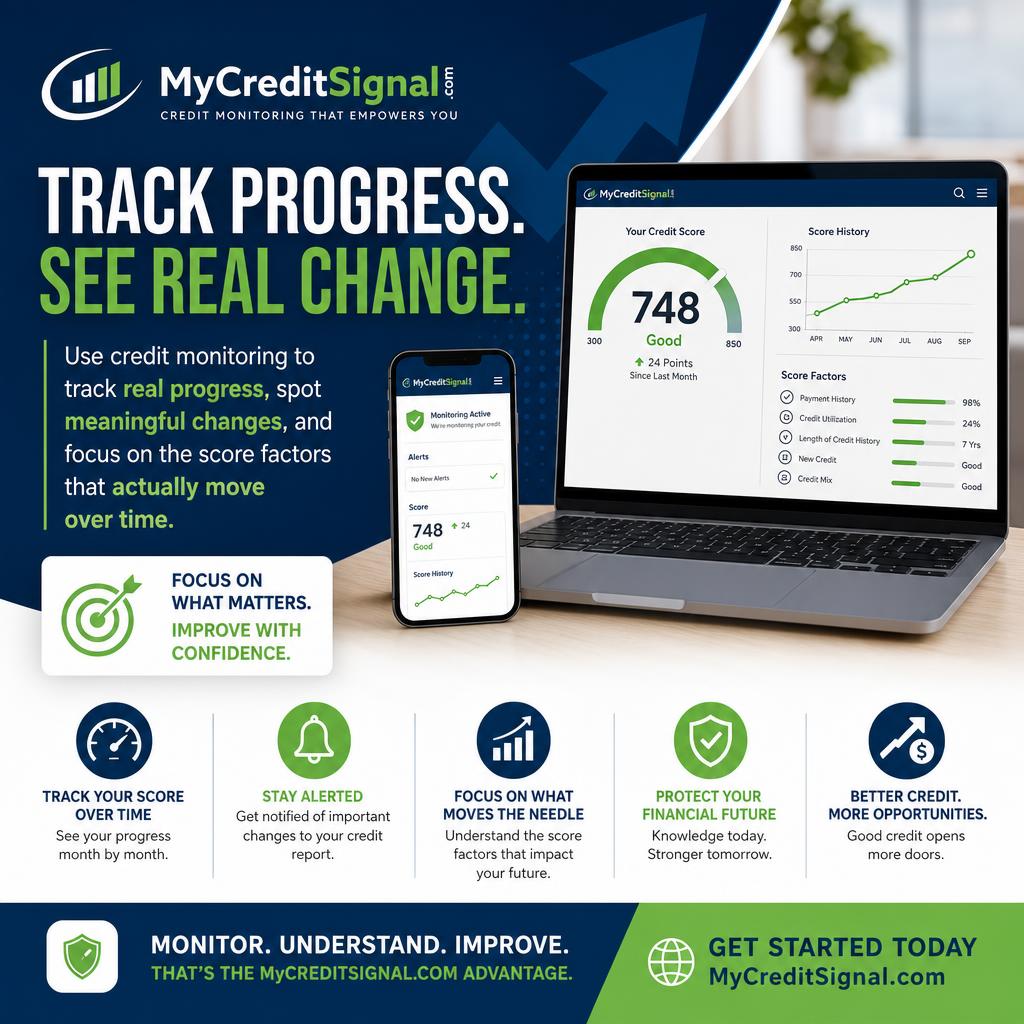
You paid down a card, made every payment on time, and skipped applying for anything new. Then you check your score a few weeks later and wonder whether anything is actually working. That is where credit monitoring becomes useful. It gives you a repeatable way to watch your credit building progress instead of guessing from month to month.
This guide is for people who are actively building or rebuilding credit and want a simple tracking system they can stick with. You will learn what to monitor, which numbers matter most, how often to check, and how to separate normal score noise from real progress. You will also see how to connect monitoring with practical tools like a credit score simulator and a credit mix analyzer so you can decide what to do next.
Contents
- 1 Who should use credit monitoring this way
- 2 What credit monitoring actually tracks
- 3 The progress signals that matter more than daily score changes
- 4 The numbers and thresholds worth tracking each month
- 5 A weekly and monthly plan to monitor progress without obsessing
- 5.1 Pick one main monitoring source and one backup
- 5.2 Create a five-line credit log
- 5.3 Review alerts once a week, not every hour
- 5.4 Track utilization before and after statement closing dates
- 5.5 Separate what to do this week from what takes time
- 5.6 Use tools to test before you apply
- 5.7 Set a 90-day review point
- 6 Mistakes that make credit monitoring less useful
- 7 What many credit monitoring guides leave out
- 8 What to do first versus later
- 9 FAQ
- 10 Helpful tools and related resources
- 11 Conclusion
Key Takeaway
Good credit monitoring is not about checking your score every day; it is about tracking the few report changes and behavior patterns that actually move your profile over time.
Who should use credit monitoring this way
This approach works best for people who are in an active credit-building phase, not people who just want a number to glance at once in a while. You will likely benefit if you fit one of these situations:
- You opened your first card in the last 12 months and want to see whether low balances and on-time payments are helping.
- You are rebuilding after high utilization, missed payments from the past, bankruptcy, collections, or identity theft recovery and need an objective way to measure improvement.
- You are preparing for a loan in the next 6 to 18 months and want fewer surprises.
- You use more than one score source and want to understand why the numbers differ.
- You want alerts for new accounts, hard inquiries, or address changes that could signal fraud.
It may be less useful as a daily habit if you are not using credit at all, if all your accounts are already stable and mature, or if frequent checking makes you anxious without changing your behavior. In that case, a monthly review is usually enough.
If you are still building your base, these related guides can help you match monitoring with the right habits: how to build credit in your 20s wisely and first credit card approval tips for beginners.
What credit monitoring actually tracks
According to the Consumer Financial Protection Bureau, a credit monitoring service typically alerts you to changes in your credit report by email, text, or phone. Those changes can include a new account, a hard inquiry, a balance shift, or personal information updates. The main benefit is early detection of fraudulent activity, but for someone building credit, monitoring also becomes a progress dashboard.
In plain English, there are three layers to watch:
- Report changes: Did a lender report a new payment, new balance, or new inquiry?
- Score movement: Did your score move up, down, or stay flat after those updates?
- Behavior trends: Are you consistently paying on time, keeping utilization low, and avoiding unnecessary applications?
The key is not treating every alert as equally important. A $40 balance increase on a $5,000 limit card is very different from maxing out a $500 starter card. Monitoring only becomes useful when you connect the alert to the underlying factor.
The CFPB also notes that you can get credit scores from multiple sources, including lenders and monitoring services, and score monitoring often comes with alerts when your report changes. See the CFPB overview here: where to get your credit scores.
The progress signals that matter more than daily score changes
Most people focus too much on the score itself and not enough on the ingredients. If your goal is to track credit building progress, watch these signals in order.
1. Payment history updates
If your account reports another on-time payment, that is usually a positive sign even if your score does not jump immediately. Credit building often works like compounding. One month looks small, but six straight months of clean payments tell a stronger story than one lucky score spike.
2. Credit utilization
Credit utilization is the ratio of your card balances to total available credit. Formula: current revolving balances divided by total revolving limits. If you owe $300 across cards with a total $1,500 limit, your utilization is 20 percent. If you owe $900 on that same limit, it is 60 percent. Higher utilization can hurt your score; lower utilization generally helps.
If utilization is the main issue on your profile, spend time with this related guide: store credit cards and your credit score. Store cards often have lower limits, so small balances can push utilization up faster than expected.
3. New hard inquiries
A hard inquiry can affect your score temporarily, while soft pulls used to check scores do not affect it. That means checking your own credit is safe. The myth that every score check hurts you is false, as the CFPB explains in its score access guidance.
4. Age of accounts and account stability
This is the slower part of the process. If you keep older accounts open and avoid applying for too many new ones, your profile often becomes more stable over time. Monitoring helps because it reminds you not to overreact and open unnecessary accounts just because your score plateaued for a month.
5. Credit mix
Credit mix matters, but it should not be forced. A mix of revolving and installment accounts may help some profiles, yet taking out a loan just for mix is rarely the first move. Use a credit mix analyzer to review whether mix is a secondary issue or whether utilization and payment consistency deserve your attention first.
The numbers and thresholds worth tracking each month
Standard FICO and VantageScore models commonly use a 300 to 850 scale, but lenders do not all use the same score version. FICO scores remain the most widely used by U.S. lenders, while VantageScore 4.0 and 5.0 are increasingly used in mortgage and other lending decisions, according to VantageScore. That is why your progress should be judged by trend lines, not a single score from a single source.
Here are the most practical numbers to log monthly:
- Your current score source and model: Example, FICO from a card issuer or VantageScore from a monitoring service.
- Total revolving limits: Add all card limits together.
- Total revolving balances: Add statement balances or reported balances.
- Utilization percentage: Balances divided by limits.
- Number of on-time payments added this month: Count reported accounts.
- New hard inquiries: Zero is ideal unless you intentionally applied.
- New accounts opened: Useful for understanding why scores may dip temporarily.
A simple decision framework: first fix payment history, then utilization, then application pace, then fine-tune mix. That order keeps you focused on the biggest levers first.
Example: suppose Maya has two cards with limits of $500 and $1,000, so total available credit is $1,500. In January, her balances report at $600 total. Her utilization is 40 percent. By March, she pays that down to $225 total. Her utilization is now 15 percent. Even if her score does not jump in a straight line each month, that is real progress because the underlying ratio improved materially.
If you want to model what a paydown might do before your next statement closes, test scenarios with the credit score simulator.
A weekly and monthly plan to monitor progress without obsessing
The best tracking system is light enough to stick with. Daily checking usually creates noise. A weekly alert scan plus a monthly review is enough for most people.
Pick one main monitoring source and one backup
Use one source as your primary trend tracker so you are comparing similar data month to month. Then keep a backup source for cross-checking. Major bureaus like Experian, TransUnion, and Equifax offer free monitoring access or free report components, although premium features may cost extra, as noted by Experian.
Create a five-line credit log
Once a month, record your score, total limits, total balances, utilization percentage, and any new inquiries or accounts. That takes less than five minutes and makes it much easier to spot patterns later.
Review alerts once a week, not every hour
If you get an alert for a new inquiry, account, or personal info change you do not recognize, treat that as urgent. If the alert is simply that a balance updated after your statement closed, note it and move on. Credit monitoring is most effective when it supports decisions instead of feeding panic.
Track utilization before and after statement closing dates
Know when each card typically reports. If one card has a $1,000 limit and you let $700 report, that single card is at 70 percent utilization even if you pay in full later. For score tracking, reported balance timing matters. If your goal is score improvement in the short term, paying down before the statement closes may matter more than paying after.
Separate what to do this week from what takes time
This week: set autopay, pay down a balance, confirm statement dates, and turn on alerts. Over the next 3 to 12 months: let accounts age, keep balances controlled, and avoid unnecessary applications. Fast factors and slow factors both matter, but only some are controllable right now.
Use tools to test before you apply
If you are considering a new account, simulate the tradeoff first. A new line could help available credit, but it could also add a hard inquiry and reduce average account age. Running scenarios with the simulator and reviewing your profile with the credit mix tool can help you choose timing more carefully.
Set a 90-day review point
Credit building is easier to measure in 90-day blocks than in 9-day blocks. At the end of 90 days, compare your starting and ending utilization, inquiry count, and payment streak. That gives you a better read on whether your habits are working.
Five concrete actions you can take this week:
- Turn on credit monitoring alerts from your main provider.
- List every card limit and current balance in one note or spreadsheet.
- Calculate your utilization percentage using balances divided by limits.
- Set autopay for at least the minimum due on every account.
- Check your statement closing date and move one payment earlier if you want lower reported balances.
- Run one payoff scenario in the credit score simulator.
- Review whether credit mix is really a problem before opening anything new with the credit mix analyzer.
Mistakes that make credit monitoring less useful
Watching the score but ignoring the report changes
Behavior: You refresh your score constantly but do not review what actually updated. Consequence: You miss the reason behind the move and may make the wrong next decision. Fix: Pair every score check with a quick look at balances, inquiries, and account updates.
Comparing different score models as if they should match
Behavior: You look at a FICO score from one source and a VantageScore from another and assume one is wrong. Consequence: You may think your progress is fake when the numbers simply come from different models. Fix: Track trends within the same model and source first, then use other scores as secondary reference points.
Applying for new credit just because your score stopped moving
Behavior: You chase progress by opening accounts too quickly. Consequence: More hard inquiries and younger average account age can slow your progress. Fix: Before applying, ask whether the problem is really low limits, high utilization, or just impatience.
Paying on the due date but letting large balances report
Behavior: You pay in full eventually, but only after a high statement balance is reported. Consequence: Your score may look weaker than your actual cash flow habits. Fix: Make an extra payment before the statement closes when you want lower utilization to show up sooner.
What many credit monitoring guides leave out
Two people can do the same thing and see different score movement. That is normal. Results vary by credit profile, scoring model, and what is already on the file. If you have a thin file, one new account or one utilization swing may cause a bigger change than it would for someone with a thicker, older profile.
Another overlooked point is that monitoring is not the same as improvement. Alerts tell you what happened; they do not fix anything by themselves. You still need a behavior plan.
There is also a timing issue with newer scoring models. FICO remains widely used, but VantageScore 4.0 and 5.0 are gaining traction in mortgage and other lending contexts. If you are preparing for a major loan, ask which score version the lender is likely to use. That can help you interpret your monitoring data more realistically.
Finally, non-traditional data is becoming more relevant. Industry documentation around VantageScore notes growing use of consumer-permissioned data and timely payment data such as rent-related information in broader credit assessment. If that applies to you, read this rent reporting credit guide for renters to understand when those payments may help.
What to do first versus later
If you feel overloaded, use this order:
- Do first: turn on alerts, set autopay, calculate utilization, and stop unnecessary applications.
- Do next: pay down the highest-utilization card first, especially if one small-limit card is carrying a large reported balance.
- Do later: consider whether you need another account, a broader credit mix, or lender-specific score tracking for a future mortgage or auto loan.
This matters because the highest-return actions are often the least flashy. A lower reported balance and another month of on-time payments usually help more than chasing a new product.
FAQ
Does checking my own credit score hurt it?
No. Soft pulls used to check your own score do not affect your score. Hard inquiries from credit applications can affect it temporarily.
Should I monitor FICO or VantageScore?
Both can be useful, but pick one main source for trend tracking. FICO is still widely used by lenders, while VantageScore is also used and is becoming more relevant in some major lending areas.
How often should I check my credit building progress?
Use alerts continuously, scan them weekly, and do a deeper monthly review. For judging whether your habits are working, compare progress in 60- to 90-day blocks.
- Credit score simulator to test how balance paydowns may affect your profile.
- Credit mix analyzer to see whether account variety is actually a weak point.
- How to build credit in your 20s wisely for a starter-friendly long game.
- First credit card approval tips for beginners if you are still deciding which first account to open.
- Rent reporting credit guide for renters if you want to track non-card payment data more strategically.
Get weekly credit tips, tool updates, and practical guides – free.
Conclusion
Credit monitoring works best when you use it as a decision tool, not a scoreboard you refresh all day. Track one main score source, watch report changes, calculate utilization every month, and judge your progress in 90-day windows instead of daily swings. That gives you a much clearer picture of whether your habits are building a stronger file.
Your next step is simple: turn on alerts, log your current balances and limits, and run one scenario in the simulator before your next statement closes. Small, consistent tracking beats random score checking every time.


Leave a Reply
You must be logged in to post a comment.