
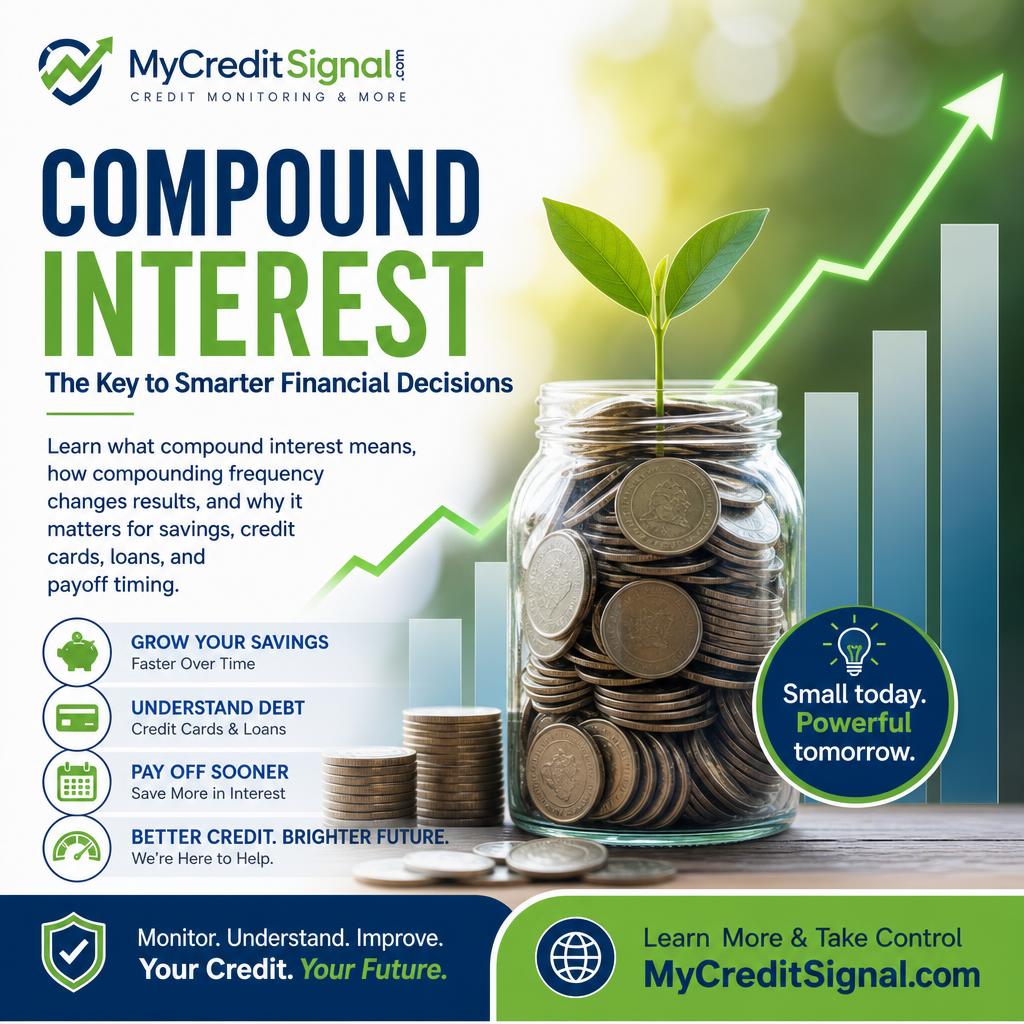
If you leave a savings balance alone for years, it can grow faster than you expect. If you leave a debt balance alone, it can get more expensive than you expected. That is the basic reason people search for compound interest. They want to know why the number changes so much over time.
This guide is for beginners who want a practical explanation, not a textbook one. You will learn what compound interest means, how daily versus monthly compounding changes the math, how it shows up in savings and debt, and what to do this week to keep it working for you instead of against you.
Contents
- 1 Who should care about compound interest first
- 2 The plain English version of how compound interest works
- 3 Where you will actually see it in real life
- 4 Daily vs monthly compounding changes the outcome
- 5 The numbers that matter more than the headline rate
- 6 A simple example with realistic numbers
- 7 Why interest does not directly set your credit score
- 8 What to do first this week and what can wait
- 9 A step by step plan to use compound interest wisely
- 10 Mistakes that make compound interest more expensive
- 11 What many beginner articles skip
- 12 FAQ
- 13 Helpful tools and related resources
- 14 The bottom line
Key Takeaway
Compound interest means interest earns interest over time, so the biggest levers are how long money sits, how often it compounds, and whether your balance is growing or shrinking.
Who should care about compound interest first
Compound interest matters most if you are in one of these groups:
- You are starting to save and want to understand why time matters so much.
- You carry credit card debt and want to know why balances seem stubborn even when you pay something every month.
- You are comparing loans and want to understand why the stated rate is not the full story.
- You are paying down tax debt, where timing can matter because the IRS uses daily interest calculations in many situations, as explained in its interest rules.
It matters a little less if you are only looking at a very short window, such as a few days before paying off a small balance. In that case, other details like fees, due dates, and whether a lender uses simple or precomputed interest may matter just as much. The CFPB notes that interest can be calculated on different schedules and that loan structures can change your true cost over time.
If your main question is not “How does compounding work?” but “Why is my minimum payment barely moving the balance?” then a more targeted next read is how minimum payments can raise your total borrowing cost.
The plain English version of how compound interest works
Compound interest is interest earned on the original amount and on prior interest that has already been added. The CFPB defines it this way: interest earns interest over time, which can create exponential growth for savings or debt. The FDIC teaches the same core idea in its consumer education materials on building savings.
Here is the simple version:
- Day one or month one: interest is calculated on your starting balance.
- Next period: interest is calculated again, but now the balance may include earlier interest.
- Repeat: each cycle can make the next cycle a little bigger.
That is why compounding is powerful in both directions. A savings account can grow faster the longer you leave it alone. A debt balance can become more expensive the longer you let it sit.
Think of it as a snowball rolling downhill. A small snowball picks up more snow, which makes it larger, which helps it pick up even more snow. Money can behave the same way.
Where you will actually see it in real life
Most people do not care about the definition alone. They care about where it shows up on their own statements. Here are the common places:
Savings accounts and investments
This is the good version. When interest or returns stay in the account, future interest can be earned on a larger amount. The FDIC emphasizes that time is a major factor in building wealth because compounding has more cycles to work.
Credit cards and other debt
This is the expensive version. If interest charges are added and you do not reduce the principal much, future charges may be based on a higher balance. Even when a product does not use classic compounding in the way a savings account does, the practical effect is similar: time raises your cost if the balance does not fall fast enough.
Taxes owed to the government
The IRS is a useful real-world example because it explicitly uses daily interest calculations in many underpayment and overpayment situations. Daily compounding means each extra day can matter.
Installment loans
Loans may use simple interest, amortized interest, or other methods. The CFPB explains that different loan designs, such as simple versus precomputed approaches in auto loans, can change how interest behaves over time. So the smart move is to check the loan terms instead of assuming all debts compound the same way.
Daily vs monthly compounding changes the outcome
Compounding frequency matters because more frequent compounding means the balance updates more often. The CFPB notes that interest may be compounded daily, monthly, or yearly. The FDIC also points out that more frequent compounding can accelerate savings growth at the same nominal rate.
That does not mean you need to become a spreadsheet person. It means you should know one practical rule: when two accounts advertise the same annual rate, the one that compounds more frequently can produce a slightly better result for savings, or a slightly worse result for debt.
For example, a savings balance that compounds daily has more opportunities for prior interest to start earning its own interest than a balance that compounds monthly. The difference may look small in one month, but over years it becomes more noticeable.
If you want to translate an annual percentage rate into a day-by-day view, use the APR to daily rate converter. That is especially useful when you are comparing how fast interest can stack up on balances that accrue every day.
The numbers that matter more than the headline rate
Beginners often fixate on one number: the APR. But compound interest is really driven by a short checklist of moving parts.
1. Principal
This is your starting amount. A larger balance creates more interest in dollars, even at the same rate.
2. Rate
The annual rate still matters. Higher rates produce faster growth for savings and faster costs for debt.
3. Frequency
Daily, monthly, or yearly compounding changes how often interest gets added back into the balance.
4. Time
This is the multiplier people underestimate most. The FDIC specifically highlights time as a key reason compound growth becomes powerful.
5. Whether you add money or make payments
Regular contributions to savings can boost the effect. Regular extra payments on debt can interrupt the effect.
A good decision framework is this:
- If the balance helps you: maximize time, consistency, and compounding frequency.
- If the balance hurts you: minimize time, reduce the balance quickly, and avoid letting interest roll forward.
To compare two loan paths side by side, such as a lower payment over a longer term versus a higher payment over a shorter term, use the loan comparison calculator. It helps make the time-and-interest tradeoff visible.
A simple example with realistic numbers
Suppose two people each start with the same amount in savings and the same annual rate. One account compounds monthly and the other compounds daily. Neither person touches the money. The account with more frequent compounding will end up slightly higher because interest gets added to the balance more often.
Now flip the example to debt. Suppose you have a revolving balance and interest is accruing over time. If you make only the required payment and most of it goes toward interest and very little toward principal, the next cycle starts from a balance that is still high. That is why small payments can stretch repayment far longer than expected.
You do not need an exact national average or made-up sample APR to understand the lesson. The lesson is structural: the longer a balance remains high, and the more often interest is applied, the more total cost grows. That is why paying earlier usually matters more than paying later.
If your goal is cutting interest on debt, read Debt Avalanche Method Steps That Cut Interest for a payoff order that focuses on your most expensive balances first.
Why interest does not directly set your credit score
This is one of the biggest misconceptions. Your interest rate or APR does not directly determine your credit score. Credit scoring models such as FICO focus on factors like payment history, amounts owed, and credit utilization, not the APR itself, according to myFICO education materials.
But interest can still affect your scores indirectly.
- If interest charges push your balance higher, your credit utilization can rise.
- If the account becomes harder to manage, you may be more likely to miss a payment.
- If debt grows faster than your budget can handle, your overall credit profile may weaken.
The CFPB explains that scores look at how you manage debt and repayment behavior. So the practical connection is this: interest rate is not a scoring factor, but the financial stress created by interest can lead to behaviors that affect your score.
What to do first this week and what can wait
If you feel overloaded, separate urgent actions from later optimizations.
Do first
- Check whether your debt or savings account compounds daily, monthly, or yearly.
- Look at your current balance and your last interest charge.
- Identify whether your payment is actually reducing principal in a meaningful way.
- Make at least one extra payment if you are carrying expensive revolving debt.
Do next
- Compare refinancing, payoff sequencing, or transfer options.
- Automate savings contributions so compounding works for you.
- Review loan structures before opening a new account.
This order matters because understanding the schedule and current balance gives you the highest-value information first. Optimization comes after clarity.
A step by step plan to use compound interest wisely
Identify which balances are helping you and which are hurting you
List every account where interest applies. Separate them into two groups: savings or investments on one side, debts on the other. This sounds basic, but it changes your strategy immediately. Money earning you interest should usually stay consistent. Money costing you interest should usually be reduced faster.
Find the compounding or accrual schedule
Look for terms such as daily, monthly, yearly, simple interest, or precomputed interest in your account disclosures or monthly statements. The CFPB and IRS both show that calculation methods matter. If you cannot find it, call the lender or bank and ask how interest is calculated and added.
Measure your last 30 days of interest cost
Open your latest statement and note the interest charged in dollars. This gives you a concrete number, not just an abstract rate. If you paid 40 dollars in interest last month, that is 40 dollars of budget space you could eventually redirect once the balance falls.
Choose one action that reduces time
Time is the fuel for compounding. So remove time where debt is involved. Make an extra payment this week, switch to biweekly payments if your lender allows it, or increase your automatic payment amount. If you are comparing payoff paths, use the calculator tools before you commit.
Automate one positive compounding habit
Set up an automatic transfer into savings, even if it is modest. The FDIC stresses that time matters, so starting earlier is usually better than waiting for the perfect amount. Consistency creates more compounding periods.
Review high-interest debt for a better strategy
If debt is the main issue, consider a structured payoff order. The debt avalanche method prioritizes the highest-interest balances first, which can reduce total interest cost over time. For a practical walkthrough, see a debt avalanche approach to saving interest and the more detailed guide at How to Pay Off Multiple Credit Cards Smartly.
Mistakes that make compound interest more expensive
Looking only at the APR and ignoring timing
Behavior: You compare accounts only by the stated annual rate. Consequence: You miss how daily versus monthly compounding or a longer payoff timeline changes the real result. Fix: Check both the rate and how often interest is calculated or added.
Making payments without checking whether principal is shrinking
Behavior: You pay something every month but never review how much goes to interest versus principal. Consequence: The balance stays high longer, so future interest keeps building from a large base. Fix: Review your statements and track whether the principal is dropping month to month.
Assuming interest rate and credit score are the same thing
Behavior: You believe a high APR directly causes a lower credit score. Consequence: You may focus on the wrong problem and ignore utilization or payment history. Fix: Treat APR as a cost issue and credit score as a behavior-and-profile issue. Work on both, but do not confuse them.
Waiting too long to act on growing debt
Behavior: You delay extra payments until you feel fully ready. Consequence: More time passes, and time is exactly what makes debt more costly. Fix: Start with one small extra payment now and refine your strategy later.
What many beginner articles skip
Most basic explainers make compound interest sound universal and identical across all products. It is not. Different debts can use different interest methods, and that changes what action matters most.
Another nuance: compounding is not automatically good just because it sounds powerful. It is only good when the balance belongs to you. If the balance is a debt, “powerful” usually means “expensive.”
And finally, not every money decision should be solved by attacking interest first. If you are behind on essentials, facing possible late payments, or do not have enough cash flow to cover basics, the first move is stabilizing your monthly budget. Once you stop new damage, interest strategies become more effective.
FAQ
What is compound interest in one sentence?
It is interest earned on both your original balance and previously added interest, which makes growth speed up over time.
Does daily compounding always make a huge difference?
Not always in the short term, but more frequent compounding can create a larger difference over longer periods, especially when balances are large or time is long.
Do credit card interest charges hurt my credit score directly?
No. Scoring models do not directly use APR. But interest can raise balances and utilization or make payments harder to manage, which can affect scores indirectly.
If you want to turn the concept into an actual plan, these resources can help:
- APR to daily rate converter to see how annual rates translate into day-by-day cost.
- Loan comparison calculator to compare payoff timelines and total interest tradeoffs.
- Debt avalanche strategy guide for a same-silo payoff approach focused on reducing interest.
- Pay Off Personal Loan Faster With Less Interest if you want specific extra-payment tactics.
- Mastering Debt Payoff Strategies for a broader overview of payoff options.
For authoritative background, see the CFPB explanation of compound interest, the FDIC lesson on the power of compounding, and myFICO education on what affects scores.
Get weekly credit tips, tool updates, and practical guides – free.
The bottom line
Compound interest is not complicated once you strip it down. A balance changes, interest gets added, and the next calculation starts from a new number. The more time involved, the more the effect grows.
Your next step is simple: check one savings account or one debt statement today and find the interest schedule, the last interest charge, and whether the balance is moving in the right direction. Once you know those three things, you can make better decisions much faster.



Want to understand your credit report?
Get plain-English explanations with our free AI Credit Analyzer →
Leave a Reply
You must be logged in to post a comment.