
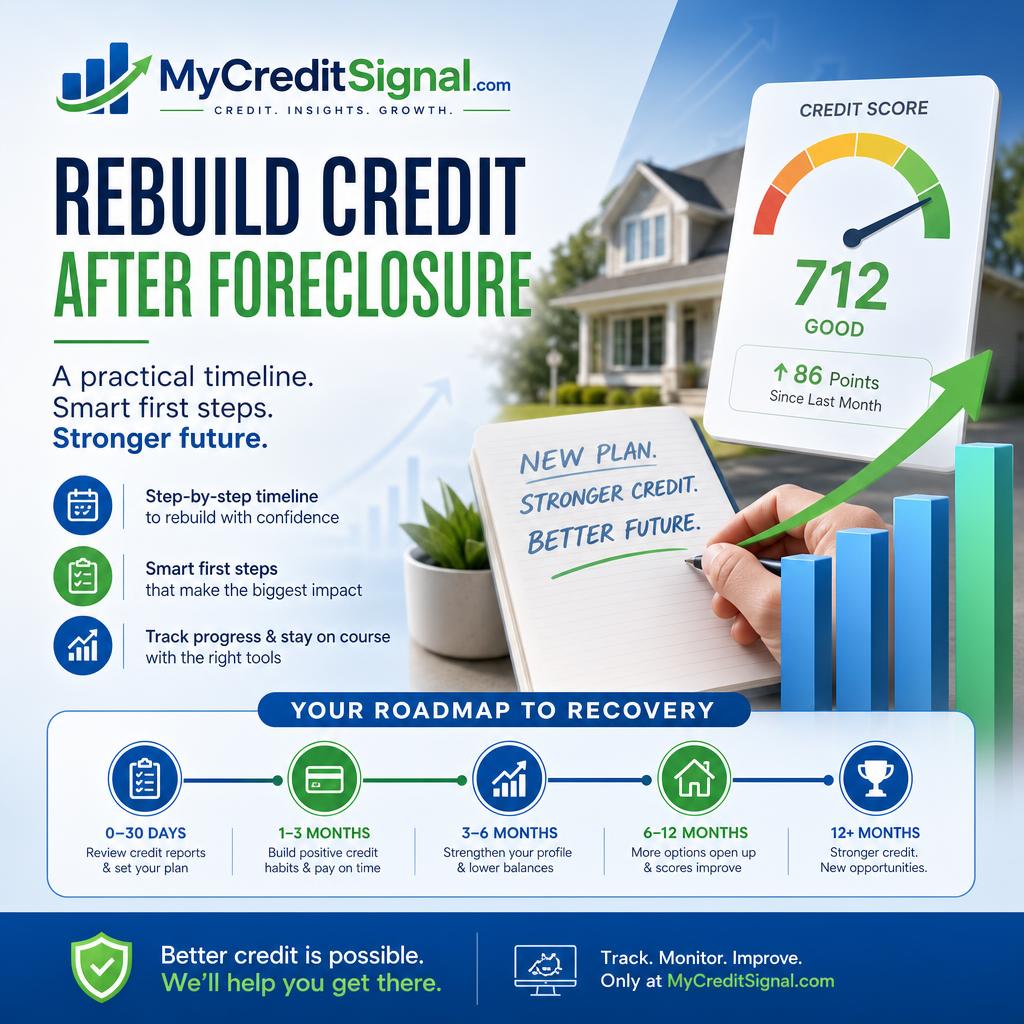
If you recently went through foreclosure, the hard part is not just the home loss. It is the months and years after, when every credit decision seems more expensive, slower, and more complicated. You may be wondering whether your score can recover, when lenders will start taking you seriously again, and what to do first so you do not waste time.
This guide is for people rebuilding credit after foreclosure and trying to create a realistic path forward. You will learn what changes now, which numbers matter most, how to rebuild without over-borrowing, and what steps you can take this week to move from damage control to steady progress.
Contents
- 1 Who this rebuild plan is for
- 2 What foreclosure changes in your credit profile
- 3 The first numbers to watch after foreclosure
- 4 How rebuilding credit after foreclosure actually works
- 5 A realistic timeline from month 1 to year 2
- 6 Your step by step plan for this week and this year
- 6.1 Pull and review all three credit reports
- 6.2 Set every current bill to on-time status
- 6.3 Lower revolving balances before applying anywhere
- 6.4 Open one credit-building account, not several
- 6.5 Use the account lightly and predictably
- 6.6 Consider rent reporting if your rent is always on time
- 6.7 Wait before adding a second product
- 6.8 Reevaluate loan offers with a simple filter
- 7 Mistakes that slow down recovery
- 8 What most articles miss about foreclosure recovery
- 9 FAQ
- 10 Helpful tools and related resources
- 11 Conclusion
Key Takeaway
A foreclosure can stay on your credit report for 7 years, but consistent on-time payments, low credit utilization, and carefully chosen new accounts can start rebuilding credit much sooner.
Who this rebuild plan is for
This article is most useful if your foreclosure is already complete or you are in the immediate aftermath and need a credit rebuilding plan. It is especially relevant if you want to qualify for lower-cost credit later, rent a new place, or eventually apply for another mortgage after rebuilding.
It is also a fit if you have enough income to pay current bills on time and want to use the next 12 to 24 months wisely.
This may not be the right starting point if you are still missing current payments on multiple accounts, are relying on new debt to cover basic living expenses, or have no stable monthly cash flow yet. In that case, fix the budget first. A rebuild strategy only works if new accounts stay current.
If your current issue is repeated late payments rather than a completed foreclosure, read this guide on recovering from late payments for tactics that fit that stage better.
What foreclosure changes in your credit profile
A foreclosure is a major negative event because it signals severe payment breakdown on a large installment debt. The Consumer Financial Protection Bureau says foreclosure generally stays on a credit report for 7 years from the foreclosure date. That does not mean your score is frozen for 7 years. It means lenders and scoring models can still see the event during that period.
The impact usually feels worst early on. Over time, the effect can lessen if you add newer positive information. FICO explains that score recovery varies by starting score and later behavior, and newer delinquencies plus high balances can keep scores suppressed much longer than the foreclosure alone would.
Think of it this way:
- The foreclosure is the old damage. You cannot speed up the clock on how long it remains reportable.
- Your current habits are the new data. On-time payments, lower balances, and stable account management can gradually outweigh some of the earlier harm.
- Lenders do not use one universal rule. The Federal Reserve has noted that banks and credit unions make post-foreclosure decisions based on loan program standards and risk tolerance, so approvals and rates vary.
This is why rebuilding credit after foreclosure is not about one magic product. It is about stacking enough positive signals that future lenders see less risk than they would have six or 12 months ago.
The first numbers to watch after foreclosure
After a foreclosure, people often obsess over one score. A better approach is to track a handful of indicators that directly affect your next lending decision.
1. Your 7-year reporting window
The CFPB guidance is clear: a foreclosure generally remains on your report for 7 years. Mark that date in your records. You are not waiting passively for 7 years, but knowing the timeline helps set expectations.
2. Payment history
Payment history is typically the largest factor in FICO scoring at 35%, according to FICO consumer education materials. That means every on-time payment now matters more than most people realize. Missing a $40 minimum payment on a starter card can undercut months of progress.
3. Revolving utilization
If you open a secured card or another revolving account, keep the balance low relative to the limit. There is no single perfect number in the research provided here, but lower utilization is consistently associated with stronger rebuilding outcomes. If your secured card has a $300 limit, charging $240 and carrying it can signal stress. Charging $30 to $90 and paying on time is a much cleaner pattern. For a deeper breakdown, see this credit utilization guide.
4. Age of new accounts
TransUnion notes that delinquency history and the age of new credit accounts influence how quickly someone can qualify again. That means opening three new accounts in one month is not automatically better than opening one well-managed account and letting it season.
5. Time since foreclosure
FICO materials indicate that under some conditions, a notable rebound can begin within about 2 years. That does not mean everyone gets the same result. Profiles with lower balances, no new delinquencies, and steady on-time payments usually have a better setup than profiles with fresh missed payments or maxed-out cards.
How rebuilding credit after foreclosure actually works
The rebuilding process is simple in theory and slow in practice. You replace negative momentum with positive momentum.
That usually means four things happening at the same time:
- You stop all new missed payments.
- You keep revolving balances modest.
- You add positive information carefully, not aggressively.
- You give the file time to age.
For many people, the best early mix is a stable checking account, automatic bill pay, one starter revolving line, and maybe one additional credit-building product later. FICO and Experian consumer guidance both point to tools like secured credit cards, credit-builder loans, and in some cases rent reporting as ways to establish new positive payment history.
Monitoring also matters. Federal Reserve consumer guidance notes that credit reports and scores are built from multiple data sources, so tracking reports from all three major bureaus helps you see whether progress is appearing consistently.
If you want a simple place to organize your next moves, the credit rebuilding checklist tool can help you set priorities without guessing.
A realistic timeline from month 1 to year 2
One reason people get discouraged is that they expect a straight-line recovery. Credit rebuilding after foreclosure is usually uneven. Here is a more realistic sequence.
Months 1 to 3
Your job is stabilization. Bring all current bills to on-time status, reduce any high revolving balances, and avoid unnecessary applications. If you cannot pay every bill on time yet, do not rush into opening new accounts.
Months 4 to 6
If cash flow is stable, consider one small credit-building product such as a secured card. Use it lightly and pay in full or keep the balance very low. This is also a reasonable time to look at rent reporting if your rent payment is steady and a provider you use reports to bureaus.
Months 7 to 12
Consistency matters more than expansion. The goal is 6 to 12 months of clean payment data, not a wallet full of fresh cards. If you already have one new account reporting positively, that may be enough for now.
Year 1 to Year 2
This is the period where some borrowers begin seeing more noticeable improvement, especially if there are no new negatives and utilization stays low. FICO guidance indicates that under certain conditions, notable rebound can begin around 2 years after foreclosure. That is not a promise. It is a reminder that the timeline rewards patience.
If you want to estimate how changes in balances or on-time history might affect your direction, use the credit score simulator as a planning tool before making moves.
Your step by step plan for this week and this year
Pull and review all three credit reports
Start by checking each major bureau so you know which accounts are still reporting, which balances are active, and whether your new positive accounts are appearing. Because lenders may use different bureau data, rebuilding on only one report is not enough.
Set every current bill to on-time status
Use automatic payments or calendar reminders for rent, utilities, phone, insurance, and any open credit account. Since payment history typically makes up 35% of a FICO score, preventing one new late payment can matter more than opening a new product.
Lower revolving balances before applying anywhere
If you have a card with a $500 limit and a $400 balance, paying that down helps more than applying for another line right away. Lower utilization supports rebuilding. If you need help with the math, review your current balance-to-limit ratio and compare options using your own numbers.
Open one credit-building account, not several
A secured credit card can be a practical first move if your income is stable and you can fund the deposit. A credit-builder loan may also fit some borrowers later. The key is to choose one product you can manage easily rather than scattering applications across multiple lenders.
Use the account lightly and predictably
Put one or two small recurring charges on the card, such as a streaming bill or tank of gas, then pay it on time. A modest usage pattern often looks healthier than large swings in spending.
Consider rent reporting if your rent is always on time
Experian consumer guidance notes that rent, utilities, and phone payments can be captured in some credit-building tools. This can help add positive payment history if traditional tradelines are limited. It is not a substitute for core credit habits, but it can help some files show more consistent behavior.
Wait before adding a second product
Let your first new account age. TransUnion points out that account age and delinquency history affect rebuilding speed. In many cases, 6 to 12 months of clean history on one starter account is more useful than opening several new accounts too quickly.
Reevaluate loan offers with a simple filter
Use this decision framework: First, ask whether the account adds positive reporting. Second, ask whether the payment easily fits your budget. Third, ask whether the cost feels reasonable for a temporary rebuilding step. If the answer is no to any of the three, skip it.
Those are your specific actions. If you want a short list for this week, do these five first: check all three reports, automate current bills, pay down any high card balance, research one secured card or credit-builder option, and track your progress in a written checklist.
Mistakes that slow down recovery
Opening too many new accounts at once
Behavior: Applying for multiple cards or loans right after foreclosure because you want to rebuild fast. Consequence: You create several brand-new accounts with no history, increase the chance of overspending, and may look riskier to lenders. Fix: Start with one manageable account and let it age before considering another.
Carrying high balances on a starter card
Behavior: Using most of a small secured card limit month after month. Consequence: High utilization can keep your score under pressure even while you are paying on time. Fix: Keep usage modest and pay the balance down quickly. If you need the card only for reporting activity, one small recurring charge is enough.
Taking the first loan offer without checking the total cost
Behavior: Accepting expensive credit just because approval feels like progress. Consequence: High-cost debt can strain your budget and increase the risk of another missed payment. Fix: Compare offers carefully and choose rebuilding products that you can comfortably pay on time every month.
Ignoring non-credit bills
Behavior: Focusing only on your score while rent, utilities, or phone bills become unstable. Consequence: Cash flow problems can spill into new late payments and derail your rebuild. Fix: Build the budget first, then add credit-building tools once your essentials are covered.
What most articles miss about foreclosure recovery
Many articles make rebuilding sound like a checklist you finish in 90 days. That is not how this works. The foreclosure stays visible for 7 years, and lenders may still price risk conservatively for a while even if your score improves.
The CFPB also notes that it is possible to qualify for a mortgage again after foreclosure, but borrowers should weigh the costs and risks of new financing versus waiting longer to rebuild. That point matters. Qualifying again is not the same as getting a deal that makes financial sense.
Another thing people miss is that positive alternative data can help some borrowers. Rent reporting, utilities, and phone payment programs can add support if your payments are steady. But they work best as a supplement to the basics, not a replacement for on-time traditional credit management.
FAQ
How long does a foreclosure stay on my credit report?
In general, 7 years from the foreclosure date, according to the CFPB. Its scoring impact can lessen over time if you build positive history afterward.
Can I buy a home again after foreclosure?
Yes, it may be possible, but the CFPB says you should weigh the costs and risks of new financing against waiting longer to rebuild credit and strengthen your application.
Should I use a secured card or a credit-builder loan first?
It depends on your budget and what you can manage consistently. For many people, one starter product used responsibly is better than opening several accounts too quickly.
If you want to turn this advice into a plan, start with the credit rebuilding checklist. If you are deciding whether to pay down balances before applying, use the credit score simulator to think through possible outcomes. And if high revolving balances are part of the problem, this credit utilization guide can help you understand why balance management affects recovery so much.
For authoritative background, review the CFPB explanation of foreclosure and future mortgage decisions, FICO consumer education on score factors and rebuilding, and TransUnion guidance on credit recovery behavior. Those sources support the big picture: time matters, but what you do during that time matters more.
Get weekly credit tips, tool updates, and practical guides – free.
Conclusion
Rebuilding credit after foreclosure is less about finding a shortcut and more about creating a cleaner file month by month. The foreclosure can remain on your credit report for 7 years, but you do not have to wait 7 years to make progress. Payment history, utilization, careful account selection, and time can all work in your favor.
Your best next step is simple: stabilize current bills, choose one practical rebuilding tool, and track your progress across all three reports. If you stay consistent, your credit profile can become stronger, more predictable, and easier for future lenders to trust.


Leave a Reply
You must be logged in to post a comment.