
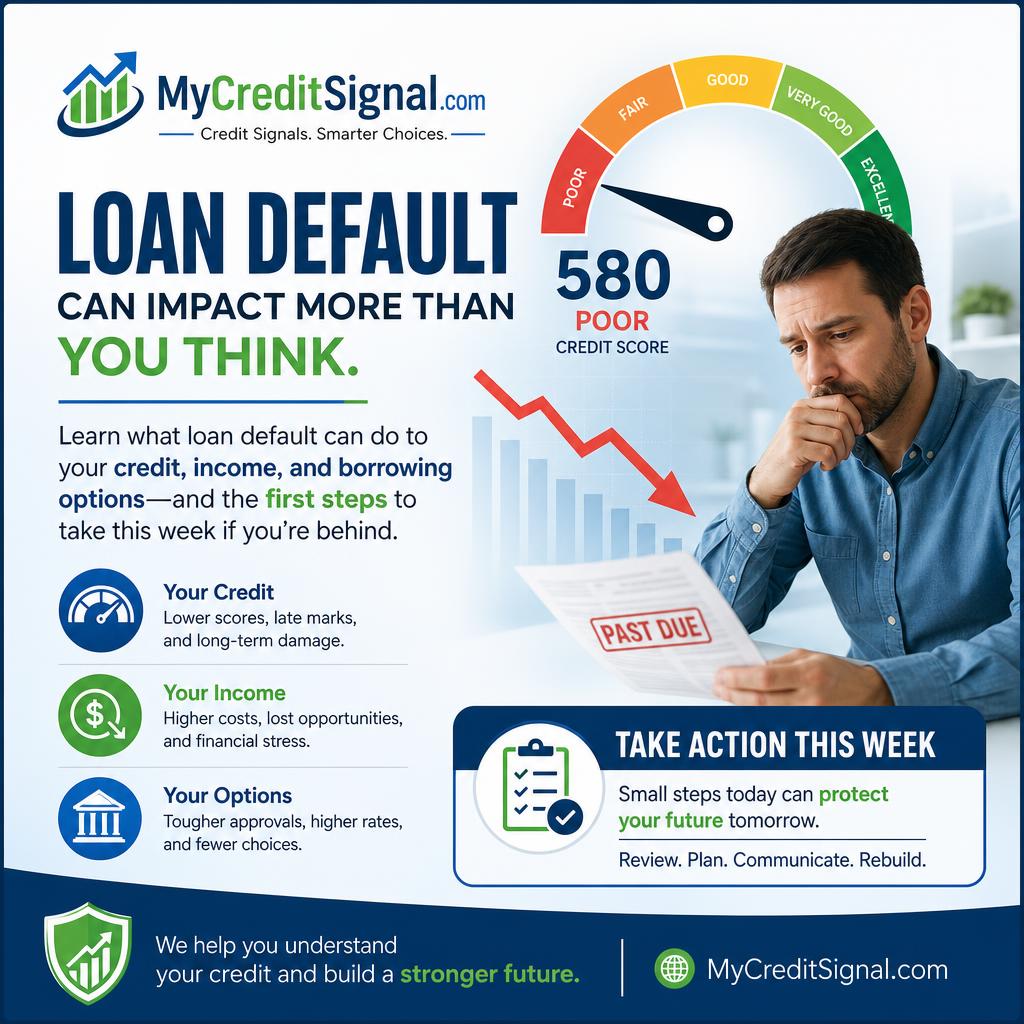
Miss enough loan payments and the problem can move from a late fee to something much bigger. A loan default can damage your credit, limit future borrowing, trigger collections, and in the case of federal student loans even lead to wage garnishment or tax refund offsets. If you are worried because you are seriously behind, or you want to understand the real-world consequences before that happens, this guide is for you.
You will learn what default usually means, what changes once a loan crosses that line, which timelines matter, and what to do first this week to reduce the damage. The goal is not to scare you. It is to help you act early, protect your cash flow, and make better next-step decisions.
Contents
- 1 Who should care about loan default right now
- 2 When a missed payment becomes a default
- 3 What loan default can affect besides your credit score
- 4 The numbers and timelines that matter most
- 5 A fast decision framework for what to do first
- 6 A step by step plan to contain the damage
- 6.1 Confirm whether you are delinquent or in default
- 6.2 List every immediate risk to your cash flow
- 6.3 Build a one page survival budget
- 6.4 Contact the lender, servicer, or collector and take notes
- 6.5 Choose a formal resolution path you can actually sustain
- 6.6 Protect the rest of your credit profile
- 6.7 Start rebuilding once the account is stabilized
- 7 Mistakes that make loan default more expensive
- 8 What many articles miss about default
- 9 Helpful tools and related resources
- 10 Frequently asked questions about loan default
- 11 The bottom line on loan default
Key Takeaway
Loan default can hurt your credit and your budget for years, but the fastest way to limit damage is to confirm your status, stop the account from drifting further, and choose a formal resolution path right away.
Who should care about loan default right now
This article is most useful for three groups.
- Borrowers who are 30 to 180 days behind and want to avoid crossing from delinquency into default.
- People already in default who need to understand the credit and collection consequences before deciding what to do next.
- Anyone planning a major credit move soon such as applying for a car loan, mortgage, apartment, or even some utility accounts, where a default can raise costs or reduce approval odds.
It may be less useful if your issue is a temporary billing error or a very short-term late payment. Default is a more serious stage than being a few days late. If you are only recently behind, your best move is usually to contact the lender immediately and prevent the account from escalating.
If your broader problem is juggling too many balances at once, a practical payoff framework can help you see where your cash should go first. My Credit Signal has a good walkthrough on building a debt payoff plan that actually sticks so you can fit past-due accounts into a realistic weekly system.
When a missed payment becomes a default
In plain English, default is the point when the lender or loan holder decides you have gone far enough without making required payments that the account has moved into a more severe collection status. The exact timeline depends on the loan type and contract.
For many federal student loans, the CFPB says default commonly happens after 270 days without a required payment. That is much later than the 90-day delinquency threshold many consumers associate with other types of accounts, which is one reason borrowers often misunderstand the timeline. You can be deeply behind before federal student loan default officially begins, but once it does, the consequences can be broad. See the CFPB overview here: What Happens If I Default on a Federal Student Loan?.
Private loans and other consumer debts work differently. There is no single universal default rule across lenders. Some contracts define default around a specific number of missed payments. Others define it based on material breach or acceleration terms. That is why the same missed-payment pattern can create different consequences depending on whether the debt is a federal student loan, private student loan, personal loan, or another installment account.
What loan default can affect besides your credit score
Most people search this topic because they want to know what happens to their credit. That matters, but it is not the whole story. Default can touch multiple parts of your finances at once.
Credit access
The Federal Reserve has long noted that payment history is the largest predictor of FICO scores, so delinquency and default can have persistent effects on creditworthiness. That means a default can make future approvals harder, shrink credit limits, or push you into higher rates. Read the Federal Reserve background here: Credit Scoring and Its Effects on Availability and Cost of Credit.
Monthly cash flow
Default can create a budget problem, not just a reporting problem. For federal student loans, the CFPB says consequences can include wage garnishment, loss of tax refunds, or offsets against Social Security benefits. Those actions can reduce the money you have available for rent, transportation, groceries, and other debt payments.
Future education financing
Borrowers with federal student loans in default may become ineligible for additional federal aid until the default is cured or a repayment arrangement is made, according to the CFPB. That matters if you planned to return to school, retrain, or finish a degree.
Collections pressure
If a debt collector contacts you, your rights still matter. The FTC explains that collectors must follow rules about when and how they can pursue collections, and consumers have rights involving verification and limits on certain collection attempts. The FTC debt collection hub is here: Debt Collection.
If your credit is already taking hits from missed payments, My Credit Signal also has a same-silo guide on how to recover from late payments. That is useful when your account has not fully stabilized yet but you need a score-rebuilding plan in parallel.
The numbers and timelines that matter most
You do not need dozens of metrics here. You need a short list that changes your next move.
1. The default trigger timeline
For many federal student loans, default commonly starts after 270 days without a required payment. Before that, you may still be in delinquency rather than default. That distinction matters because available remedies and collection intensity can change once default begins.
2. The reporting timeline
Negative information tied to default can remain on a credit report for up to 7 years, based on major bureau guidance cited by Experian. Paying or curing the debt does not usually mean the history instantly disappears. One of the biggest misconceptions is that the score fully snaps back as soon as the balance is resolved. It often does not.
3. The score-recovery timeline
There is no universal number of points everyone gains back or one exact recovery calendar. Results vary by credit profile and scoring model. Still, research and bureau guidance point in the same direction: default can cause meaningful score declines, and recovery can take years depending on what happens next. On the positive side, a New York Fed note cited an 11-point median improvement in some subgroups linked to student loan default transitions and related policy changes, which shows that improvement is possible even if it is rarely immediate.
4. The scale of the issue
CFPB reporting pointed to roughly 6 million borrowers in default on federal student loans in 2024. That number matters because it shows this is not a rare edge case. There are established resolution pathways, and if you are in default, you are not dealing with an unusual or impossible problem.
5. The borrowing-cost example
Suppose two people each need a $15,000 used-car loan. Borrower A still has strong credit. Borrower B has a recent default on file. Even without assigning an exact rate difference, it is realistic that Borrower B may face a higher APR, a larger down payment requirement, or even a denial. Over a multi-year loan, that can add thousands in total borrowing cost. The key point is not the exact rate. It is that default can turn future financing into an expensive problem long after the original missed payments.
If you want to compare how different financing choices affect total cost, use the loan comparison calculator. It is especially useful when you are deciding whether to refinance another debt, accept a higher-rate offer, or wait while you rebuild.
A fast decision framework for what to do first
Before you take action, sort your situation into one of these buckets:
- Not yet in default: Your main job is prevention. Call the lender, ask about hardship options, and stop further missed payments.
- Already in default on a federal student loan: Focus on formal federal resolution options, not informal promises you cannot sustain.
- Already in default on a private loan or other consumer loan: Focus on confirming the account owner, understanding collection status, and evaluating settlement or repayment options based on your budget.
That simple sort matters because the wrong first move wastes time. For example, someone with a federal student loan in default may need a formal cure path, while someone with a private installment loan may need to verify who holds the debt and what repayment terms are actually available.
A step by step plan to contain the damage
Confirm whether you are delinquent or in default
Do not guess from memory. Pull your latest statements, log in to the lender or servicer portal, and check the current status. If it is a federal student loan, review whether the account is simply past due or officially in default. This changes which options are on the table.
List every immediate risk to your cash flow
Write down what could happen in the next 30 to 60 days: late fees, collection calls, possible offset risk, or a tighter budget because another bill is due. If your tax refund or paycheck is important to catching up on rent or utilities, that risk needs to be on paper today.
Build a one page survival budget
For this week, do not start with annual goals. Start with essentials: housing, food, transportation, insurance, utilities, and minimum required payments that keep other accounts from sliding. If you need structure, pair this with a broader payoff system like the one in this debt payoff spreadsheet guide so you can track balances and due dates in one place.
Contact the lender, servicer, or collector and take notes
Ask for the current balance, account status, available payment arrangements, and what happens if you do nothing for another 30 days. If a collector is involved, remember the FTC guidance says collectors are subject to rules on contact practices and verification. Keep names, dates, and promises in writing where possible.
Choose a formal resolution path you can actually sustain
For federal student loans, that may involve a program such as Fresh Start during applicable periods or an income-driven repayment path after you exit default, depending on the current rules and your eligibility. CFPB reporting in 2024 highlighted the role of Fresh Start and IDR-related options in helping borrowers move out of default status. For private loans, the path may be a repayment arrangement or negotiated settlement, but only if it fits your real budget.
Protect the rest of your credit profile
A default often gets worse because borrowers stop paying other accounts too. If possible, keep current accounts current. Payment history is heavily weighted in credit scoring, so preventing new late payments can matter almost as much as resolving the existing default.
Start rebuilding once the account is stabilized
After the default is resolved or under control, use a structured rebuild plan. The credit rebuilding checklist can help you focus on the basics: on-time payments, manageable balances, and consistent monitoring over time.
Those are seven actions, but if you need a shorter version for this week, start with these five: confirm status, map cash-flow risks, build a survival budget, call the account owner, and choose a formal path.
Mistakes that make loan default more expensive
Waiting because you hope the account is not that serious
Behavior: Ignoring notices because the wording feels confusing or you assume you can catch up later. Consequence: The account can move deeper into collections, and federal loans may trigger wage garnishment or refund offsets after default. Fix: Verify the exact account status this week and ask what deadline applies to your case.
Agreeing to payments you cannot maintain
Behavior: Promising a monthly amount that only works in a perfect month. Consequence: You default again on the arrangement, lose leverage, and fall behind on other essential bills. Fix: Base any agreement on your stripped-down budget, not your optimistic budget.
Assuming paying the balance instantly restores your score
Behavior: Treating resolution as the end of the process. Consequence: You may be surprised when approvals or rates do not improve right away because negative history can remain for years. Fix: Expect a two-part process: resolve the default, then rebuild credit habits consistently.
Letting one default trigger new debt elsewhere
Behavior: Using credit cards heavily to make up for lost cash flow without a repayment plan. Consequence: Utilization rises, balances compound, and the default starts a second credit problem. Fix: Cut optional spending and create a cash buffer plan before adding more revolving debt. If this is already happening, the guide on how to avoid new debt during debt payoff can help you stop the leak.
What many articles miss about default
Most articles stop at “your score goes down.” That is true, but incomplete. Here are the nuances that actually change your decision-making.
Default is a cash-flow event as much as a credit event
If federal collections reduce your paycheck or tax refund, the immediate crisis may be your budget, not just your score. In that case, protecting housing, transportation, and work-related expenses comes first.
Not every borrower should use the same fix
Someone planning to buy a home in the next year may prioritize stabilizing the account and preventing any new derogatory marks. Someone with unstable income may need the most flexible affordable payment path first, even if score recovery is slower.
Post-default behavior matters a lot
Federal Reserve and bureau guidance both point toward the persistence of delinquency effects, but they also imply something important: what you do after the default still matters. Clean payment history on your remaining accounts and lower balances can support gradual recovery.
If you want to turn this into action, start with resources that help you compare options and stay organized.
- Loan comparison calculator to estimate how future borrowing choices could affect your total repayment cost.
- Credit rebuilding checklist to map the habits that support recovery after a serious delinquency or default.
- Debt payoff strategies guide for choosing the right order to attack balances while protecting current accounts.
Frequently asked questions about loan default
What happens to my credit report when I default on a loan?
A default can be reported as serious negative payment history, which can lower credit scores and make future borrowing harder. The exact impact varies by profile and scoring model, but payment history is one of the most important parts of most scoring systems.
How long can a default stay on my credit file?
Default-related negative information may remain for up to 7 years based on major credit bureau guidance. Paying or resolving the debt does not usually remove the history immediately.
Do federal and private loan defaults work the same way?
No. Federal student loan default can involve federal collection tools such as wage garnishment and tax refund offsets. Private loan default usually follows different contract and legal processes, so consequences and resolution options can differ.
Get weekly credit tips, tool updates, and practical guides – free.
The bottom line on loan default
Loan default is not just a label. It can affect your credit, your monthly budget, your access to new borrowing, and for some federal borrowers even your paycheck or tax refund. The biggest mistake is waiting for clarity while the account keeps getting worse.
Your next step is simple: verify your status, write a one-page survival budget, and contact the account owner with a clear goal of getting into a formal, realistic resolution path. Then protect the rest of your credit profile while you rebuild. Done early enough, those steps can save you money, reduce stress, and shorten the recovery timeline.



Want to understand your credit report?
Get plain-English explanations with our free AI Credit Analyzer →
Leave a Reply
You must be logged in to post a comment.