
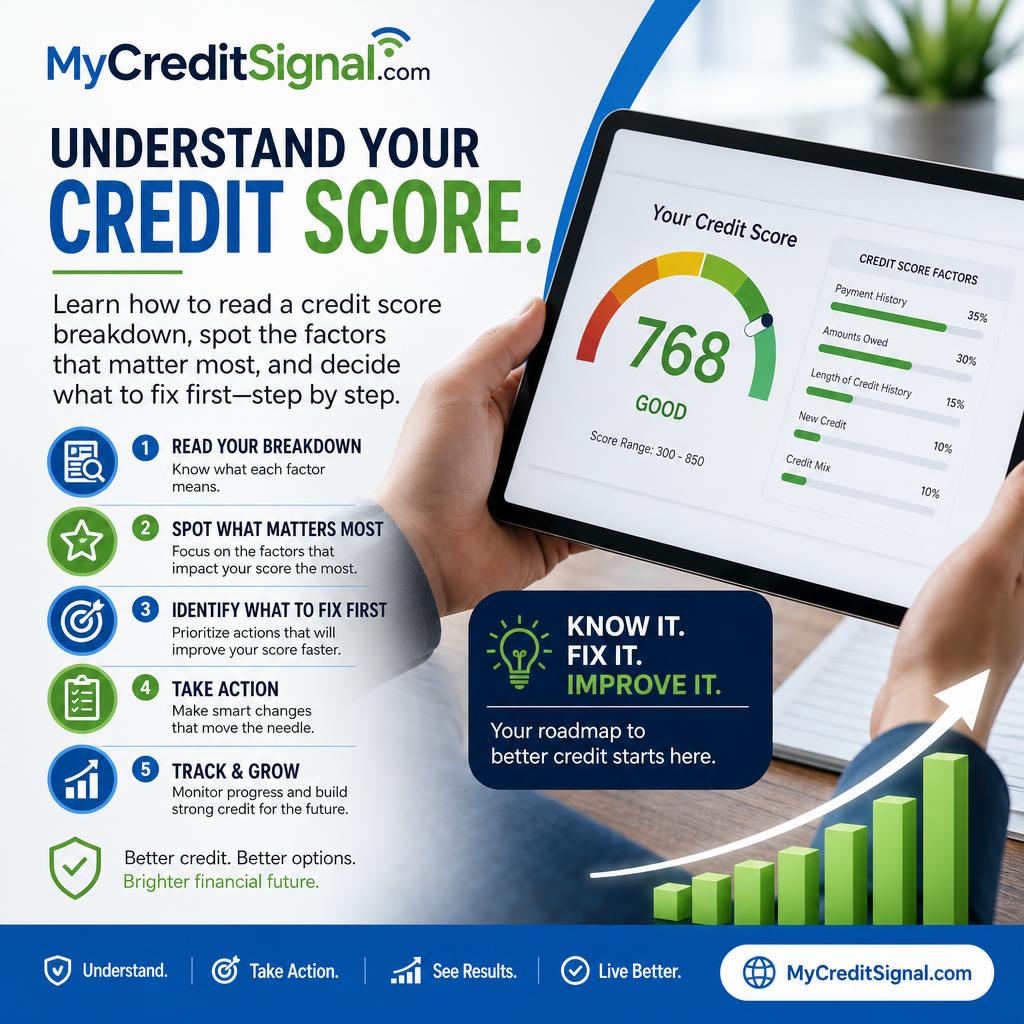
You check your score, see a number like 682 or 741, and then hit a wall. The score itself is easy to spot. The hard part is understanding why it is that number and what to do next. That is where a credit score breakdown matters. If you want to raise your score, protect it before a mortgage or auto loan, or simply stop guessing, reading the breakdown correctly can save months of trial and error.
This guide is for people who can already see their score factors but are not sure how to prioritize them. By the end, you will know how to read each category, which signals matter most, and how to turn a vague score summary into an action plan.
Contents
- 1 Who should care about a credit score breakdown
- 2 What a credit score breakdown is actually showing you
- 3 How to read each factor without overreacting
- 4 The numbers and thresholds that matter most
- 5 A step by step plan to interpret your score like an expert
- 5.1 Write down the score, model, and date
- 5.2 Rank the factor ratings from worst to best
- 5.3 Match each weak factor to a real account behavior
- 5.4 Calculate your current utilization by dollars
- 5.5 Separate fast fixes from slow fixes
- 5.6 Run one scenario before making a move
- 5.7 Set five actions for this week
- 6 Mistakes that make score breakdowns harder to use
- 7 What many articles miss about credit score breakdowns
- 8 FAQ
- 9 Helpful tools and related resources
- 10 Conclusion
Key Takeaway
A credit score breakdown is only useful if you rank the factors by impact, timing, and what you can realistically change in the next 30 to 90 days.
Who should care about a credit score breakdown
This matters most if you fall into one of these groups:
- You are planning to apply for credit in the next 3 to 12 months.
- Your score moved and you do not know which factor caused it.
- You have decent habits but want to stop leaving points on the table.
- You carry revolving balances and want to know whether utilization is your main issue.
- You are comparing advice from different apps and seeing slightly different score explanations.
It may matter less if you are not borrowing anytime soon and already have strong credit habits. In that case, the goal is usually maintenance, not aggressive optimization. If that sounds like you, this related guide on how to maintain an 800 credit score can help you focus on protection instead of constant tweaking.
What a credit score breakdown is actually showing you
A credit score breakdown is not usually a full formula. Most consumer tools show a simplified view of the categories that influence scoring models. Think of it like a dashboard, not the engine itself. It points you to the likely drivers of your score, such as payment history, amounts owed, age of accounts, recent credit activity, and credit mix.
For many FICO scores, payment history makes up 35 percent, amounts owed 30 percent, length of credit history 15 percent, new credit 10 percent, and credit mix 10 percent, according to myFICO. That does not mean you can read your score by doing quick math. It means you should give more attention to the highest-impact categories first.
VantageScore explains its factors in a different way, grouping them into categories like payment history, age and type of credit, percentage of credit limit used, total balances, recent behavior, and available credit, according to VantageScore. That is why two apps may describe your score differently even if they are both broadly accurate.
If you are seeing a score change and need help narrowing down the likely cause, read why your credit score dropped and what it often means. It pairs well with a score breakdown because it helps you connect category-level signals to recent actions.
How to read each factor without overreacting
Payment history
This is the first place to look because it tends to carry the most weight. Ask one question before anything else: did you miss or pay any account late in the last 30 to 60 days? If yes, fix that pattern first. A perfect utilization strategy will not outweigh repeated missed payments.
If your breakdown says payment history is excellent, do not spend time obsessing over it. Protect it. Set autopay for at least the minimum and move on to the next factor. For a deeper look, see how payment history credit really works.
Amounts owed and utilization
This is where many people can make the fastest gains. Your breakdown may call it amounts owed, revolving usage, or credit utilization. The practical question is simple: what percent of your card limits are you using when balances get reported?
Example: if you have two cards with limits of $2,000 and $3,000, your total limit is $5,000. If your reported balances add up to $2,000, your overall utilization is 40 percent. That is much different from paying in full after the statement closes if the high balance has already been reported.
Consumer Financial Protection Bureau guidance explains that using a high amount of available credit can hurt scores, even if you pay on time, and keeping balances lower relative to limits is generally better, according to the CFPB.
If your breakdown flags this category, learn the thresholds and timing in these utilization spike warning signs. You can also test different payoff scenarios with the credit score simulator.
Age of accounts
This factor moves slowly. Your breakdown may label it age of credit, length of history, or average account age. If this is your weak spot, there is usually no fast hack. You improve it mostly by keeping older accounts open when it makes sense and avoiding unnecessary account churn.
If you are tempted to close an older card, pause first. The impact depends on utilization, account age, and the rest of your file. Timing matters.
Recent credit activity
This area includes new applications, hard inquiries, and recently opened accounts. A single inquiry is usually not the end of the world, but stacking several new accounts in a short window can make your breakdown look weaker across multiple categories at once.
This is a good example of why you should not read factors in isolation. A new card might slightly lower average age, add an inquiry, and eventually help utilization if you do not run up new balances.
Credit mix
This is often overhyped. Credit mix generally refers to having experience with more than one type of account, such as revolving credit and installment loans. It can matter, but it is not usually the first lever to pull. Do not take out a loan just to improve mix. Instead, use a tool like the credit mix analyzer to understand whether it is a minor issue or a real gap in your profile.
The numbers and thresholds that matter most
When people say they want to understand a credit score breakdown, they usually want thresholds. Not every scoring model publishes exact cutoffs, but some ranges are consistently useful.
Utilization thresholds
- Under 10 percent: often seen as strong for score optimization.
- Under 30 percent: commonly treated as a safer range than higher usage.
- Above 30 percent: can start to pressure scores more noticeably.
- Above 50 percent: usually a warning sign that balances are heavy relative to limits.
- Near maxed out: often much worse, even if payments are on time.
These are practical screening ranges, not promises. Individual card utilization can matter too. Someone with overall utilization of 18 percent could still look risky if one card is at 95 percent.
Payment timing thresholds
The biggest threshold here is simple: on time versus late. From a score perspective, protecting on-time payments is more important than paying the full balance if cash flow is tight this month. From an interest perspective, paying in full is better. If you cannot do both, preserve the on-time record first and make a payoff plan next.
Application timing
If you expect to apply for a mortgage, auto loan, or major card in the near future, avoid random applications in the months leading up to it unless the benefit is clear. A score breakdown that suddenly shows weaker recent activity is often self-inflicted.
A quick first-versus-later framework
Use this order when reading your breakdown:
- Fix first: missed payments, very high utilization, maxed-out cards, multiple recent applications.
- Fix next: uneven card balances, statement timing, avoidable closures.
- Leave alone: age of history, credit mix, minor score swings after normal activity.
This helps you avoid wasting energy on slow-moving factors when a high-balance card is doing the real damage.
A step by step plan to interpret your score like an expert
Write down the score, model, and date
Start with the exact score source. Is it FICO or VantageScore? What date was it updated? If you compare scores from different places without logging the model and date, you can misread a change that is not actually a change. This week, create a simple note with the source, score, and any alerts shown next to it.
Rank the factor ratings from worst to best
Most score dashboards use labels like poor, fair, good, very good, or exceptional. Do not try to fix everything at once. Identify the weakest one or two categories only. If utilization is poor and age is fair, utilization usually deserves your attention first because it is more adjustable in the short term.
Match each weak factor to a real account behavior
Translate the category into something tangible. Poor utilization means balances are too high relative to limits. Weak recent activity usually means too many new applications or new accounts. Weak payment history means at least one account was not paid as agreed. The goal is to move from labels to causes.
Calculate your current utilization by dollars
Add your total card limits. Add your current statement balances or expected reported balances. Divide balances by limits. Example: $1,500 divided by $6,000 equals 25 percent utilization. Then look at each card individually. A single card at 80 percent can still hurt even if your overall ratio is decent.
Separate fast fixes from slow fixes
Fast fixes include paying down revolving balances, moving a payment before the statement closes, and stopping new applications. Slow fixes include account age and long-term payment history. This matters because it tells you what can improve in one billing cycle versus what needs six to twelve months.
Run one scenario before making a move
Before paying off a card, opening a new one, or closing an old account, test the idea. Use the credit score simulator to compare possible outcomes. If you are considering a new account to improve mix or available credit, check whether the tradeoff on inquiries and age is worth it.
Set five actions for this week
Here is a practical weekly checklist: set autopay on every account, bring at least one high-utilization card below a lower threshold, pause new applications for 30 days, record statement closing dates, and review whether any old cards should stay open to protect age and utilization. These are small moves, but together they make your score breakdown more useful and more stable.
Mistakes that make score breakdowns harder to use
Chasing the least important factor first
Behavior: focusing on credit mix or one inquiry while carrying high card balances. Consequence: you spend effort on a lower-impact issue and see little progress. Fix: address payment history and utilization before anything else.
Treating every score source like it uses the same formula
Behavior: comparing a FICO score from one app to a VantageScore from another and assuming one of them is wrong. Consequence: confusion, overcorrection, and bad decisions based on mismatched numbers. Fix: compare like with like and note the model every time you track a score.
Looking only at overall utilization
Behavior: seeing a reasonable total utilization and ignoring an individual card that is nearly maxed out. Consequence: you miss a major signal that can still weigh on scores. Fix: review both overall and per-card utilization every month.
Closing a card before understanding the tradeoff
Behavior: shutting down an older card after paying it off without checking available credit impact. Consequence: your utilization ratio may jump and your score can soften. Fix: estimate the before-and-after math first, especially if that card supports a large share of your total limit.
What many articles miss about credit score breakdowns
The biggest thing most articles miss is timing. Your score breakdown is not just about what you owe. It is about what gets reported and when. A person can pay in full every month and still show 40 percent utilization if their statement closes before they make a large payment. Another person can owe the same total amount but report only 8 percent because they paid before the statement date.
The second missed point is that not every factor deserves action. Some categories are descriptive, not urgent. If your age of accounts is average because you are fairly new to credit, there may be nothing to fix right now beyond patience and consistency.
The third missed point is that lender decisions do not depend only on the score. Income, debt obligations, application details, and lender-specific rules all matter. A cleaner breakdown helps, but it does not guarantee approval.
FAQ
What is the most important part of a credit score breakdown?
Usually payment history first and utilization second. If both are strong, then look at age, recent activity, and credit mix.
Can I improve a weak credit score breakdown in 30 days?
Sometimes. Utilization can improve quickly if you lower reported balances. Age of accounts and long-term payment history usually take much longer.
Why do two apps show different score breakdowns?
They may use different scoring models, different update dates, or different ways of summarizing the same file. Always check the model and date before comparing.
If you want to put this article into action, start with these resources:
- Test different balance and timing scenarios with the credit score simulator.
- See whether your account types are helping or just distracting you with the credit mix analyzer.
- Learn how high balances can distort your score in Utilization Spike Credit Score Warning Signs.
- If your score changed recently, review Credit Score Dropped and Here Is Why to connect the breakdown to likely causes.
Get weekly credit tips, tool updates, and practical guides – free.
Conclusion
A credit score breakdown becomes powerful when you stop treating it like a mystery chart and start using it like a checklist. Look at the model, rank the weakest factors, identify the behaviors behind them, and fix the issues with the highest short-term impact first. For most people, that means protecting payment history, lowering utilization, and avoiding unnecessary new applications.
Your next step is simple: pull up your score breakdown, calculate your current utilization in dollars and percentages, and choose one action you can complete this week. The more specific your reading, the smarter your next move will be.



Leave a Reply
You must be logged in to post a comment.