
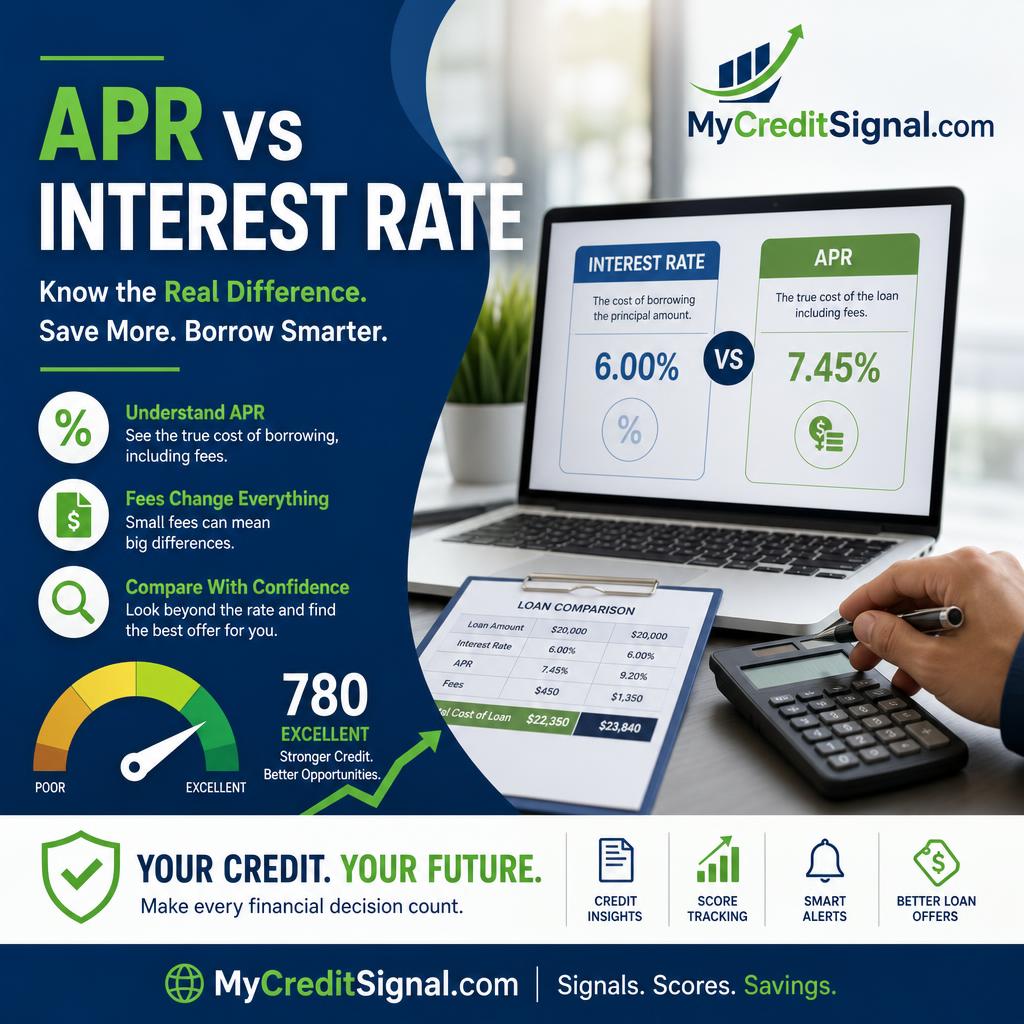
You find two loan offers side by side. One shows a lower interest rate, but the other has a lower APR. Which one is actually cheaper? That question trips up a lot of borrowers, especially when lenders spotlight the number that looks best in big type and leave the rest in the details.
This guide is for anyone comparing personal loans, auto loans, mortgages, or even credit card offers and trying to understand APR vs interest rate without getting lost in jargon. By the end, you will know what each number means, when APR matters more, where fees change the picture, and how to compare offers with more confidence.
Contents
- 1 Who should care about APR vs interest rate
- 2 APR and interest rate are not interchangeable
- 3 Why APR is often higher than the advertised rate
- 4 The numbers that change your decision
- 5 A practical comparison example
- 6 What to do first and what to do later
- 7 A step by step plan to compare loan offers this week
- 7.1 Write down both the interest rate and the APR
- 7.2 List every upfront charge
- 7.3 Compare the monthly payment at the same loan amount
- 7.4 Check the repayment timeline
- 7.5 Review your credit profile before applying widely
- 7.6 Use a calculator instead of guessing
- 7.7 Choose the best fit, not just the prettiest number
- 8 Mistakes to avoid when comparing APR and interest rate
- 9 What many articles skip about APR
- 10 FAQ
- 11 Helpful tools and related resources
- 12 The bottom line
Key Takeaway
Interest rate tells you the cost of borrowing principal, while APR gives a broader view of borrowing cost by including interest plus most fees, which makes APR the better comparison tool for many loans.
Who should care about APR vs interest rate
This matters most if you are shopping for a new loan and trying to compare offers that do not look identical. It is especially useful for:
- Borrowers comparing personal loans with different origination fees
- Car buyers reviewing dealer financing versus a bank or credit union offer
- Homebuyers seeing mortgage offers with different points or closing costs
- Anyone deciding whether to refinance existing debt
- Credit card users evaluating standard APRs after a promotional period
You may need a different approach if your main problem is not comparison shopping but cash flow. For example, if you are already carrying several balances, your first move may be payoff strategy, not new borrowing. In that case, it may help to read these debt avalanche method steps or review how to pay off multiple credit cards smartly before taking on another loan.
APR also has limits. It helps with comparison, but it does not answer every question by itself. A loan can have a competitive APR and still be a poor fit if the monthly payment strains your budget or if the term is longer than you need.
APR and interest rate are not interchangeable
In plain English, the interest rate is the percentage a lender charges to borrow the principal. The APR, or annual percentage rate, is the broader annual cost of borrowing because it includes interest plus most fees tied to getting the loan.
According to the Consumer Financial Protection Bureau, the difference is that APR includes interest and many fees, while the interest rate does not include most fees. The CFPB also notes that APR disclosures are meant to help you compare loan costs across products and lenders before you finalize credit.
That distinction matters because two loans can have the same interest rate but different fees. In that case, the APR can reveal which offer is really more expensive. The reverse can also happen: a loan with a slightly higher rate but much lower fees may be the better deal, depending on how long you keep it.
The federal disclosure framework behind this is the Truth in Lending Act. The FTC overview of TILA explains that lenders must disclose APR so consumers can compare credit terms more easily. Think of APR as the standardized comparison label on a financial product.
Why APR is often higher than the advertised rate
If you have ever wondered why a lender promotes one rate and then shows a higher APR in the disclosures, fees are usually the reason. The CFPB explains here that APR can be higher because it annualizes origination charges and other fees into the total cost of the loan.
Common costs that can push APR above the nominal interest rate include:
- Origination fees on personal loans
- Points and some closing costs on mortgages
- Certain finance charges tied to getting the credit
- Upfront fees that are effectively part of the borrowing cost
That does not mean APR will always be higher. On some products, especially when fees are minimal, the APR and interest rate can be very close. But if you see a noticeable gap, your next question should be simple: What fees are included?
The numbers that change your decision
When comparing APR vs interest rate, four numbers deserve your attention first: the interest rate, the APR, the loan term, and any upfront fee. If you only check one or two of these, you can miss the true cost.
1. Loan term changes the total interest you pay
A longer term can lower your monthly payment while increasing total interest over time. Even if the APR looks manageable, the amount you pay across years can be much larger simply because you stay in debt longer.
That is one reason borrowers often underestimate the cost of minimum payments. If that is your situation, the article on how minimum payments cost more over time can help you see why stretching repayment usually raises the final bill.
2. Fees can make a lower rate more expensive
Imagine Offer A has a lower interest rate but charges an origination fee. Offer B has a slightly higher rate but no origination fee. On paper, Offer A looks cheaper until the APR shows the fee-adjusted annual cost.
This is why the CFPB says APR is the better basis for comparison across lenders. If the fee is rolled into the loan or paid upfront, it still affects your cost.
3. Credit score influences the rate and APR you are offered
Your credit profile affects pricing before you ever start comparing offers. Experian and myFICO both explain that lenders commonly use credit scores to set loan rates, and FICO Scores generally range from 300 to 850. Higher scores tend to qualify for better rates, which can reduce your lifetime borrowing cost.
Within many FICO models, payment history accounts for 35% of the score and amounts owed account for 30%, based on Experian guidance. So if you want better loan pricing later, on-time payments and lower revolving balances usually matter more than chasing tiny optimizations.
4. Product type matters
An APR on a mortgage is not directly comparable to a credit card APR or a personal loan APR without context. The APR is standardized for disclosure within products, but the structure of the debt still matters. A secured auto loan, an unsecured personal loan, and a revolving credit card account all work differently.
A practical comparison example
Suppose you are looking at two personal loan offers. One lender advertises a lower rate, but the second lender has a lower APR after fees are considered. Which should you choose?
Here is the decision framework:
- First: compare APRs to understand the broader borrowing cost
- Second: compare monthly payments to make sure the loan fits your budget
- Third: compare the term to see how long you stay in debt
- Fourth: review every fee and whether the rate is fixed or variable
If you expect to keep the loan for the full term, the lower APR often gives you the cleaner cost comparison. If you expect to pay the loan off early, upfront fees may matter even more because you are spreading them over a shorter real-life borrowing period than the disclosure assumes.
That is a big reason not to shop based on marketing headlines alone. A lender can advertise an appealing rate, but if fees are heavy, the APR gives you the more honest snapshot.
To run your own side-by-side numbers, use the loan comparison calculator. If you are analyzing how annual rates translate into daily charges on revolving debt, the APR to daily rate converter is also useful.
What to do first and what to do later
If you are comparing loans this week, start with the numbers that affect your decision now. Save score improvement work for after you know whether you actually need the loan yet.
Do first
- Collect each loan’s interest rate, APR, term, and all fees in one place
- Confirm whether the rate is fixed or variable
- Check the monthly payment against your current budget
- Calculate the full payoff cost if you keep the loan to term
- Ask whether there is any prepayment penalty or promo expiration
Do later
- Improve your credit profile before a future refinance or next application
- Restructure other debts if the new payment would crowd out essentials
- Build a payoff plan after the loan closes so interest does not linger longer than necessary
If you are choosing between payoff methods once the debt is already yours, this guide to choosing a debt payoff strategy can help you match your plan to your cash flow and motivation.
A step by step plan to compare loan offers this week
Write down both the interest rate and the APR
Do not rely on memory or a lender ad. Put each offer in a simple list and make sure you have the nominal rate and the APR side by side. If one is missing, ask for the disclosure before moving forward.
List every upfront charge
Check for origination fees, points, and other finance charges tied to getting the loan. APR often reflects these costs, but you still want to know the actual dollar amount and whether it is paid upfront or financed into the loan balance.
Compare the monthly payment at the same loan amount
Even a better APR is not a win if the payment breaks your budget. Review the required monthly amount and ask whether it still works if a utility bill rises or your grocery costs jump for a month.
Check the repayment timeline
A lower payment over a longer term can still cost more overall. Put the term next to each offer and decide whether you are comfortable staying in debt that long.
Review your credit profile before applying widely
Because lenders use credit scores to price loans, your current score affects the offers you see. FICO Scores commonly range from 300 to 850, and higher scores generally qualify for better pricing. If your profile is borderline, improving payment consistency and lowering balances may lead to a better offer later.
Use a calculator instead of guessing
Run both options through a tool so you can see the likely cost difference clearly. The loan comparison calculator helps you compare real offers instead of trying to estimate in your head.
Choose the best fit, not just the prettiest number
If one loan has a lower APR, affordable payment, and no deal-breaking terms, it is usually the stronger option. But if you plan to repay early, revisit the fee structure before deciding. A lower APR is helpful, not magical.
Mistakes to avoid when comparing APR and interest rate
Picking the lowest advertised rate without checking APR
Behavior: choosing the offer with the smallest rate shown in the ad. Consequence: you may miss fees that make the loan more expensive overall. Fix: compare APRs first, then review the fee breakdown and payment.
Ignoring the loan term
Behavior: focusing only on the monthly payment or only on APR. Consequence: you can end up paying interest for far longer than necessary. Fix: compare total cost over the full term and decide whether the timeline matches your goals.
Comparing products that do not work the same way
Behavior: treating a credit card APR, auto loan APR, and mortgage APR like identical numbers. Consequence: you may draw the wrong conclusion because the products have different structures and risks. Fix: compare similar products first, then layer in payment, collateral, and term differences.
Assuming your score does not matter much
Behavior: applying without reviewing the basics of your credit profile. Consequence: you may get a higher APR than necessary. Fix: focus on on-time payments and balances before a major loan search, since payment history and amounts owed are major scoring factors.
What many articles skip about APR
APR is extremely useful, but it is not the whole story.
Another nuance: APR should be used to compare costs across offers, but CFPB guidance also makes clear that you should not compare APR directly to a nominal interest rate as if they represent the same thing. That is an apples-to-oranges move.
Finally, a lower APR does not automatically mean you should borrow. If the loan is mainly covering a spending gap that your budget cannot support, solving the cash flow issue may save more than financing it. For readers dealing with expensive revolving debt already, this debt avalanche guide focused on saving interest can help you cut borrowing costs faster.
FAQ
What is the real difference between APR and interest rate?
The interest rate is the cost of borrowing the principal. APR is the annualized borrowing cost that includes interest plus most fees, which is why APR is usually better for comparing loan offers.
Why is APR sometimes higher than the advertised interest rate?
Because APR includes certain fees, such as origination charges or points, while the interest rate usually does not include most of those costs.
Should I compare only APR when shopping for loans?
No. Compare APR, monthly payment, term, total repayment cost, and whether the rate is fixed or variable. APR is essential, but it is not the only useful number.
- Use the loan comparison calculator to review competing offers side by side.
- Convert annual borrowing costs with the APR to daily rate converter if you want to understand how interest builds over shorter periods.
- Read Debt Avalanche Method Steps That Cut Interest if your bigger goal is lowering current debt costs.
- Review Choose a Debt Payoff Strategy That Fits if you need a payoff framework after borrowing.
Get weekly credit tips, tool updates, and practical guides – free.
The bottom line
If you remember one thing, make it this: the interest rate tells you part of the story, but APR usually tells you more of the cost story. That is why federal disclosure rules require it and why comparison shoppers should pay close attention to it.
When you review loan offers, start with APR, then check fees, payment, term, and rate type. From there, use a calculator, compare similar products, and make sure the loan fits your budget in real life, not just on paper. Your next step is simple: pull two real offers and compare them line by line before you sign anything.



Want to understand your credit report?
Get plain-English explanations with our free AI Credit Analyzer →
Leave a Reply
You must be logged in to post a comment.