
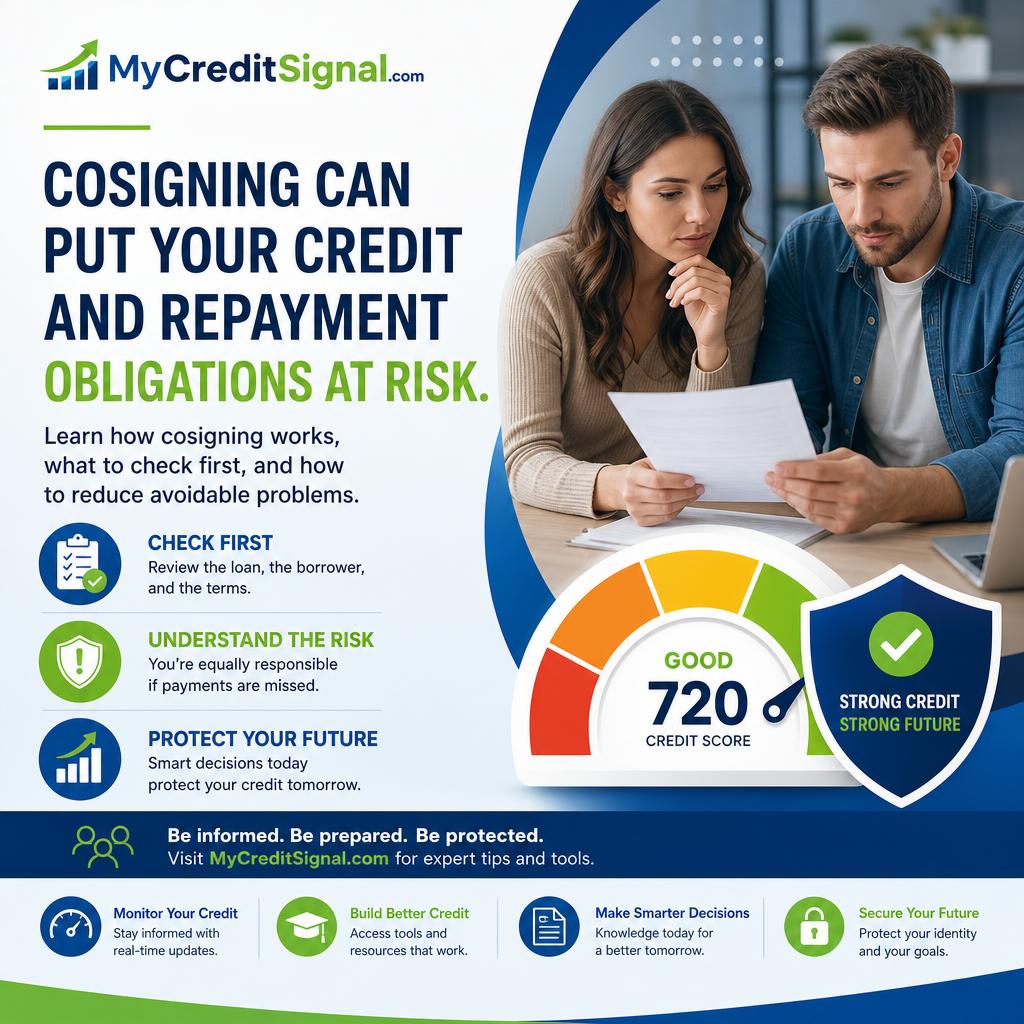
You agree to help someone qualify for a loan, and then a payment is missed. The lender may look to you for repayment, and the late payment can affect your credit history as well as the primary borrower’s. That is the central risk behind cosigning in 2026: you are not just providing a reference or lending your good credit. You are accepting a legal obligation that can influence your borrowing plans, credit profile, and cash flow.
This guide is for anyone considering a cosigned student, auto, personal, or other installment loan, as well as current cosigners who want to monitor the risk. You will learn what a cosigner is, which loan terms matter, how to decide before signing, and what to do this week to protect yourself.
Contents
- 1 Who should pay attention to cosigner risks in 2026?
- 2 What is a cosigner legally responsible for?
- 3 Which numbers and loan terms should you check first?
- 4 What should you do before signing a cosigned loan?
- 5 What mistakes make cosigning more dangerous?
- 6 When might cosigning advice need a different approach?
- 7 What can current or potential cosigners do this week?
- 8 Cosigner questions people ask before signing
- 9 Helpful tools and resources for a safer decision
- 10 The bottom line on cosigner risks in 2026
Key Takeaway
Before cosigning, assume you may have to repay the entire loan yourself and confirm that the obligation will not interfere with your own credit or financial goals.
Who should pay attention to cosigner risks in 2026?
Cosigner risks matter most to people whose credit, income, or upcoming borrowing plans cannot absorb another loan obligation. That includes parents helping with education, relatives supporting a vehicle purchase, partners applying for a mortgage-related loan, and friends helping someone qualify for personal financing.
A cosigner may be especially exposed when the primary borrower has limited credit history, unstable income, high existing debt, or a history of missed payments. Those conditions do not guarantee a problem, but they make it important to examine the payment plan rather than relying on trust alone.
This advice may not fit someone who is only an authorized user on a credit card. An authorized user generally does not sign the same repayment promise as a cosigner. It also may not fit a loan where the lender clearly does not report the obligation or payment history to credit bureaus, although you should verify that detail in writing before relying on it.
What is a cosigner legally responsible for?
A cosigner is a person who agrees to take on the legal obligation to repay a loan if the primary borrower fails to do so. In practical terms, the lender can treat the cosigner as responsible for repayment under the loan contract, not as a backup contact who can decline later.
Cosigner liability is typically shared for the entire loan if the primary borrower defaults, unless the loan terms specify otherwise. That means the risk can continue through the remaining balance, interest, fees, and collection activity described in the contract. The precise remedies depend on the loan agreement and applicable law, so read the promissory note before signing.
The CFPB explains that late or missed payments on a cosigned loan can affect both the borrower’s and cosigner’s credit reports and scores. The agency also recommends considering whether you can tolerate harm to your own credit and looking for a cosigner release option when one is available. See the CFPB explanation of cosigner responsibility for consumer-focused guidance.
Which numbers and loan terms should you check first?
The first number to check is the full amount you could be required to repay, not merely the monthly payment shown in an advertisement. Write down the principal, annual percentage rate, loan term, estimated monthly payment, late-fee rules, and whether the lender reports the account to the credit bureaus.
For a simple example, imagine a $20,000 auto loan. A monthly payment that looks manageable to the borrower may still become your responsibility if the borrower stops paying. The relevant question is not whether you would prefer to help with one payment. It is whether you could cover the contractual obligation while paying your own rent, bills, and debts.
The 4.77% figure reported by Experian for a new auto loan among borrowers with top-tier credit in late 2024 illustrates why the interest rate matters. A cosigner should compare the offered rate and total cost rather than assuming the borrower received the best available terms. Rates, approval standards, and total costs can change, and a cosigner does not automatically receive the same pricing as a top-tier borrower.
Credit impact can also take time to become visible. Experian reports that new debt may take about 6–10 months to be reflected in credit scores, depending on lender reporting and payment behavior. That is not a guaranteed timetable for every profile or scoring model. It is a reason to monitor the account early instead of waiting for a future loan application.
How can one cosigned loan affect your next application?
A cosigned account can appear as an obligation connected to your credit profile. Even when payments are made on time, another loan may matter when a lender evaluates your existing debt and ability to repay a new account. If payments are late, the damage can affect both parties.
Score results vary by credit profile, lender reporting practices, and scoring model. Experian notes that the exact impact depends on how the loan is reported and whether the lender reports on-time payments or delinquencies. Read its guidance on how cosigning can affect credit before making assumptions about a specific score change.
What should you do before signing a cosigned loan?
Use this decision framework: sign only if you understand the contract, could cover the payments from your own cash flow, and have a monitoring and exit plan. If any one of those three conditions is missing, pause and ask the lender for clarification or consider declining.
Ask for the complete loan documents
Request the promissory note, disclosures, payment schedule, interest rate, fees, and cosigner language before signing. Do not make a decision from a text message, sales pitch, or monthly payment alone.
Calculate your worst-case monthly obligation
Add the proposed payment to your current fixed obligations. Then ask whether you could make the payment if the borrower lost income or stopped communicating. If the answer is no, the loan is outside your safe helping limit.
Confirm how the account will be reported
Ask whether the lender reports the account and payment history to credit bureaus, when reporting begins, and how delinquencies are handled. Get the answer in the loan paperwork or a written message from the lender.
Set up direct account monitoring
Ask whether you can receive statements, payment alerts, or online access. A private agreement with the borrower is useful, but it does not replace information from the lender.
Discuss cosigner release before approval
Cosigner release is a lender option that removes your legal obligation after timely and satisfactory payments for a set period. Ask what conditions apply, whether the borrower must requalify independently, and what happens if the lender does not offer release.
Write down the repayment arrangement
Agree in writing about who makes payments, how you will be notified about financial trouble, and what happens if a payment is late. This agreement may help organize expectations, but it does not override your lender contract.
Complete the first three actions before you sign anything. Set up monitoring and document the family or personal arrangement next. Treat release as a possible later option, not as a guaranteed escape route.
What mistakes make cosigning more dangerous?
Relying on a verbal promise
Behavior: You agree because the borrower says the payments will always be made. Consequence: The lender can still hold you responsible if the promise is broken, and late payments may affect both credit profiles. Fix: Review the contract, establish account monitoring, and decide based on your ability to pay rather than the borrower’s assurance.
Focusing only on the monthly payment
Behavior: You approve a loan because the monthly amount appears affordable. Consequence: A longer term, interest, fees, or a larger remaining balance can make the total obligation much greater than expected. Fix: Compare the principal, rate, term, total repayment cost, and your worst-case obligation.
Assuming release is automatic
Behavior: You sign expecting to be removed after a few on-time payments. Consequence: Release may not be available, may require a set payment history, or may require the borrower to qualify independently. Fix: Ask for the release terms before signing and treat them as conditional.
Ignoring new financing features
Behavior: You assume a loan with Buy Now, Pay Later components cannot affect credit. Consequence: BNPL loans can affect FICO Scores when they are reported to credit bureaus, increasing the risk attached to the borrower’s overall credit activity. Fix: Ask whether each financing component is reported and review the repayment schedule.
FICO’s analysis of BNPL financing with Affirm shows why reporting details deserve attention in 2026. A BNPL feature is still financing; its credit effect depends in part on whether and how it is reported. Read the FICO analysis of BNPL and credit scores for the broader reporting context.
When might cosigning advice need a different approach?
Not every cosigned loan has the same risk. Student loans, auto loans, personal loans, and products with BNPL components can have different underwriting, reporting, release, and collection terms. Experian provides separate discussion of cosigning an auto loan, including how the account may affect both parties.
Release is also an important edge case. Some loans offer a path to release after satisfactory payments, but the option is not universal. The borrower may need to meet new credit and income requirements, and the lender may retain discretion under the agreement.
Another limitation is that a credit score does not capture every cost. A loan can affect your borrowing capacity, cash reserves, stress level, and relationship with the borrower even if the score change is small. Conversely, an on-time cosigned loan may support a positive payment history when it is reported, but that possible benefit does not cancel the repayment risk.
Do not cosign if you are being pressured to sign immediately, cannot inspect the documents, would need to borrow money to make the payment, or are already preparing for a major loan application. Helping someone qualify is not a reason to put your own housing, transportation, or emergency needs at risk.
What can current or potential cosigners do this week?
Make the decision concrete with a short checklist. This week, take these actions in order:
- Request every loan document and highlight the sections on liability, default, fees, notices, and release.
- Write down the full loan amount, proposed payment, interest rate, term, and payment due date.
- Ask the lender how and when the account will be reported to credit bureaus.
- Use the cosigner risk assessment tool to organize your ability to handle the obligation.
- Ask whether the borrower’s financing includes BNPL or another separate payment account.
- Set a calendar reminder to check the account and your credit information regularly.
- Discuss a backup payment plan and cosigner release requirements before signing.
If the loan is for a vehicle, compare the proposed financing with alternatives using the loan comparison calculator. Comparing rates and total repayment costs can reveal whether the borrower needs a different vehicle, larger down payment, or less expensive loan rather than a cosigner.
Cosigner questions people ask before signing
What happens to my credit if the borrower misses payments?
Late or missed payments on a cosigned loan can affect both the primary borrower’s and cosigner’s credit reports and scores when reported by the lender. You may also remain legally responsible for bringing the account current under the loan agreement.
Can I remove myself from a cosigned loan?
Only if the loan contract and lender process allow it. A cosigner release may require timely payments for a set period and independent approval of the primary borrower, so it is not guaranteed upon request.
Does cosigning always lower my credit score?
Not always. The effect depends on how the lender reports the account, payment behavior, your existing credit profile, and the scoring model. New debt and missed payments can create different effects at different times.
Helpful tools and resources for a safer decision
Use the cosigner risk assessment tool before agreeing to help. For vehicle or other installment financing, the loan comparison calculator can help you compare the cost of different borrowing choices. For additional consumer guidance, review the FTC cosigning FAQs, which address common questions about the risks and responsibilities involved.
If you want a plan tailored to your exact credit situation, the optional personalized Credit Signal Action Plan is another next step. The free tools remain free.
Get weekly credit tips, tool updates, and practical guides – free.
The bottom line on cosigner risks in 2026
Cosigning can help a borrower qualify, but it makes your credit and cash flow part of the loan’s risk. The safest decision starts with the full contract, the worst-case payment calculation, confirmed reporting details, and a realistic release plan.
Before you sign, run the numbers and use the cosigner risk assessment tool. If you could not comfortably respond to a missed payment, declining or finding a lower-cost alternative may protect both your financial goals and your relationship.



Leave a Reply
You must be logged in to post a comment.