
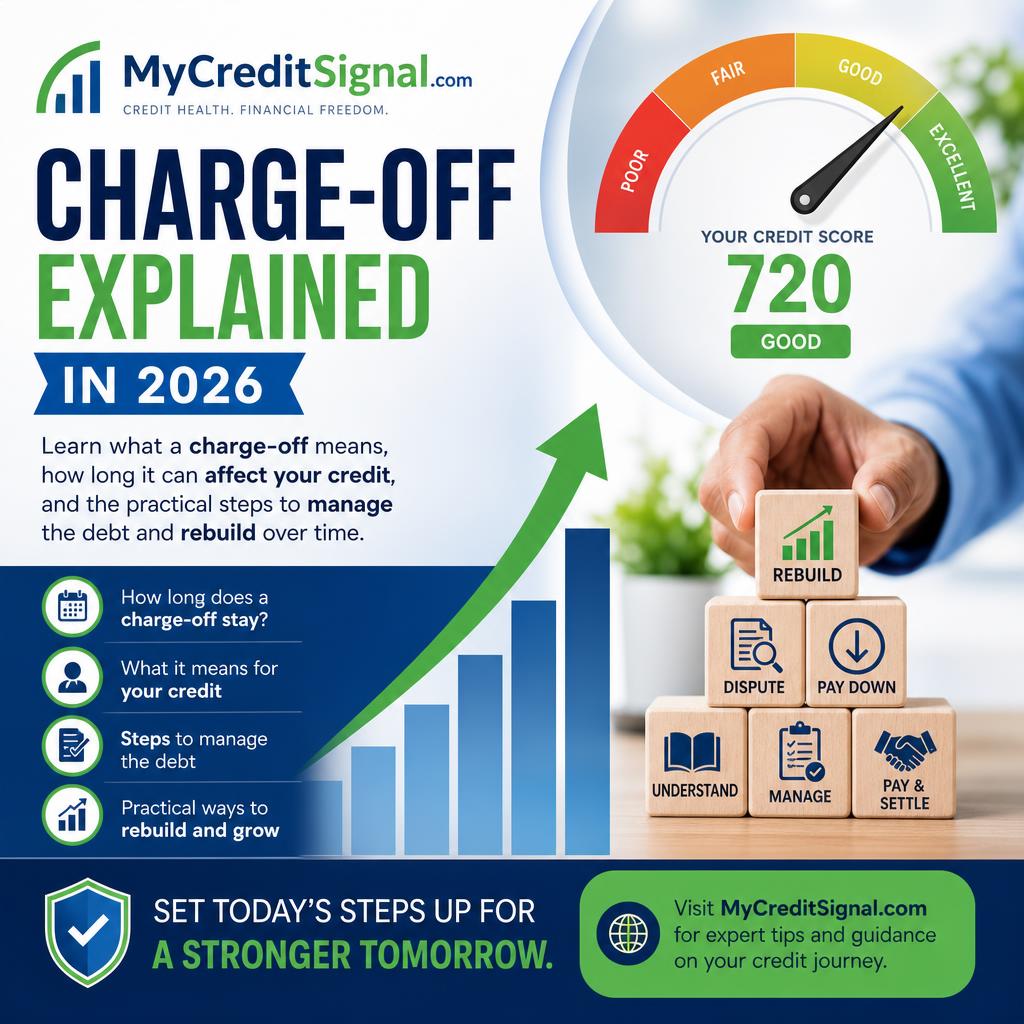
A charge-off in 2026 does not mean your debt disappeared. It means a creditor recorded the unpaid account as a loss, while the balance may still be owed, collected, or reported on your credit history. This guide explains the consequences, the timeline, and what to do first so you can make a practical decision instead of reacting to collection calls or a score change.
If you have a recently charged-off credit card, an older account still showing a balance, or a debt that has been sold to a collector, the right next step depends on the account status, your budget, and your near-term goals. You will leave with a six-step plan for stabilizing payments, evaluating resolution options, and rebuilding credit habits.
Contents
- 1 Who needs a charge-off consequences plan?
- 2 What does a charge-off mean in 2026?
- 3 How long will a charge-off stay on your credit report?
- 4 How much can a charge-off affect your score?
- 5 What should you do first after a charge-off?
- 6 What are the most common charge-off mistakes?
- 7 What charge-off advice often misses
- 8 Charge-off questions people ask in 2026
- 9 Helpful tools for your next move
- 10 The bottom line on charge offs in 2026
Key Takeaway
A charge-off can remain on a credit report for up to seven years from the first delinquency, but its effect generally fades with time; handling the balance and establishing new on-time payment history are separate parts of recovery.
Who needs a charge-off consequences plan?
This article is for anyone whose account has been charged off or appears headed in that direction. It is especially useful if you are deciding whether to pay the original creditor, work with a collection agency, settle the balance, or focus first on keeping current accounts from becoming delinquent.
It is also relevant if you are preparing for a major application. A lender may evaluate the charge-off alongside your current payment history, balances, income, loan type, and the scoring model used for the application. A charge-off is important, but it is not the only fact in your file.
A different approach may be needed if the debt is connected to a court judgment, secured collateral, a business account, or a legal deadline. Credit reporting and collection rules can also depend on where you live and on the account agreement. For questions about legal rights, consult a qualified professional rather than relying on a general credit article.
What does a charge-off mean in 2026?
A charge-off is an accounting action in which a creditor writes a debt off as a loss after a period of nonpayment. The accounting entry does not automatically cancel the consumer’s obligation. The creditor may continue collection activity, transfer or sell the account, or report the charge-off to credit bureaus.
Delinquency usually comes first. Delinquency means a scheduled payment was not made on time. If the account remains unpaid, the creditor may eventually classify it as a charge-off under its policies and applicable rules. The exact timing can vary by lender and account type, so do not assume every account follows the same calendar.
The Federal Deposit Insurance Corporation describes charge-off concepts in its credit-card risk-management materials, while the Federal Reserve publishes aggregate charge-off and delinquency data for commercial banks. Those national statistics describe banking trends, not the outcome for one person. Your account agreement and individual history control your situation.
For broader context, you can review the Federal Reserve charge-off and delinquency data and the FDIC credit-card risk-management guidance.
How long will a charge-off stay on your credit report?
A charge-off can remain on a consumer credit report for up to seven years from the date of the first delinquency that led to the charge-off. The seven-year period is tied to the initial delinquency, not necessarily the later date when the creditor updated the account as charged off.
The negative effect generally becomes less pronounced as the item ages, although the exact score change varies by scoring model and the rest of your credit profile. A recent charge-off can matter more than an older one because newer negative information often carries greater weight in scoring decisions.
Paying or settling the balance does not automatically erase the charge-off. It may change the account’s status to paid or settled and can help with lender review or future collection activity, but the record may continue to appear during the applicable reporting period. Experian explains the reporting timeline in its guide to how long charge-offs stay on a credit report.
How much can a charge-off affect your score?
A charge-off is a serious negative item under FICO and VantageScore scoring systems, but there is no universal score deduction. The effect depends on the scoring version, how recent the charge-off is, whether other late payments are present, the number and age of your accounts, and your current balances.
MyFICO cites an approximate 7% to 10% impact range for a single charge-off in the early to middle life of the item, with the result varying by score version and overall file. Treat that figure as an illustration rather than a promise. A person with several recent delinquencies may see a different result from someone with one isolated older account.
Scoring models can also treat paid, settled, and unpaid accounts differently. Some newer models may give more favorable treatment to paid collections than older models, but lenders can use different versions and may apply separate underwriting rules. Check the score type connected to the decision you care about instead of assuming a score from one app will match a lender’s score.
The practical lesson is to avoid chasing an exact point estimate. First stop new late payments, then reduce revolving balances, and maintain accounts that are already open and current. These actions strengthen the parts of your profile you can control now.
What should you do first after a charge-off?
Do not begin by sending an unaffordable payment. Begin by identifying the account, confirming who currently owns or services it, and protecting your current accounts. Then choose a resolution option that your budget can sustain.
List the account details
Write down the creditor name, account type, approximate balance, date of first delinquency if available, current status, and the name of any collection company contacting you. Keep letters, statements, and payment offers in one folder. This prevents you from making a decision based only on a phone conversation.
Protect every account that is still current
Set reminders or automatic minimum payments for open accounts you can afford. A new late payment can add another negative event while you are trying to manage the charge-off. If automatic payment could overdraw your account, use calendar reminders and review cash flow before each due date.
Build a realistic payment amount
Calculate what remains after housing, utilities, food, transportation, insurance, and current minimum payments. Reserve a small buffer for irregular expenses before assigning money to the charged-off debt. A plan that fails after one unexpected bill is not a sustainable plan.
Compare repayment and settlement options
Repayment targets the full balance over time. Settlement may resolve the account for less than the amount claimed, but the terms, tax treatment, credit reporting, and collection consequences can differ. Ask for any agreement in writing before paying and make sure the payment schedule fits your budget.
Keep a complete payment record
Save the written agreement, confirmation numbers, receipts, and final account statement. Record the date and amount of every payment. If the account changes hands, your records help you explain what was paid and what remains under the agreement.
Rebuild with current positive activity
Once the immediate account decision is organized, focus on paying current accounts on time and keeping revolving balances manageable. Use a credit product only if its payment fits your budget. A paid charge-off and a strong recent payment pattern solve different problems, so address both.
Use this priority order: first, prevent additional delinquencies; second, understand the charged-off account and choose an affordable resolution; later, optimize balances and consider new credit only when the budget is stable. If you need a structured way to test payoff choices, the collection settlement budget planner can help you compare an offer with your available cash flow.
What are the most common charge-off mistakes?
Assuming the debt vanished
Behavior: Treating the charge-off as canceled because the original creditor wrote it off. Consequence: The balance may still be pursued or transferred, and ignoring it can leave you unprepared for collection activity. Fix: Identify the current account owner or servicer and review the information before choosing a response.
Paying without a written agreement
Behavior: Sending money after a verbal promise that the account will be closed or updated. Consequence: You may misunderstand the amount, dates, or expected account status. Fix: Request written terms, verify the payment address, and retain proof of every transaction.
Expecting payment to remove the record
Behavior: Paying or settling while assuming the charge-off will disappear immediately. Consequence: The account may remain on the report for up to seven years, creating disappointment and poor planning. Fix: View payment as a debt-resolution step, not a guaranteed deletion, and track positive credit activity separately.
Opening new credit too quickly
Behavior: Applying for several accounts to offset the negative item. Consequence: New payments and balances can strain a budget that is already under pressure. Fix: Stabilize cash flow first and use the credit-building option that you can manage consistently.
What charge-off advice often misses
The account’s age matters. A recent charge-off and an older charge-off may appear together, but they do not necessarily carry the same scoring weight. The negative effect generally fades over time, while new on-time payments can demonstrate that your current behavior has changed.
Ownership matters too. The original creditor may keep the account, or the account may be assigned or sold to a collection agency. That difference can affect who receives payment and what documentation you need. Never rely on a generic payoff instruction copied from another person’s situation.
Settlement also has tradeoffs. A lower payoff amount may be easier to afford, but settlement terms can affect how the account is described and may have tax implications depending on the amount forgiven and your circumstances. Get advice from a tax professional if cancellation-of-debt income could apply to you.
Do not prioritize a charge-off payment over essential housing, utilities, food, insurance, or a current account that is about to become late. Protecting basic stability and preventing fresh delinquencies can be more urgent than making an aggressive payment toward an older account.
For a broader recovery framework after resolving debt, read the credit score after settlement recovery guide. If your concern is whether your current score is moving into a stronger range, the guide to good credit score ranges provides useful context.
Charge-off questions people ask in 2026
Does paying a charge-off improve your credit score?
Paying or settling can update the account status and may support improvement over time, but it does not guarantee an immediate score increase or remove the charge-off. The result varies by scoring model and the rest of your credit profile.
Can a charge-off still be collected?
Yes. A charge-off is an accounting write-off, not automatic cancellation of the debt. The original creditor or a collection agency may continue collection activity, subject to applicable laws and the account’s circumstances.
Should you settle a charge-off or pay it in full?
Choose the option that you can afford and document. Paying in full may resolve the claimed balance, while settlement may cost less but can involve different reporting and tax considerations; review written terms before deciding.
Helpful tools for your next move
Start with a tool that matches the decision in front of you:
- Use the collection settlement budget planner to test whether a proposed payment fits your cash flow.
- Try the credit score simulator to explore possible changes, remembering that simulated results are estimates and actual lender scores can differ.
- Read the settlement recovery guide for a longer-term rebuilding sequence.
- Review the good credit score range guide when you are ready to measure progress beyond the charge-off itself.
The free tools remain available for planning and education. If you want a plan tailored to your exact situation, an optional personalized Credit Signal Action Plan provides a custom 90-day plan in a PDF with tools.
Get weekly credit tips, tool updates, and practical guides – free.
The bottom line on charge offs in 2026
A charge-off is serious, but it is a defined problem with a manageable sequence: understand the account, protect current payments, choose an affordable resolution, document the result, and build a fresh record of on-time activity. The mark can remain for up to seven years from the first delinquency, yet its influence generally weakens as it ages.
Your next step this week is simple: make an account list, calculate an affordable amount, and use the settlement budget planner before agreeing to terms. Then direct your attention to the accounts and habits that can improve your credit profile from this point forward.



Leave a Reply
You must be logged in to post a comment.