
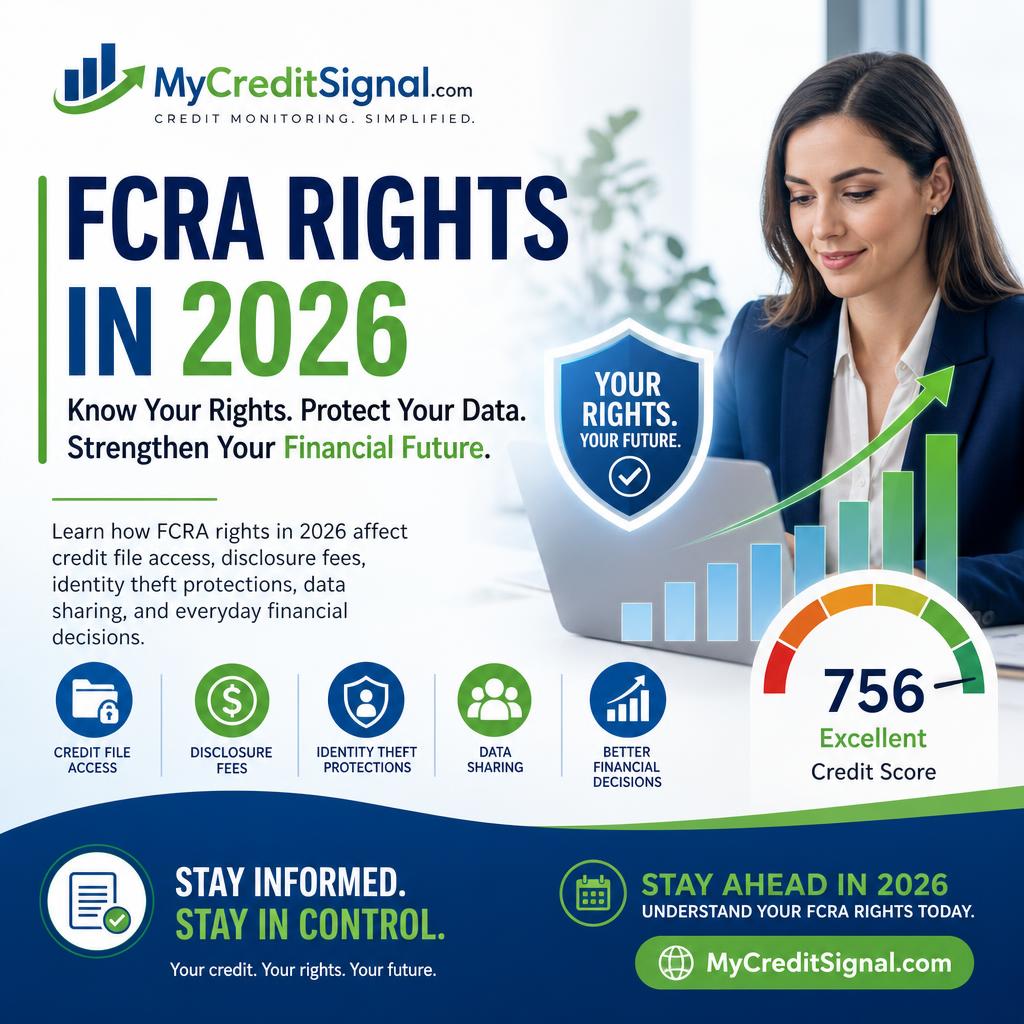
A lender asks for permission to use your credit information, a bank offers an app that connects to your financial accounts, or an unfamiliar company appears in a credit-related notice. In each situation, your FCRA rights in 2026 help determine who may access consumer information, what disclosures you can request, and how identity theft protections work. This guide is for people who want a practical understanding of those rights without reading a federal rule from start to finish.
The Fair Credit Reporting Act, or FCRA, is a federal law governing how consumer information is collected, shared, and used by credit reporting agencies and businesses that use consumer reports. In 2026, updated disclosure charges, Regulation V changes, and phased financial-data rights rules make it especially useful to know what to request, what to save, and which agency or company is responsible for a particular action.
Contents
- 1 Who needs to understand FCRA rights in 2026?
- 2 What does the FCRA regulate?
- 3 How much can a file disclosure cost in 2026?
- 4 What protections apply to identity theft and fraud?
- 5 How does financial-data sharing fit with FCRA rights?
- 6 What should you do first this week?
- 7 What mistakes can weaken your protection?
- 8 What does the latest guidance leave open?
- 9 FCRA rights 2026 questions answered
- 10 Helpful tools and related resources
- 11 Your next move
Key Takeaway
In 2026, focus first on knowing who has access to your consumer information, requesting the disclosures available to you, protecting against identity theft, and checking how financial-data sharing is authorized.
Who needs to understand FCRA rights in 2026?
Anyone applying for credit, renting a home, seeking employment where consumer reporting is used, or connecting financial accounts to an outside service should understand the basic framework. The law affects both the companies that maintain consumer files and the businesses that request or use consumer reports.
It matters most when you are preparing for a major application, reviewing a notice from a lender, monitoring for signs of identity theft, or deciding whether to authorize a financial-data connection. You do not need to become a compliance specialist. You do need a simple record of what information was requested, by whom, and for what stated purpose.
This guide is not a substitute for legal advice about a specific case. If a company has sent you a formal legal notice or you believe a company violated your rights, consider speaking with a qualified consumer-law attorney or an appropriate government agency.
What does the FCRA regulate?
The FCRA regulates the collection, disclosure, and use of consumer-report information. Credit reporting agencies, often called CRAs, are companies that collect and maintain consumer information and provide reports to lenders and other permitted users. Experian, Equifax, and TransUnion are major examples, but the term can cover other entities that maintain or provide consumer data.
The law also places responsibilities on users of consumer reports and on businesses that furnish information to reporting agencies. A user generally needs a permissible purpose, meaning a legally recognized reason to obtain or use a consumer report. Applying for credit, insurance, housing, or employment can involve different rules and notices, so do not assume every inquiry has the same legal basis.
Regulation V is the set of rules implementing important FCRA requirements for CRAs, users of consumer reports, and furnishers. The Federal Reserve and CFPB describe updates with effective dates beginning in 2026 and beyond, including clarifications involving report access, identity-theft protections, and user obligations. You can review the Federal Reserve and CFPB Regulation V information for the regulatory text and current implementation details.
How much can a file disclosure cost in 2026?
The maximum allowable charge for certain FCRA-required file disclosures is $16.00 in calendar year 2026. That ceiling does not mean every request costs $16, and it does not eliminate situations in which a consumer may qualify for a free disclosure. The applicable charge depends on the type of disclosure and the circumstances covered by the FCRA.
Sections 609 and 612 are commonly associated with file disclosures. A file disclosure is information a CRA provides to you about the consumer file it maintains, subject to the law’s requirements. Keep the request confirmation, the date submitted, the response, and any fee receipt in one folder.
The CFPB’s 2026 FCRA disclosures rule update explains the updated charge ceiling and disclosure requirements. If a fee seems unclear, ask the provider to identify the disclosure being supplied and the authority for the charge.
What protections apply to identity theft and fraud?
FCRA-related identity-theft protections are designed to help consumers respond when someone uses personal information to create or access financial accounts. Regulation V updates include clarifications related to identity-theft rights and the duties of businesses that use consumer reports.
Your practical goal is to reduce additional access and create a clear record. Save account alerts, notices, transaction details, and correspondence. Contact the company connected to the suspicious activity through a verified channel rather than relying on an unexpected email or text message.
Identity theft protection is different from general credit monitoring. Monitoring can alert you to changes, while legal protections and account-security steps address what happens after suspicious activity is identified. The credit monitoring alerts guide can help you build a regular review routine.
How does financial-data sharing fit with FCRA rights?
The CFPB’s Personal Financial Data Rights rule aims to give consumers more control over financial data held by covered institutions. It addresses who may access data, how information can be shared, and how it should be protected. This is broader than a traditional credit report because it can involve account and transaction information held by banks and other financial providers.
Compliance is phased. The CFPB states that the largest covered institutions have timelines reaching 2026, while the smallest covered institutions have a compliance deadline in 2030. Because implementation can depend on the institution and the type of data involved, check the provider’s current privacy and data-access disclosures before authorizing a connection.
Use this decision framework when an app asks to connect to an account: Need, Scope, Time, Exit. Need asks whether the connection provides a benefit you will actually use. Scope asks what accounts and fields are requested. Time asks how long access lasts. Exit asks how you revoke access and confirm that it ended.
What should you do first this week?
Use the sequence below to turn broad legal rights into a manageable credit-information routine. Start with visibility and security; handle optional planning tasks after those basics are in place.
Write down the companies you interact with
Make a short list of current lenders, card issuers, landlords, employers, monitoring services, and financial apps that may use or access consumer information. For each one, record its name, the reason you interacted with it, and the date of the latest notice or application.
Request and organize available disclosures
When you request a file disclosure, confirm what is included and whether a fee applies. In 2026, certain FCRA-required disclosures have a maximum charge of $16. Save the result in a secure folder and label it with the request date.
Review identity and access signals
Check account alerts, lender notices, and connected financial apps for activity you do not recognize. Change passwords through official websites, turn on available multi-factor authentication, and contact the relevant company through a verified phone number if something appears suspicious.
Ask what purpose supports a report request
If a company contacts you about a consumer report, ask what product or service the report supports and where its privacy explanation is located. A legitimate business should be able to explain its role and provide a channel for questions about its consumer-report practices.
Check your data-sharing permissions
Open the privacy or security settings for financial apps and review which institutions are connected. Remove access you no longer need, and keep a simple list of active connections so future reviews take only a few minutes.
Escalate unresolved questions carefully
Keep a timeline of contacts, names or departments, dates, and promised follow-up. If the issue concerns a regulated consumer-reporting practice, consult the CFPB’s FCRA compliance and consumer-rights resources or the FTC’s credit-reporting information before deciding what to do next.
What mistakes can weaken your protection?
Paying before identifying the disclosure
Behavior: You pay a fee without confirming what file or report you will receive. Consequence: You may receive a product that does not answer your question. Fix: Ask whether the request is an FCRA file disclosure, what it contains, and why the stated fee applies.
Granting broad app access once and forgetting it
Behavior: You connect an app and never review its permissions. Consequence: Data may continue to be shared after the original purpose ends. Fix: Keep a permission list and remove connections that are no longer useful.
Relying on alerts as a complete security plan
Behavior: You wait for an alert instead of securing accounts and reviewing notices. Consequence: You may miss activity that does not trigger the alert you expected. Fix: Combine monitoring with strong passwords, multi-factor authentication, and a documented review routine.
Assuming every data provider follows the same process
Behavior: You expect a bank, lender, CRA, and budgeting app to use identical procedures. Consequence: You may send a question to the wrong department or misunderstand the information provided. Fix: Identify whether the issue concerns a CRA, a report user, a furnisher, or a financial-data provider before taking action.
What does the latest guidance leave open?
FCRA rights are important, but they do not guarantee a particular lending decision, credit score, interest rate, or account approval. A company may use information from multiple sources, and scoring results can vary by credit profile and scoring model. Your rights concern fair handling, access, disclosures, privacy, and permitted use; they do not require a lender to approve an application.
Implementation timing is another important edge case. A federal rule may have a published effective date while individual institutions update systems and customer notices on their own schedules. The 2026 and 2030 data-rights milestones therefore should be treated as regulatory timeline markers, not promises that every feature will appear for every customer on the same day.
Another limitation is that not every company holding financial information is necessarily a CRA. A bank’s account-history data, a CRA’s consumer file, and a lender’s internal records can be governed by different rules. Identify the data holder before choosing a request or complaint channel.
FCRA rights 2026 questions answered
What is the FCRA in plain English?
The FCRA is a federal law governing how consumer information is collected, shared, and used by CRAs, lenders, and other permitted users. It includes rights related to file access, disclosures, privacy, and identity-theft protections.
Is the maximum FCRA disclosure fee $16 in 2026?
The 2026 maximum allowable charge for certain FCRA-required file disclosures is $16.00. The ceiling does not mean every disclosure costs that amount, and specific circumstances may allow a free disclosure.
When do the financial-data rights deadlines arrive?
The CFPB describes phased compliance, with the largest covered institutions reaching milestones by 2026 and the smallest covered institutions having a deadline in 2030. The exact experience depends on the institution and data-access service involved.
Use a practical system rather than trying to remember every rule. The credit score simulator can help you explore how hypothetical changes may affect a score, although results vary by credit profile and scoring model. For ongoing visibility, review the credit monitoring alerts resource and choose a schedule you can maintain.
Credit information can also affect borrowing decisions in specialized situations. Our guide to medical collections and credit scores in 2026 explains that topic separately. For official background, consult the FTC’s credit-reporting resources, which include consumer education and enforcement information.
Get weekly credit tips, tool updates, and practical guides – free.
Your next move
The most useful FCRA habit in 2026 is organized awareness. Know which companies may access your information, understand what disclosure you are requesting, review identity and data-sharing signals, and keep records of important notices.
Start this week by making your company list, reviewing connected financial apps, and saving the official CFPB and FTC resources. Those small steps make your consumer-information rights easier to use when a major application, privacy decision, or security concern arrives.


Leave a Reply
You must be logged in to post a comment.