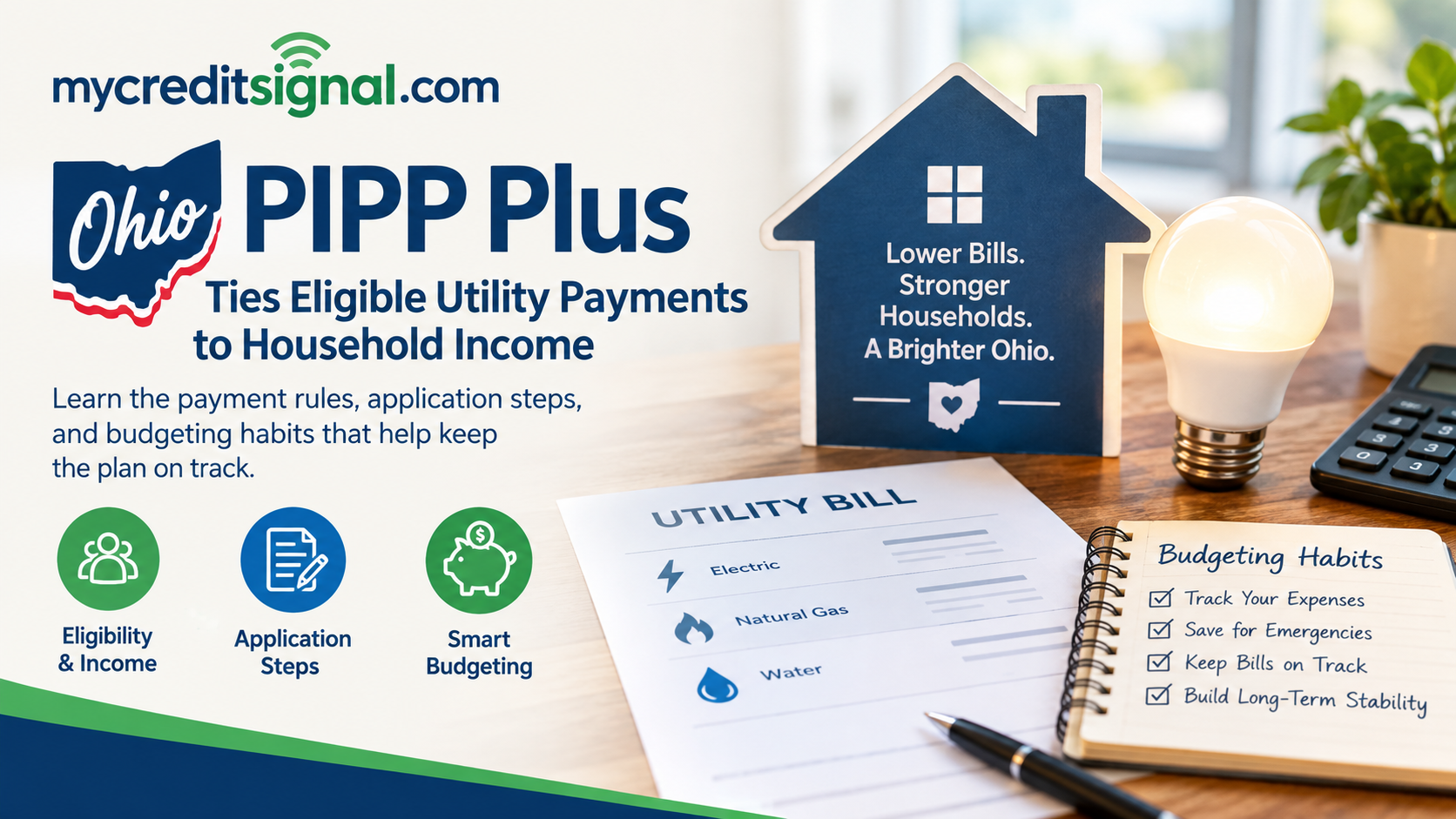
A utility bill that competes with groceries needs more than a spending cut. Ohio PIPP Plus, the Percentage of Income Payment Plan, bases eligible customers’ gas and electric payments on household income rather than actual monthly usage, according to the Ohio Consumers’ Counsel program guide. For Ohio residents struggling to budget for energy, the practical next step is to check eligibility, confirm the required payment, and build a calendar around it.
Contents
- 1 Who should check Ohio PIPP Plus eligibility?
- 2 How much would your utility payment be?
- 3 What happens to an existing utility balance?
- 4 Build your application and payment plan this week
- 5 Avoid these payment-plan mistakes
- 6 When the standard approach needs adjusting
- 7 Questions Ohio applicants often ask
- 8 Free resources for your revised utility budget
- 9 Start with the bill, not a guessed payment
Key takeaways
- Check your utility and household eligibility before changing what you pay.
- Budget from the approved installment, not your own estimate.
- Keep payment confirmations and renewal paperwork together.
Who should check Ohio PIPP Plus eligibility?
Start with PIPP Plus if energy bills are crowding out essentials and you receive service from a participating PUCO-regulated utility. The Ohio Consumers’ Counsel lists an income ceiling of 175% of federal poverty guidelines, an active account in the applicant’s name, and participation in other eligible energy-assistance programs among the requirements. Verified October 5, 2026: see the agency’s current eligibility guidance.
Bring your actual bills into this decision. Identify the company delivering service, the account holder, and the fuel used to heat your home. Do not rely solely on a supplier advertisement or the fact that a neighbor receives assistance.
If utilities are included in rent, someone else holds the account, or you have already left the program, ask an energy-assistance provider which route fits your situation. Start with that question instead of trying to force your circumstances into a standard application.
For household budgeting, use this decision framework: address an immediate service problem first, establish an affordable ongoing payment next, and strengthen savings after the arrangement is confirmed. Our guide to starting an emergency fund with no savings can help with that last step without making a large savings target your first hurdle.
How much would your utility payment be?
The payment depends on household income and whether electricity supplies your heat. Ohio’s electric rules specify 5% of monthly household income for non-electric-heating service and 10% for electrically heated homes, subject to the minimum payment. Gas-heating payments are generally 5%, with a $10 minimum, under the Ohio gas PIPP Plus rules; the electric calculation appears in the electric PIPP Plus rules.
Do not treat the gas percentage as covering both bills. If both gas and electric accounts participate, budget for the required payment on each account. Write the company name beside each installment so that a combined household estimate does not become a missed bill.
Current income benchmarks
The following annual limits come from the Ohio Consumers’ Counsel’s 2026–2027 income table, checked October 5, 2026. Use them as screening benchmarks, not an approval decision.
A calculation using the published benchmark
For an illustration, divide the published $27,930 annual benchmark by 12 months. That produces average monthly income of $2,327.50. Applying the verified payment percentages gives approximately $116.38 at 5% or $232.75 at 10%. These are arithmetic examples based on the official figures above, not a personalized payment quote.
Use the example to understand the formula, then replace it with the amount on your approval notice. Ask the provider how it treats variable earnings and income exclusions rather than calculating eligibility from your bank deposits alone.
What happens to an existing utility balance?
Qualifying payments can earn credits toward existing utility arrears, meaning past-due charges. Under Ohio’s gas rules, an on-time required payment earns a credit for the difference between the current bill and the income-based payment, plus one twenty-fourth of the applicable accumulated arrears. The gas program’s incentive provisions explain the calculation and recalculation conditions.
Ask the utility to label your account figures separately: current required installment, missed installments, accumulated arrears, and credits earned. That makes your next decision clearer than a single large balance printed at the top of a statement.
Before sending extra money toward the old utility balance, request an explanation of how that payment would be applied. Compare that answer with your other immediate needs. The aim is not to ignore a balance; it is to understand the agreement before assigning money that may be needed for rent, food, or the next installment.
For that household tradeoff, use our saving versus paying debt decision guide. Keep the utility’s actual arrangement beside your budget while you compare options.
Build your application and payment plan this week
Begin by resolving any immediate service concern, then collect the information needed for a complete application. Treat the steps below as a working checklist rather than a reason to postpone calling until your paperwork is perfect.
Identify the urgent issue
Open your newest bills and any disconnection notice. Write down the service address, account number, amount requested, and stated deadline. If service is at risk, call the utility and explain that you are seeking assistance. Ask what action is required while your application is being reviewed, and record the answer.
Make a single application folder
Gather identification, recent utility bills, household-member information, and income documentation. These are among the materials identified in the Ohio Consumers’ Counsel application checklist. Before an appointment, ask the provider which documents fit your income sources and whether anything additional is needed.
Confirm where to apply
Use the application route or local Energy Assistance Provider listed in the official guide. Ask whether your gas and electric accounts are both included in the application. Save the submission confirmation, the contact person’s name, and any request for follow-up information in the same folder.
Get a written payment starting point
Ask for confirmation of enrollment, the approved installment, and when that amount begins. Ohio’s electric rules provide for written eligibility and installment notices through the administering office or local agency. Check the electric enrollment procedures, and do not substitute your estimate for the utility’s confirmed billing instructions.
Assign the payment to a paycheck
Place each approved installment beside the paycheck that will fund it. If the due date arrives before that paycheck, reserve money from the earlier deposit. Set a reminder to review the bill and another to confirm that the payment posted. Use automatic payment only if you can reliably keep the required money available.
Create a maintenance calendar
Copy the program dates from your bill into your calendar. Ohio’s consumer guidance calls for annual reverification and reporting income or household-size changes within 30 days. Verify your dates using the PIPP Plus participation requirements, then set preparation reminders before the deadlines.
Once these tasks are complete, update the rest of your budget. Keep any apparent savings uncommitted until you have checked the first bill reflecting enrollment. Then decide deliberately whether the available money belongs in groceries, a cash cushion, or another obligation.
Avoid these payment-plan mistakes
A useful payment arrangement still needs a reliable household routine. Focus on the decisions you control: what amount you use, when you act, and which records you keep.
Budgeting from an unconfirmed estimate
Behavior: You calculate a payment online and immediately spend the difference elsewhere. Consequence: Your budget depends on an amount that has not been approved. Fix: Keep the existing obligation in your planning worksheet until you receive clear billing instructions; mark the estimate as provisional.
Filing a payment receipt without checking the account
Behavior: You assume pressing the payment button finishes the task. Consequence: You have not confirmed whether the intended account received the intended amount. Fix: Save the confirmation and check the account afterward. Keep the payment date, amount, and account identifier together.
Putting all program tasks on one reminder
Behavior: You create a general utility reminder but leave out document preparation and follow-up. Consequence: An unfinished application or renewal can disappear behind ordinary bills. Fix: Give each unfinished task its own reminder and leave it open until you have confirmation.
When the standard approach needs adjusting
Ask for individualized instructions if you are moving, changing household members, returning after a previous enrollment, or unable to afford the approved installment. Bring those facts up at the beginning of the conversation rather than after agreeing to a plan.
For an upcoming move, request a written explanation of both accounts: what remains due at the old address and what you must arrange at the new one. Keep those obligations separate in your moving budget.
For irregular earnings, prepare a dated income record and ask which period the provider needs to evaluate. Do not choose whichever paycheck makes the application look most favorable. An accurate starting point is more useful than an optimistic estimate you cannot maintain.
These are Ohio program instructions, not nationwide utility-assistance rules. Use the local provider to confirm the arrangement for your particular service account.
Questions Ohio applicants often ask
Can I apply for Ohio PIPP Plus outside winter?
Yes. Applications are accepted year-round, according to the Ohio Consumers’ Counsel; you do not need to wait for a winter heating bill.
Does enrolling erase my utility balance immediately?
No. The electric program ties arrearage credits to qualifying payments, rather than simply eliminating the balance at enrollment. Ask the utility to explain your credit calculation under the electric payment and crediting rules.
Can I skip a gas payment during a low-use month?
No. Ohio’s gas rules require the income-based payment each billing cycle, including periods when usage charges are lower than the installment. Follow the gas PIPP Plus payment requirements and contact the utility if you cannot pay.
Free resources for your revised utility budget
Once you have a confirmed installment, enter it in the free Monthly Cash Flow Calculator alongside your other household expenses. Use your take-home income for this spending exercise, not the gross-income figure used in the program calculation.
Review the result before making new spending commitments. If the budget still does not balance, bring that shortfall into your next assistance conversation instead of assuming enrollment solved every problem. Browse the free tools library when you are ready to explore a savings target or other household planning questions. The tools remain free; they do not determine program eligibility.
Get weekly credit tips, tool updates, and practical guides – free.
Start with the bill, not a guessed payment
The strongest next move is a specific one: gather your latest utility bills, identify the account holder and heating source, and contact the official application provider. Ask what you qualify for, what you would owe, and what must happen next.
Then turn the confirmed arrangement into a repeatable routine: reserve the payment, check that it posts, and keep program paperwork current. That gives your utility budget a firmer foundation without depending on an unapproved estimate.



Want to understand your credit report?
Get plain-English explanations with our free AI Credit Analyzer →
Leave a Reply
You must be logged in to post a comment.