
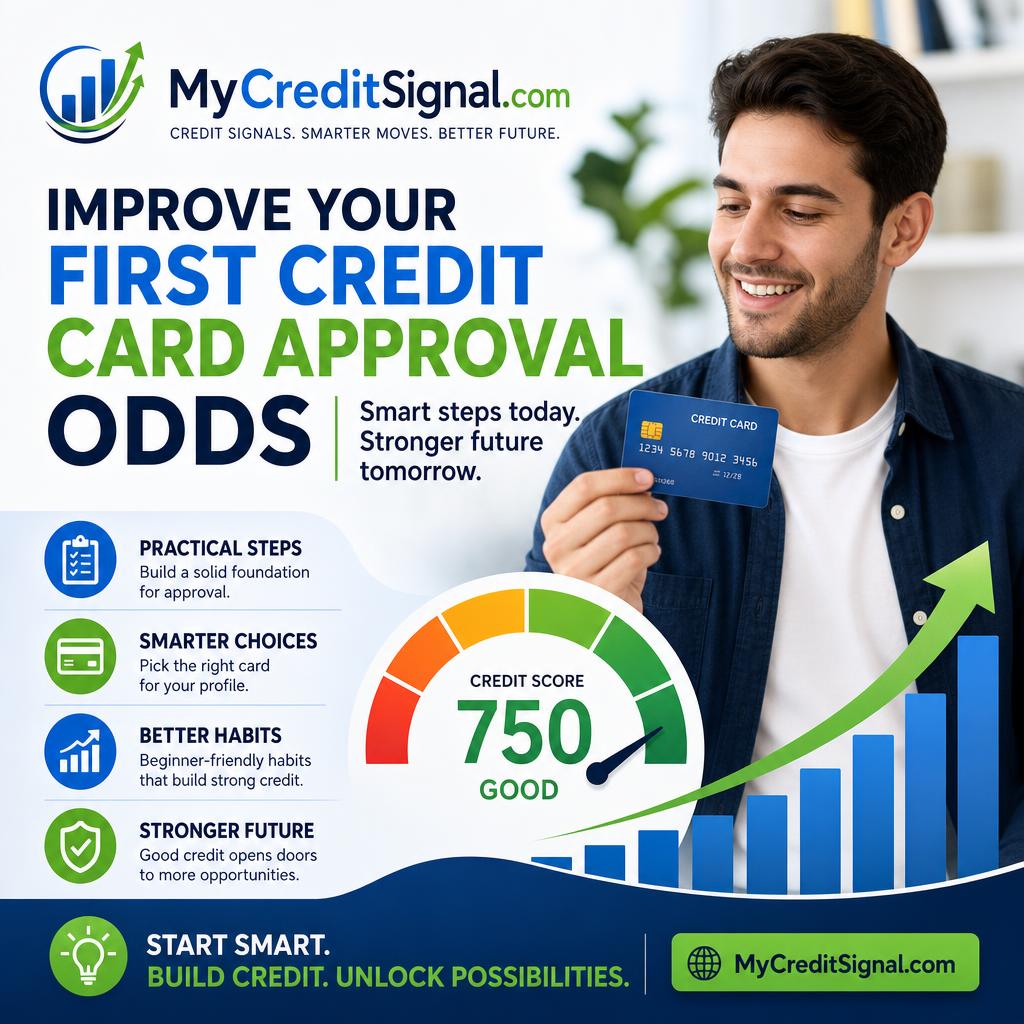
You pick a beginner card, fill out the application in 10 minutes, and hope for instant approval. Then the doubt kicks in. Was your income high enough? Should you have tried a secured card first? Did one application just hurt your odds for the next one?
If you are trying to improve your first credit card approval odds, this guide is for you. It is built for beginners with no credit or very thin credit who want a realistic plan, not vague advice. You will learn what card issuers usually look for, which numbers matter most, how to choose the right starter card, and what to do this week to apply with more confidence.
Contents
- 1 Who should use this guide and who should not
- 2 What first credit card approval really depends on
- 3 Starter card choices that improve your odds
- 4 The numbers and thresholds that matter most
- 5 A step by step plan to improve approval odds this week
- 5.1 Check whether you need to build first or apply first
- 5.2 Write down your real monthly income
- 5.3 Pick one lane before you apply
- 5.4 Target low fee, simple terms, and a manageable limit
- 5.5 Plan your first 60 days before you submit the application
- 5.6 Set autopay and a mid-cycle payment reminder
- 5.7 Track alerts from day one
- 6 Mistakes that lower your chances or make the first card harder to manage
- 7 What many first card guides leave out
- 8 FAQ
- 9 Helpful tools and related resources
- 10 The bottom line
Key Takeaway
Your best shot at a first credit card approval usually comes from applying for the right starter card, showing clear ability to pay, and keeping your first limit easy to manage from day one.
Who should use this guide and who should not
This guide is a good fit if you are in one of these groups:
- You have never had a credit card before.
- You have little or no credit history and want a practical first move.
- You are a student, recent graduate, or young worker comparing secured and unsecured starter cards.
- You were denied once and want to improve your next application instead of guessing.
This is probably not the right approach if you are trying to recover from a major credit setback like bankruptcy or identity theft. In that case, start with a more targeted plan such as this bankruptcy recovery guide or this identity theft credit rebuilding guide.
If you are not sure whether a card should even be your first move, read ways to build credit without a credit card. Some people do better starting with a different product first.
What first credit card approval really depends on
Many beginners assume approval is all about one magic credit score. That is too simple. According to FICO, the most common predictors behind credit decisions and scoring models include payment history, existing debt, and the length of your credit history. If you are brand new to credit, the problem is not necessarily bad credit. It is often a lack of evidence.
The CFPB also notes that most first-time approvals depend on establishing some positive credit history and showing the ability to pay over time. That means issuers are often looking for a combination of:
- Income or cash flow: Can you reasonably handle monthly payments?
- Existing obligations: If you already have loan payments, your application can look tighter.
- Credit history depth: No history is different from poor history, but both can limit options.
- Card fit: A beginner who applies for a premium rewards card may get denied even if a starter card would approve them.
A good way to think about it is this: approval odds improve when the product matches your current file. If you have no score yet, secured cards and entry-level unsecured cards are usually more realistic than high-reward cards with stricter underwriting.
Some issuers now offer prequalification tools that use soft inquiries and do not affect your credit score, which can help you gauge odds before a full application. Capital One specifically notes this approach in its beginner card guidance. If you want to understand how your behavior might affect your score after approval, use the credit score simulator before you apply and again after your card starts reporting.
Starter card choices that improve your odds
Choosing the right first card matters more than many beginners realize. Chase advises new cardholders to look for a low or $0 annual fee and straightforward terms. That is not just about saving money. It also reduces the chance that you pick a card designed for a stronger profile than yours.
Here is a practical decision framework:
If you have no credit, limited income, or no prior accounts: lean toward a secured card or a basic student card if you qualify.
If you have steady income and maybe one small installment account: a beginner unsecured card may be realistic, especially if you can prequalify first.
If you are under 21: confirm you meet the CFPB requirement around independent ability to pay or a co-signer before you apply.
If your budget is already tight: avoid annual fees unless the card clearly gives you a path you can manage.
If you want help deciding whether you are ready for a deposit-backed card, take the secured card readiness quiz. It can help you choose between waiting, applying now, or trying another credit-building step first.
You may also want to compare this guide with secured credit cards that actually build credit if you are leaning in that direction.
The numbers and thresholds that matter most
You do not need perfect credit to get your first card. In fact, one common misconception is that beginners need elite scores. They do not. Starter products exist because issuers know many applicants are just beginning. But there are still a few numbers that matter.
1. Age 21 matters for some applicants
Per CFPB guidance, applicants under 21 generally face extra requirements. You may need to show independent ability to pay or apply with a co-signer. If you are 19 or 20 and do not meet that standard, a denial may have more to do with legal underwriting rules than with your potential as a cardholder.
2. Utilization should stay low once you are approved
FICO says utilization is a key score driver. Utilization means the share of your available credit you are using. The formula is simple:
Balance reported divided by credit limit = utilization rate
Example: if your first card has a $500 limit and your statement closes with a $200 balance, your utilization is 40 percent. If the balance is $50, your utilization is 10 percent.
Lower is generally better for scoring, especially when you only have one card. That is why beginners often do best using a card lightly and paying early if needed. For a deeper walkthrough, read our credit utilization guide.
3. Annual fees and deposits change the math
A $0 annual fee starter card gives you more flexibility. A secured card may require a deposit, often equal to your limit, which can make approval easier but ties up cash. If your emergency savings is only a few hundred dollars, putting all of it into a security deposit may not be wise.
4. One hard inquiry is manageable, several in a short period can backfire
Not every application becomes an approval. CFPB market data show 67.7 million mass-market credit card applications were approved in 2024, but approvals vary by issuer and applicant risk. That means you want a measured approach, not a scattershot one. Apply strategically, not repeatedly.
5. Your starting point may be below the average score and still workable
The average U.S. FICO score cited in 2024 reporting was 717. That number is useful as broad context, but it is not a minimum requirement for a first card. Beginners with thin files may not even have a score yet. What matters more is applying for a card built for your stage.
A step by step plan to improve approval odds this week
Check whether you need to build first or apply first
If you have absolutely no credit file, start by asking whether a card is the best first move. If you are a student or have stable income, a starter card may make sense now. If you are not there yet, an authorized user strategy or another entry-level product may be a better bridge. See authorized user credit tips if someone you trust can help you begin.
Write down your real monthly income
Do not estimate loosely. Use the amount you can document and reasonably expect. Issuers care about your ability to pay. Include stable income sources you are allowed to report, and avoid stretching the number to look stronger. A realistic application is safer than an aggressive one.
Pick one lane before you apply
Choose between a secured card, student card, or beginner unsecured card. Do not apply to all three in the same weekend. If you are not sure, use prequalification where available because some issuers use soft inquiries that do not affect your score. This helps narrow the field before a hard pull.
Target low fee, simple terms, and a manageable limit
For a first card, simplicity beats prestige. A low or $0 annual fee card with plain terms reduces the cost of learning. If a secured card asks for a $200 deposit and that still leaves you with emergency cash, that may be more sustainable than forcing an unsecured approval you may not get.
Plan your first 60 days before you submit the application
Know exactly how you will use the card. Example: charge one streaming bill and one tank of gas each month, keep the reported balance low, and pay the statement in full. If your limit is $300, a monthly statement balance of $30 means 10 percent utilization. That is much easier to manage than charging $220 and hoping you remember the due date.
Set autopay and a mid-cycle payment reminder
Your first goal after approval is not rewards. It is clean payment history. Set autopay for at least the statement balance if your checking account allows it. Then create a calendar reminder halfway through the billing cycle so you can make an extra payment if your balance is climbing.
Track alerts from day one
Use account alerts so you know when the statement closes, when the payment is due, and when spending gets high. If you want an extra layer of visibility, review how credit monitoring alerts can help you stay on top of account changes.
If you want the shortest version of the plan, do this first versus later:
- Do first: confirm your income, choose one starter card lane, check for prequalification, and decide how much you can safely spend monthly.
- Do later: chase rewards, ask for higher limits, or apply for a second card.
That order matters. Most first-card mistakes happen because people focus on approval and ignore what happens right after.
Mistakes that lower your chances or make the first card harder to manage
Applying for a card that does not match your profile
Behavior: Going straight for a premium travel or cash-back card because the rewards look better. Consequence: A denial and a wasted hard inquiry when a starter card may have been more realistic. Fix: Match the card tier to your actual credit file and income, not your long-term wish list.
Using most of the limit in month one
Behavior: Treating a $500 limit like extra income and charging $350 to $450 right away. Consequence: High utilization can hurt your early score development, especially when you only have one account. Fix: Keep charges small, pay early if needed, and aim for a low statement balance.
Applying multiple times after one denial
Behavior: Submitting several applications in a short window after getting turned down once. Consequence: More hard inquiries and more chances of additional denials. Fix: Slow down, identify the likely issue, then improve your application path before trying again.
Ignoring fees because the limit looks appealing
Behavior: Accepting a costly starter card with fees you do not fully understand. Consequence: A card that becomes expensive to keep open and harder to use responsibly. Fix: Favor simple beginner cards with low or $0 annual fees when possible, and compare the total cost before applying.
What many first card guides leave out
Most articles tell you to build credit history. That is true, but they skip the tradeoffs.
First, approval is not the whole game. A card you cannot manage can do more harm than waiting one or two months to apply for a better-fit option. Your first account should be easy to keep open for years, because credit history length matters.
Second, results vary by credit profile and scoring model. Two beginners can make the same move and see different outcomes. One may already have a thin file from a student loan or authorized user account. The other may have no file at all.
Third, cash flow matters more than optimism. If paying a $200 secured deposit means you will carry overdraft risk next month, that card may not be your best starting point yet.
There is also a fairness issue worth acknowledging. Federal Reserve data show credit access and approval patterns vary across groups. That does not change your immediate action plan, but it is a reminder that denials are not always a simple personal failing. A better product match and a better application timing can make a real difference.
FAQ
What credit score do I need for my first credit card?
There is no single required score. Many beginners do not have a score yet. Starter cards and secured cards are designed for people with limited or no credit history, so card fit often matters more than hitting one number.
Should I get a secured card or try for an unsecured one first?
If you have no credit and want the highest practical approval odds, a secured card is often the safer path. If you have steady income, student status, or a thin existing file, an unsecured beginner card may be realistic. Choose based on fit, not ego.
Are prequalification offers a guarantee?
No. Prequalification can be useful because some issuers use soft inquiries that do not affect your score, but it is still not a final approval. Your full application can produce a different result if the issuer verifies more details.
If you want to turn this advice into a plan, start with these next steps:
- Estimate how future behavior could affect your profile with the credit score simulator.
- Figure out whether a deposit-backed starter card fits your budget using the secured card readiness quiz.
- Learn what responsible low-balance use looks like in the credit utilization guide.
- If you are still deciding whether a card should be step one, read how to build credit from scratch the smart way.
- If you want more options beyond cards, review credit-building options that do not require a credit card.
Get weekly credit tips, tool updates, and practical guides – free.
The bottom line
The best way to improve your first credit card approval odds is not to chase the flashiest offer. It is to apply for a card that matches your current profile, show clear ability to pay, and make a simple plan for the first 60 days before you hit submit.
If you are ready to move, use one tool first. Check your fit with the secured card readiness quiz or map out likely score impacts in the credit score simulator. A smarter first application can save you time, stress, and unnecessary denials.

Leave a Reply
You must be logged in to post a comment.