
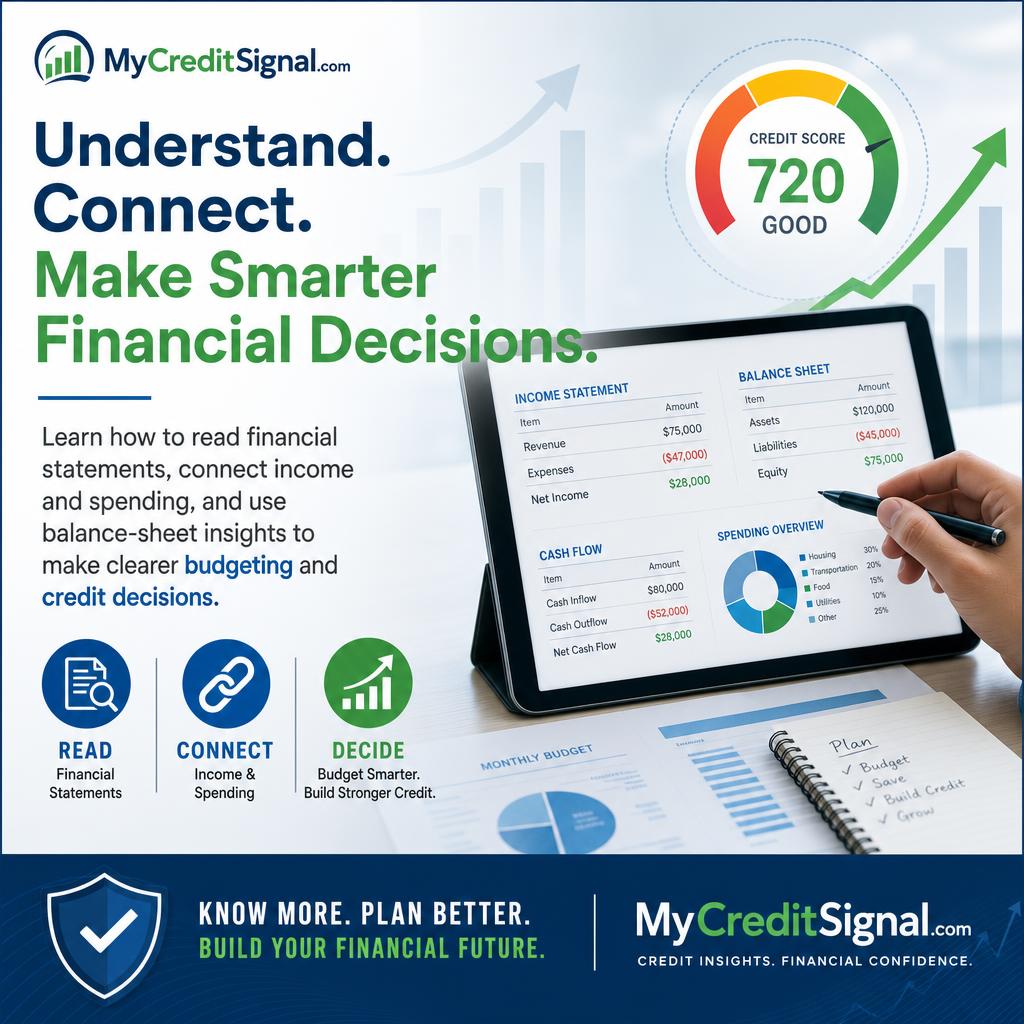
A financial statement can look like a wall of accounting language, but its job is simpler: show what came in, what went out, what you own, and what you owe. Reading financial statements well helps you spot cash-flow pressure before it becomes missed payments, decide whether a goal fits your budget, and understand whether your financial position is improving.
This guide is for anyone reviewing personal finances, a household budget, a small business, or a company’s public report. You will learn what each statement says, which figures deserve attention first, and how to turn the information into practical decisions rather than just highlighting impressive totals.
Contents
- 1 Who benefits from reading financial statements?
- 2 What are the three main financial statements?
- 3 Which numbers deserve attention first?
- 4 How do you read a statement line by line?
- 5 What should you do first versus later?
- 6 A five-step financial statement review for this week
- 7 Which financial statement mistakes cause bad decisions?
- 8 What do most financial-statement guides miss?
- 9 Financial statement reading FAQ
- 10 Helpful tools for your next review
- 11 Make the numbers useful
Key Takeaway
Read the income statement for movement, the balance sheet for position, and the cash flow statement for reality; together, they reveal whether money is being earned, retained, and actually available.
- Start with recurring income and essential expenses.
- Compare assets with liabilities to understand net worth.
- Use cash flow to test whether reported income becomes spendable cash.
- Review trends and relationships, not one isolated number.
Who benefits from reading financial statements?
People managing household money benefit because financial statements create a consistent language for decisions. A personal income statement can show whether spending is rising faster than income. A personal balance sheet can show whether debt is shrinking and savings are growing. A cash flow view can reveal why a household with adequate annual income still feels short before payday.
This skill also helps freelancers and small-business owners separate revenue from usable cash. A business may record a sale before the customer pays, while bills may be due immediately. That timing difference matters when planning payroll, taxes, debt payments, or an emergency reserve.
You may need a different approach if you are looking only for a daily spending plan. In that case, start with transaction-level budgeting and account balances. Financial statements are most useful when you want a broader view of financial health, trends, or tradeoffs.
What are the three main financial statements?
The three main financial statements are the income statement, balance sheet, and cash flow statement. Each answers a different question, and none should be read alone.
Income statement: Did money come in or go out?
An income statement summarizes revenue or income and expenses over a period. For a household, income may include wages or freelance payments, while expenses may include housing, utilities, transportation, food, insurance, and debt payments. The basic formula is:
Net income = total income − total expenses.
A positive result means the period produced a surplus before any additional choices. A negative result means expenses exceeded income during that period. The statement does not automatically tell you whether the surplus was saved, invested, or used to pay debt, so you must connect it with the other statements.
Balance sheet: What do you own and owe today?
A balance sheet is a snapshot of assets, liabilities, and net worth at a specific date. Assets are resources you own, such as cash, savings, investments, or property. Liabilities are obligations, such as credit card balances, auto loans, student loans, or a mortgage.
Net worth = total assets − total liabilities.
Net worth can rise because assets increase, liabilities decrease, or both. It can also fall even when income is steady if debt grows or assets lose value. The balance sheet is about position, not the month’s activity.
Cash flow statement: Where did the cash actually go?
A cash flow statement tracks cash entering and leaving accounts. It commonly groups activity into operating, investing, and financing categories. For personal finances, a simpler version can separate regular household cash flow, large purchases or savings transfers, and borrowing or debt repayment.
Cash flow answers a question the income statement may not: “Can I pay what is due when it is due?” A recorded income amount is less useful for an immediate bill if the payment has not arrived. Likewise, a purchase that is financed may not appear as a full cash outflow on the purchase date, even though it creates a liability.
Which numbers deserve attention first?
Read statements in an order that matches your decision. If a bill is due soon, start with cash available and near-term obligations. If you are assessing long-term progress, move to net worth and debt trends. If you are deciding whether spending is sustainable, study recurring income and expenses.
These figures are not financial-statement measures, but they illustrate why financial organization matters. Credit decisions often depend on information outside your budget, and FICO reports that its scores are used by about 90% of top U.S. lenders. A statement review cannot predict a score, but it can help you identify payment obligations, rising debt, and cash-flow risks that may affect credit management.
Use a four-question reading test
- Income: Is the money recurring, one-time, earned, or merely expected?
- Expenses: Which costs are essential, flexible, or occasional?
- Obligations: Which liabilities require payment soon, and which have longer timelines?
- Direction: Is the trend improving, worsening, or unclear?
For example, imagine a household with hypothetical monthly take-home income of $5,000, recurring expenses of $3,700, and debt payments of $600. Its remaining amount is $700 before irregular costs and savings. That result is more useful than simply saying the household earns $60,000 annually because it reveals the room available for repairs, gifts, or extra debt payments.
How do you read a statement line by line?
Begin at the top and classify each line before judging it. On an income statement, label income as recurring or irregular. Then label expenses as fixed, flexible, or occasional. This prevents a one-time refund or annual insurance payment from distorting your view of normal monthly activity.
Next, examine totals and subtotals. A gross amount may appear before taxes, fees, or other deductions. A net amount reflects what remains after the listed deductions. Always check the statement period and whether the figures are monthly, quarterly, annual, or cumulative.
On a balance sheet, list assets and liabilities separately. Do not treat a credit limit as an asset; it is available borrowing, not money you own. For debt, record the current balance, interest terms if available, and required payment. The balance sheet becomes more informative when you compare it with an earlier version.
Finally, compare the cash flow statement with the income statement. If income is positive but cash is falling, investigate timing, large purchases, transfers, debt payments, or unpaid receivables. That difference is a signal to ask better questions, not proof that the statement is wrong.
What should you do first versus later?
Handle liquidity and obligations first; optimize long-term goals after the basic picture is clear. This decision framework keeps a complicated review from turning into an overwhelming project.
- First: identify cash currently available, upcoming essential bills, and minimum debt payments.
- Next: separate recurring expenses from irregular costs and calculate the normal monthly surplus or shortfall.
- Then: update assets, liabilities, and net worth so you can see the longer-term position.
- Later: compare goals, investment choices, debt acceleration, and spending improvements against the numbers.
If cash is tight, a perfect net-worth calculation is less urgent than preventing a late payment or overdraft. If cash is stable, the balance sheet and long-term trend deserve more attention.
A five-step financial statement review for this week
Gather the statements
Collect recent income records, bank and investment balances, loan statements, credit card statements, and recurring bills. Include the statement dates so you do not compare a monthly figure with an annual one.
Build a simple income statement
Write down recurring income first, then list essential, flexible, and occasional expenses. Calculate net income using total income minus total expenses. Mark any amount that will not repeat so it does not become part of your normal spending plan.
Create a balance-sheet snapshot
List each asset and liability as of the same date. Add the assets, add the liabilities, and subtract liabilities from assets. Save the result so you can compare your next review with this starting point.
Reconcile cash movement
Compare the change in your bank balance with the cash that entered and left during the period. Investigate large differences by checking transfers, debt payments, refunds, and one-time purchases.
Choose one action and one follow-up
Choose the largest controllable pressure, such as an unused subscription, a recurring shortfall, or a high required payment. Take one action this week, then schedule a follow-up review so the change is measured rather than forgotten.
For an irregular-income household, pair this review with a budgeting approach for irregular income. If you are building a reserve, the emergency fund budget plan can help connect your surplus with a specific savings purpose.
Which financial statement mistakes cause bad decisions?
Mistake 1 Treating revenue as cash
Behavior: You count every recorded sale or expected payment as money available now. Consequence: You may commit cash to bills before it arrives. Fix: Keep expected income separate from cash already received and review payment timing.
Mistake 2 Looking at one period only
Behavior: You decide that one unusually strong or weak month defines your finances. Consequence: Seasonal costs and one-time events can lead to an unrealistic budget. Fix: Compare multiple available periods and label irregular transactions.
Mistake 3 Ignoring liabilities because payments are current
Behavior: You focus on making required payments but never update total balances. Consequence: Debt can remain unchanged or grow while your statements appear manageable. Fix: Track each balance and review whether principal is declining.
Mistake 4 Confusing net worth with financial safety
Behavior: You count property or investments as if they were immediately spendable cash. Consequence: You may underestimate the risk of a near-term bill. Fix: Separate liquid resources from assets that take time or cost money to convert.
What do most financial-statement guides miss?
Statements are summaries, not explanations. They tell you what was recorded, but they may not tell you why a number changed or whether it will repeat. A rising asset total may reflect a market movement rather than new savings. A lower cash balance may reflect a deliberate transfer rather than overspending.
Definitions also vary. A business income statement may use accrual accounting, while a personal budget usually focuses on cash received and paid. Before comparing two documents, confirm that they cover the same period and use a similar basis.
Credit is another area where context matters. The average U.S. FICO Score was 715 in 2025, according to FICO, but an average cannot tell you how a lender will evaluate a particular application. Different lenders may use different scoring models and bureau data. Your statements can help you manage the underlying habits, but they cannot guarantee a score or approval outcome.
For consumer education, the FDIC Money Smart resources offer additional financial-literacy material. The Federal Reserve also publishes annual reports and financial information, while the NCUA provides information about credit unions and their financial data.
Financial statement reading FAQ
What is the easiest financial statement to read first?
Start with the income statement because it shows income and expenses during a defined period. Then use the balance sheet and cash flow statement to understand what was retained, owed, and actually available.
What is the difference between net income and cash flow?
Net income is income minus expenses for a period. Cash flow tracks when money actually enters and leaves an account, so the two can differ because of timing, transfers, financing, or unpaid amounts.
How often should I review personal financial statements?
Review cash flow whenever you need to make a near-term spending decision and review the full income statement and balance sheet on a consistent recurring schedule. The key is comparing like periods and recording changes.
Helpful tools for your next review
Turn the reading exercise into a repeatable system with the net worth tracker. It can help organize assets and liabilities so your balance-sheet snapshot is easier to update. For goals with deadlines, use the financial goal timeline planner to connect a target with the time available and the cash flow required.
Keep your first review small: organize the documents, calculate the three core totals, and choose one decision. Once the process feels manageable, repeat it and use the trend to guide larger changes.
Get weekly credit tips, tool updates, and practical guides – free.
Make the numbers useful
Reading financial statements like a pro does not require memorizing accounting terminology. It requires asking three practical questions: what changed, why did it change, and will it continue?
Use the income statement to understand performance, the balance sheet to measure position, and cash flow to test timing. Review obligations before optional goals, compare periods instead of isolated totals, and record one action after every review. That approach turns financial statements from static paperwork into a decision-making tool.



Want to understand your credit report?
Get plain-English explanations with our free AI Credit Analyzer →
Leave a Reply
You must be logged in to post a comment.