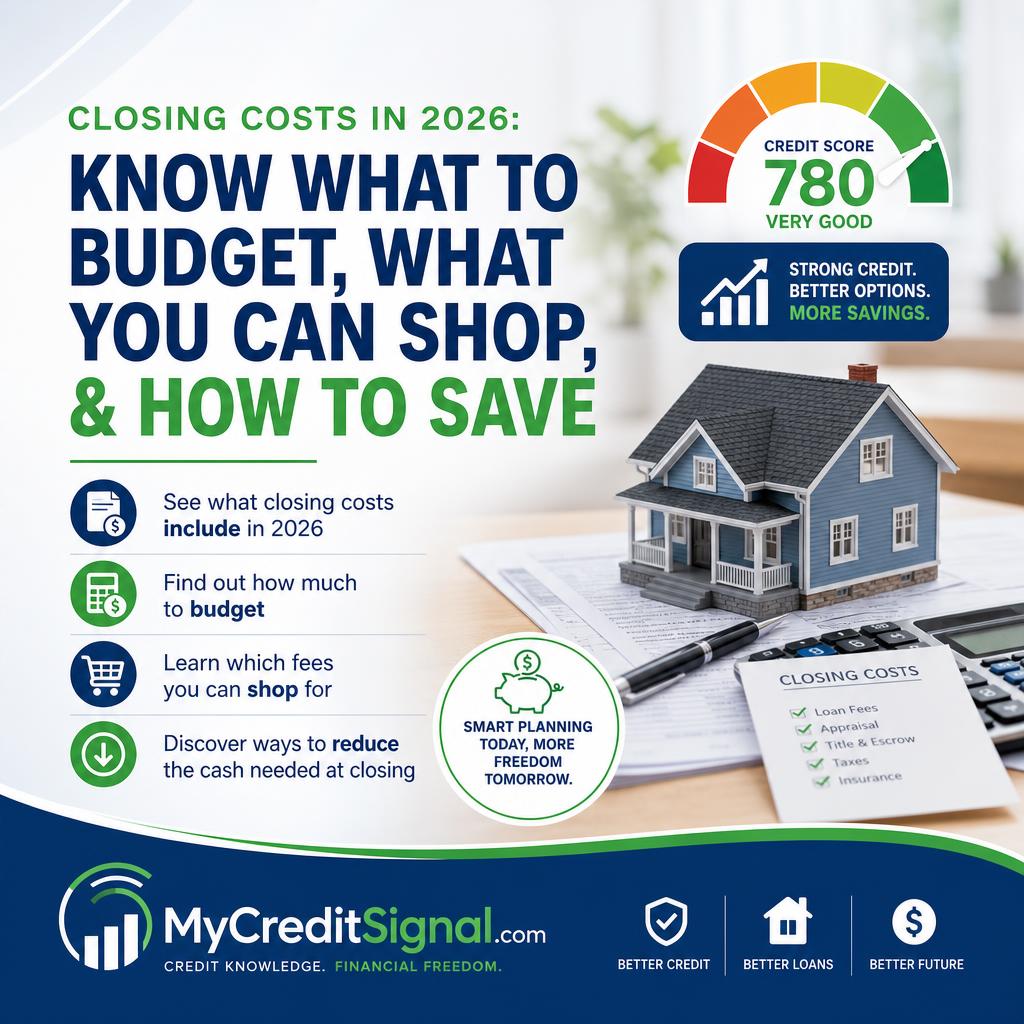
A home priced at $300,000 can require more than the down payment: typical closing costs may add $6,000 to $15,000 before you receive the keys. Closing costs in 2026 are the fees and prepaid items required to complete a mortgage and home purchase, and they are separate from the down payment. This guide is for buyers building a realistic cash-to-close number, comparing lenders, or deciding whether seller help and lender credits are worth considering.
You will learn what the charges mean, how to estimate them before choosing a lender, which costs may be negotiable, and what to check on the final Closing Disclosure. The goal is not simply to find a percentage; it is to know which dollars are unavoidable, which may change, and when each payment is due.
Contents
- 1 Who needs to plan for closing costs in 2026?
- 2 What are closing costs when buying a home?
- 3 How much are closing costs in 2026?
- 4 Which costs can you compare or negotiate?
- 5 Should you pay points in 2026?
- 6 What does the Closing Disclosure tell you?
- 7 How can you estimate closing costs before choosing a lender?
- 8 A five-action plan for this week
- 9 Three closing-cost mistakes that can disrupt a purchase
- 10 What closing-cost advice can miss
- 11 Closing costs 2026 questions buyers ask
- 12 Helpful tools for your home-buying budget
- 13 Make your cash-to-close number specific
Key Takeaway
Budget 2% to 5% of the purchase price for closing costs beyond the down payment, then verify every charge against your Loan Estimate and Closing Disclosure.
Who needs to plan for closing costs in 2026?
Anyone financing a home purchase should plan for closing costs, including first-time buyers, repeat buyers, people refinancing into a purchase loan, and buyers using assistance programs. The costs can affect whether your offer is affordable even when the monthly mortgage payment looks manageable.
Buyers with limited savings need the most detailed plan because the down payment is only one part of cash to close. Buyers selling another home may have equity available, but sale proceeds might not arrive before the new purchase closes. A buyer receiving a gift, grant, or seller contribution also needs to confirm how the funds can be used under the loan rules.
This general estimate is not a substitute for a lender’s quote. Costs vary by location, purchase price, loan terms, property type, lender, and the services selected. A cash buyer may avoid mortgage-specific charges but still face title, recording, escrow, tax, insurance, and other transaction costs.
What are closing costs when buying a home?
Closing costs are the fees charged to finalize a home purchase, plus certain prepaid items collected at closing. The Consumer Financial Protection Bureau explains that these can include lender origination charges, points, title and escrow fees, recording charges, property taxes, and homeowners insurance.
Loan costs
Loan costs may include the lender’s underwriting, origination, processing, or other charges. Discount points are prepaid interest used to obtain a lower mortgage rate. One point equals 1% of the loan amount, so the dollar amount depends on the amount borrowed rather than the home’s purchase price.
Title, settlement, and recording costs
Title services help establish and insure ownership. Escrow or settlement services coordinate the transaction and funds. Recording charges pay for putting the deed or mortgage documents into public records. Some of these services may be selected or compared by the buyer, while others may be controlled by the lender or local process.
Prepaid items and initial escrow
Prepaid items are not always lender profit. They can include property taxes, homeowners insurance, and interest collected for the period between closing and the first regular payment. Initial escrow funds may be deposited so the servicer can pay future taxes or insurance bills. These amounts can make cash to close larger even though they cover future obligations.
How much are closing costs in 2026?
The CFPB’s planning guidance puts typical closing costs, excluding the down payment, at 2% to 5% of the home purchase price. On a $300,000 purchase, that range produces an initial estimate of $6,000 to $15,000. It is a planning range, not a guaranteed quote.
Some industry reports cite a national average total purchase-mortgage closing cost of $4,528 and an average of 1.04% of the home sale price for the 2025 to 2026 horizon. That data is not an official government statistic, and an average should not replace a property-specific estimate. A low-cost transaction can fall below the CFPB planning range, while a transaction with points, large prepaid balances, higher-priced services, or location-specific charges can be higher.
Use this simple formula first: purchase price multiplied by 0.02 through 0.05 equals a starting closing-cost range. Then add the down payment separately. Finally, adjust the estimate after reviewing the lender’s Loan Estimate and comparing the projected cash to close.
Which costs can you compare or negotiate?
Many closing costs are not fixed, even though buyers often treat the entire bill as unavoidable. Compare lender fees, title and settlement services where permitted, homeowners insurance, and some third-party services. Ask whether a fee is required, whether the provider is lender-selected, and whether another provider can be used.
Compare Loan Estimates from multiple lenders using the same purchase price, down payment, loan type, rate assumption, and points assumption. A lender offering a lower rate may charge more points or lender fees. A lender offering low upfront fees may provide a higher rate or different monthly payment. The useful comparison is total cost and cash required, not one attractive line item.
Seller concessions are another possible way to reduce the buyer’s upfront cash. Seller concessions are contributions toward eligible buyer closing costs or the purchase price, subject to the lender’s and investor’s rules. Freddie Mac guidance describes seller-concession limits ranging from 2% to 9% of property value in certain loans and terms. The exact limit depends on the transaction, occupancy, financing, and other requirements, so obtain approval before relying on a proposed credit.
Lender credits may also reduce upfront costs, usually in exchange for accepting a higher interest rate or different loan pricing. This can help a buyer who needs to preserve cash, but it may cost more over time. Treat seller concessions and lender credits as tools to evaluate, not automatic savings.
Should you pay points in 2026?
Paying points may make sense when the lower monthly interest cost is likely to justify the higher upfront payment during the time you expect to keep the loan. Points are prepaid interest, and each point equals 1% of the loan amount. The IRS generally treats points as deductible over the life of the loan rather than all at closing in most cases; tax treatment depends on the facts, so review current IRS guidance on mortgage points or ask a tax professional.
Use a break-even comparison before deciding. Divide the extra upfront cost of points by the estimated monthly payment reduction. The result is the approximate number of months needed to recover the cost, before considering taxes, refinancing, selling, or changes in the loan. For example, if points cost more upfront and lower the payment, compare that extra cost with the monthly difference rather than assuming a lower rate automatically wins.
Paying points may be a poor fit if you expect to move or refinance soon, need every dollar for reserves, or cannot comfortably cover the higher cash-to-close amount. It may be more reasonable for a buyer planning a long stay who has adequate emergency savings. Ask the lender for two written versions of the Loan Estimate, one with points and one without, then compare the rate, cash needed, payment, and projected cost over your expected timeline.
What does the Closing Disclosure tell you?
The Closing Disclosure, often called the CD, is the official final document summarizing the loan terms, projected monthly payments, and total closing costs due at closing. Read it against the earlier Loan Estimate instead of treating it as a form to sign quickly.
Check the loan amount, interest rate, projected payment, points, lender charges, services you can and cannot shop for, taxes, insurance, credits, and cash to close. Look for a charge that changed without an explanation, a credit that disappeared, or prepaid amounts that do not match the latest insurance and tax information. Ask the lender or settlement agent about differences immediately; a question is easier to resolve before closing than after funds are transferred.
How can you estimate closing costs before choosing a lender?
Start with the 2% to 5% planning range, but replace it with documented estimates as soon as possible. Give each lender identical information and request a Loan Estimate. If the purchase price, down payment, or points assumption changes between lenders, the comparison is not reliable.
For a purchase price of $300,000, first create a $6,000 to $15,000 closing-cost reserve. Add the intended down payment, moving expenses, inspection or other transaction costs not shown in the lender’s estimate, and a cash reserve you do not plan to spend. Then test the plan with the lender’s actual cash-to-close figure. Keep a written list of what is included so you do not count the same money twice.
Use the mortgage payment calculator to test payment scenarios, including how the rate and loan amount affect the monthly obligation. For the full household cash-flow picture, the paycheck budget allocator can help you assign income to housing, bills, savings, and other expenses before you commit to a purchase price.
A five-action plan for this week
Write down your complete cash target
Multiply the target purchase price by 2% and 5% to create a first-pass closing-cost range. Keep the down payment in a separate line and add a reserve that you do not intend to use for closing.
Request comparable Loan Estimates
Ask more than one lender for estimates based on the same purchase price, down payment, loan type, rate structure, and points choice. Save each version so you can compare line by line.
Mark fees you may be able to shop
Review the services section and ask which providers you can select. Request written quotes for eligible title, settlement, insurance, or other services rather than accepting the first price automatically.
Ask about credits in writing
Ask the lender whether a lender credit changes the rate, and ask the real estate professional whether a seller concession is permitted for your loan. Do not assume a proposed credit is usable until the lender confirms its limits and eligible expenses.
Audit the Closing Disclosure
When the CD arrives, compare it with the Loan Estimate. Verify the rate, payment, points, credits, prepaid items, total closing costs, and cash to close. Send questions to the lender and settlement agent before signing.
Decide in this order: first confirm that the total cash requirement fits your available funds; next compare lenders and services; then evaluate points, credits, and other tradeoffs. Do not spend time optimizing a small fee until you know the transaction is affordable and the major loan terms are acceptable.
Three closing-cost mistakes that can disrupt a purchase
Budgeting only for the down payment
Behavior: The buyer calculates the down payment and assumes the remaining savings are available for moving or furnishings. Consequence: Closing costs and prepaid items create a cash shortage shortly before signing. Fix: Add a separate 2% to 5% closing-cost estimate at the beginning and update it with the Loan Estimate.
Choosing a lender by rate alone
Behavior: The buyer selects the lowest advertised rate without checking points, lender charges, credits, or cash to close. Consequence: The lower rate may require more money upfront or a higher total cost over the expected loan period. Fix: Compare matching Loan Estimates and calculate the points break-even period.
Waiting until closing to read the CD
Behavior: The buyer opens the final disclosure at the signing appointment. Consequence: An unfamiliar fee, missing credit, or changed prepaid amount creates last-minute confusion and possible delay. Fix: Review the CD as soon as it is available and ask questions before the appointment.
What closing-cost advice can miss
The 2% to 5% range is useful for planning, but it is not a promise. A buyer’s actual number can be affected by the home’s price, local taxes, insurance requirements, lender pricing, points, title arrangements, loan program, and whether the seller or lender provides an allowed credit.
Prepaid taxes and insurance can make two otherwise similar purchases require different amounts at closing. These payments may feel like fees because they are due with the transaction, but they are funding future bills. Ask the settlement agent to separate lender charges, third-party services, recording charges, prepaid items, and escrow deposits.
Tax treatment also requires care. Some home-purchase costs can affect cost basis, which is the starting amount used to calculate gain when a property is sold. The IRS describes basis adjustments and homebuying tax considerations in Publication 530. Keep the Closing Disclosure, settlement statement if provided, invoices, and records of qualifying improvements, and ask a tax professional how the rules apply to your situation.
This guide also does not determine which loan type is best for you. Conventional, FHA, VA, and other financing options can have different charges, eligibility rules, and limits on contributions. Compare the complete offer with a licensed lender, especially if you plan to use assistance, seller concessions, or a large lender credit.
Closing costs 2026 questions buyers ask
What are typical closing costs when buying a home in 2026?
Typical closing costs excluding the down payment are generally estimated at 2% to 5% of the purchase price. The final amount depends on the lender, location, services, points, taxes, insurance, and credits.
Can a seller help pay closing costs?
A seller may contribute toward eligible buyer closing costs through a seller concession, but the amount and permitted uses are controlled by the loan program, lender, investor, property value, and transaction terms. Get confirmation before counting on the contribution.
Are mortgage points worth paying?
Points can be worthwhile when the lower payment recovers the upfront cost during the period you expect to keep the loan. Compare written estimates with and without points, calculate the break-even period, and consider whether paying more upfront would weaken your cash reserves.
Helpful tools for your home-buying budget
Use the mortgage payment calculator to compare payment scenarios, then use the paycheck budget allocator to see how the proposed housing cost fits your cash flow. Before applying, the DTI and borrowing power checklist can help you organize the income and debt information lenders commonly evaluate. If closing would leave you without a cushion, review this emergency fund budget plan before deciding how much cash to commit.
Get weekly credit tips, tool updates, and practical guides – free.
Make your cash-to-close number specific
Closing costs in 2026 are best handled as a planning exercise, not a surprise at the signing table. Begin with 2% to 5% of the purchase price, separate those costs from the down payment, compare matching Loan Estimates, and verify the final figures on the Closing Disclosure.
Your next step is simple: write down the purchase price you are considering, calculate the planning range, and request a lender estimate that itemizes the actual charges. That process gives you a clearer affordability picture and creates time to compare services, evaluate credits, and protect the cash you need after the keys are yours.
Want to understand your credit report?
Get plain-English explanations with our free AI Credit Analyzer →
Leave a Reply
You must be logged in to post a comment.