
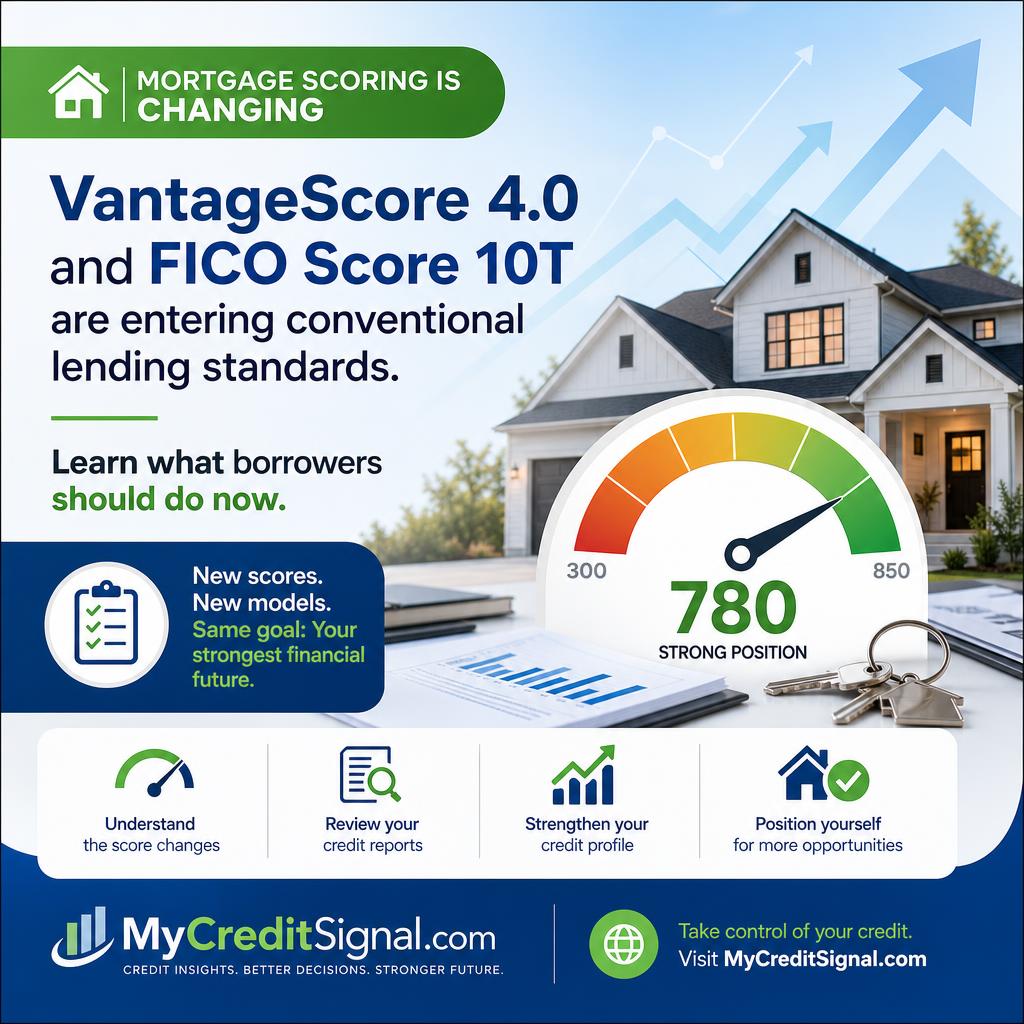
A mortgage applicant can prepare carefully, pay every bill on time, and still see a different score from the number shown in a consumer app. That is because lenders use specific scoring models for specific products, and conventional mortgage scoring is entering a modernization phase. Fannie Mae and Freddie Mac are moving toward accepting VantageScore 4.0 and FICO Score 10T alongside Classic FICO for applicable conventional loans, but the transition will be phased and lender procedures will vary.
This guide explains what VantageScore 4.0 means for mortgage borrowers, how FICO Score 10T and BNPL data fit into the change, and what you can do this week to make your credit profile easier to evaluate. It is for prospective homebuyers who want to prepare without chasing an exact score that may not be the model used for their loan.
Contents
- 1 Who should pay attention to mortgage score modernization?
- 2 What is VantageScore 4.0 for mortgage lending?
- 3 How do FICO Score 10T and BNPL data change the picture?
- 4 Which numbers matter before a mortgage application?
- 5 What should you do first and what can wait?
- 6 A five-step mortgage credit preparation plan
- 7 Mortgage scoring mistakes that can backfire
- 8 What does the transition leave unresolved?
- 9 Frequently asked questions about VantageScore 4.0 mortgages
- 10 Free tools and resources for your next move
- 11 The practical takeaway for homebuyers
Key Takeaway
Mortgage scoring is becoming more flexible, not uniform: focus first on accurate account information, consistent payments, manageable balances, and asking your lender which model and requirements apply to your loan.
Who should pay attention to mortgage score modernization?
Mortgage score modernization matters most to people planning to apply for a conventional mortgage, especially first-time buyers, borrowers with thin credit histories, and consumers who use newer forms of credit such as buy now, pay later products.
It also matters if your consumer score and a score shown by a lender do not match. Different models can weigh the same credit information differently. A VantageScore 4.0 number is not automatically interchangeable with a Classic FICO or FICO Score 10T number, and no single score guarantees approval, pricing, or a specific down-payment requirement.
Borrowers applying for products outside conventional mortgage delivery may need a different plan. Government-backed, portfolio, construction, investment, and other loans can have separate rules. Your lender or loan officer is the right source for the model currently used in your application.
What is VantageScore 4.0 for mortgage lending?
VantageScore 4.0 is a modern credit-scoring model developed by VantageScore that uses consumer credit data to estimate credit risk. Under current modernization efforts, Fannie Mae announced that VantageScore 4.0 could be used immediately for loans delivered to Fannie Mae, while FICO Score 10T is planned for future use.
Freddie Mac also published an April 2026 bulletin confirming VantageScore 4.0 and FICO Score 10T in its standards, alongside Classic FICO for certain loans. The Federal Housing Finance Agency describes this as an ongoing process rather than a complete replacement of every existing score.
That distinction is important. A lender may still use Classic FICO for a particular loan, may be preparing systems for a newer model, or may have additional underwriting requirements beyond the score itself. The practical borrower question is not “Which score is the one true score?” It is “Which model will be used for this application, and what other factors will the lender evaluate?”
For background on how credit monitoring fits into a larger preparation routine, use this guide to monitoring your credit reports. Monitoring can help you understand the data behind your scores, but it does not reproduce every lender score.
How do FICO Score 10T and BNPL data change the picture?
FICO Score 10T is a FICO model that uses trended data, meaning it can consider historical patterns in credit behavior rather than relying only on a single point-in-time snapshot. A borrower who regularly pays down revolving balances may be evaluated differently from someone whose balances repeatedly rise, even if both profiles look similar on one reporting date.
BNPL means buy now, pay later. It allows a purchase to be divided into payments over time, and some BNPL activity can be reported to credit bureaus and considered by scoring models. FICO launched FICO Score 10 BNPL and FICO Score 10T BNPL variants in 2025 to incorporate BNPL payment behavior into credit risk assessment.
BNPL data is not automatically beneficial. A history of on-time payments may provide useful information, while missed payments, frequent obligations, or a high total payment burden could create risk under a model that sees that information. The effect depends on the data reported, the model used, and the rest of the borrower’s profile.
Which numbers matter before a mortgage application?
The most important numbers are the ones your lender actually uses: the applicable score model, reported balances, monthly debt obligations, income, and loan-specific underwriting requirements. Publicly discussed averages, such as an industry-estimated VantageScore 4.0 average of 702, are context rather than a universal approval cutoff.
Start with a simple balance calculation. If a credit card has a $2,000 limit and a $600 reported balance, its utilization is 30% because $600 divided by $2,000 equals 0.30. If the reported balance rises to $1,200, utilization becomes 60%. This calculation describes the balance reported relative to the limit; it is not a guaranteed mortgage threshold.
Timing can matter because card issuers may report balances at different points in the billing cycle. Paying before a statement closes may cause a lower balance to be reported, but borrowers should not drain money needed for rent, emergency savings, closing costs, or scheduled debt payments simply to improve a snapshot.
Also distinguish credit score from debt-to-income analysis. A score summarizes credit risk under a particular model. Debt-to-income analysis compares qualifying monthly debt obligations with qualifying income. A stronger score cannot erase an unaffordable payment, and a higher income does not eliminate the importance of payment history.
Mortgage scoring access costs can also change for lenders. Experian announced a VantageScore 4.0 mortgage origination pricing option as low as $0.99 in 2026. That announcement concerns lender access and origination economics, not a fee every borrower must automatically pay.
What should you do first and what can wait?
Do the actions that protect your profile first, then address optimization. Payment consistency and cash-flow stability come before trying to manipulate a score close to an application date. New accounts, large purchases, and unnecessary credit applications can wait until you understand how they may affect your loan timeline.
- Do first: keep every account current, review obligations, and build a realistic housing budget.
- Do next: lower balances you can safely reduce and stop relying on new credit for routine expenses.
- Do later: compare lenders, ask about scoring models, and evaluate whether a particular loan type fits your finances.
For a broader view of the costs beyond the score, read this cost of homeownership guide. A mortgage decision should include taxes, insurance, maintenance, utilities, and other ownership expenses rather than focusing only on approval.
A five-step mortgage credit preparation plan
Identify your likely loan path
Write down whether you are considering a conventional mortgage or another loan type, your expected application window, and the lender questions you need answered. Ask directly which credit-score models are currently used for prequalification, underwriting, and delivery. Do not assume the score in a free app is the score pulled for the loan.
Build a payment-control system
List each minimum payment, due date, balance, and account. Set autopay for at least the minimum when your cash flow allows, then use reminders for extra payments. The goal this week is not perfection; it is reducing the chance that a missed due date disrupts an otherwise healthy profile.
Record reported card balances
For each revolving account, record the credit limit and the balance shown on the latest statement. Calculate utilization as balance divided by limit. If you plan to pay balances down, choose an amount that does not interfere with essential bills, cash reserves, or expected home-purchase costs.
Review newer credit obligations
Make a list of BNPL plans, personal loans, cards, and other recurring debts. Note the monthly payment and remaining obligation for each. Do not open new BNPL plans or credit accounts just to create activity; the potential benefit is uncertain, while the payment obligation is real.
Compare lenders before applying widely
Prepare the same questions for each lender: Which model is used? Which balances and debts are included? What documentation is needed? How long is the preapproval valid? Comparing answers helps you avoid applying blindly and gives you a clearer picture of how modernization affects your situation.
Track progress without score panic
Check your budget and account status on a regular schedule rather than reacting to every score movement. Results can vary by credit profile, bureau data, reporting date, and scoring model. A change in one consumer score does not necessarily predict the exact change in a mortgage score.
Mortgage scoring mistakes that can backfire
Chasing one score as if it controls every loan
Behavior: You treat one app’s score as a guaranteed mortgage result. Consequence: A different model or bureau may produce a different number and create confusion during underwriting. Fix: Ask the lender which model applies and use consumer scores as directional information.
Opening accounts to create a stronger profile quickly
Behavior: You open several cards or BNPL plans shortly before applying. Consequence: New obligations, inquiries, or changing balances may complicate your application. Fix: Stabilize existing accounts first and discuss any major credit change with your loan professional.
Paying down cards with money needed for closing
Behavior: You use emergency savings to reduce a reported balance. Consequence: You may improve a snapshot while weakening your ability to handle closing costs or unexpected expenses. Fix: Balance utilization goals against cash reserves and the complete home-purchase budget.
Assuming BNPL payments are invisible or always helpful
Behavior: You take on several installment plans because each payment appears small. Consequence: A lender may consider the recurring obligations, and BNPL-inclusive models may evaluate reported behavior. Fix: Count every payment in your budget and use BNPL only when the full repayment plan is affordable.
What does the transition leave unresolved?
The modernization effort does not make all credit reports and scores identical. Different lenders and products can use different models, and the same consumer can receive different results because the underlying bureau data, update dates, and model formulas differ.
It also does not create a public score threshold that guarantees mortgage eligibility. Underwriting includes more than a score, and lender standards can vary. First-time buyers should avoid delaying a realistic conversation with a lender because they are waiting for one particular model to become available.
Historical comparison data is another part of the transition. FHFA expects historical VantageScore 4.0 and FICO 10T data for loans acquired from 2013 through 2025 to be published or cited as part of modernization work, with the research and publication process extending into Summer 2026. Historical data can help lenders compare models, but it will not tell an individual borrower exactly how an application will be decided.
Frequently asked questions about VantageScore 4.0 mortgages
Will VantageScore 4.0 replace FICO scores for all mortgages?
No. Fannie Mae and Freddie Mac are supporting VantageScore 4.0 and FICO Score 10T as part of modernization, while Classic FICO remains relevant for certain loans. Lender and loan-specific implementation can vary.
Does BNPL data guarantee a better mortgage score?
No. BNPL-inclusive models are designed to evaluate reported BNPL payment behavior, but the effect can be positive, negative, or limited depending on payment history, obligations, reporting, and the rest of the credit profile.
Should I wait to buy a home until new scoring models are common?
Usually, you should not make a major timing decision based only on a model transition. Review your budget, payment history, debts, cash reserves, and lender requirements, then compare realistic loan options.
Free tools and resources for your next move
Use free resources to turn score information into a practical plan. My Credit Signal’s comparison of free credit help tools can help you choose calculators, monitoring resources, and educational tools without assuming that one score tells the whole story.
If your credit history needs a longer reset, this credit rebuilding checklist provides a structured routine for payment priorities, utilization management, and credit-building habits. The free tools remain the best place to start for tracking decisions and building consistency.
Readers who want a plan tailored to their exact situation can also consider the optional personalized Credit Signal Action Plan, a $15 one-time 90-day credit plan with a custom PDF plus tools. It is not required, and the free tools remain free.
Get weekly credit tips, tool updates, and practical guides – free.
The practical takeaway for homebuyers
VantageScore 4.0, FICO Score 10T, and BNPL-inclusive variants are expanding the mortgage scoring conversation, but borrowers do not need to predict every model change. The strongest preparation is model-agnostic: pay on time, understand reported balances, limit unnecessary new obligations, protect cash reserves, and ask lenders clear questions before applying.
Start this week by listing your accounts and monthly debts, calculating your current revolving utilization, checking your budget for a future housing payment, and writing down the scoring-model questions you will ask a lender. That gives you a more useful advantage than chasing a number that may not be the one used in your application.



Want to understand your credit report?
Get plain-English explanations with our free AI Credit Analyzer →
Leave a Reply
You must be logged in to post a comment.