
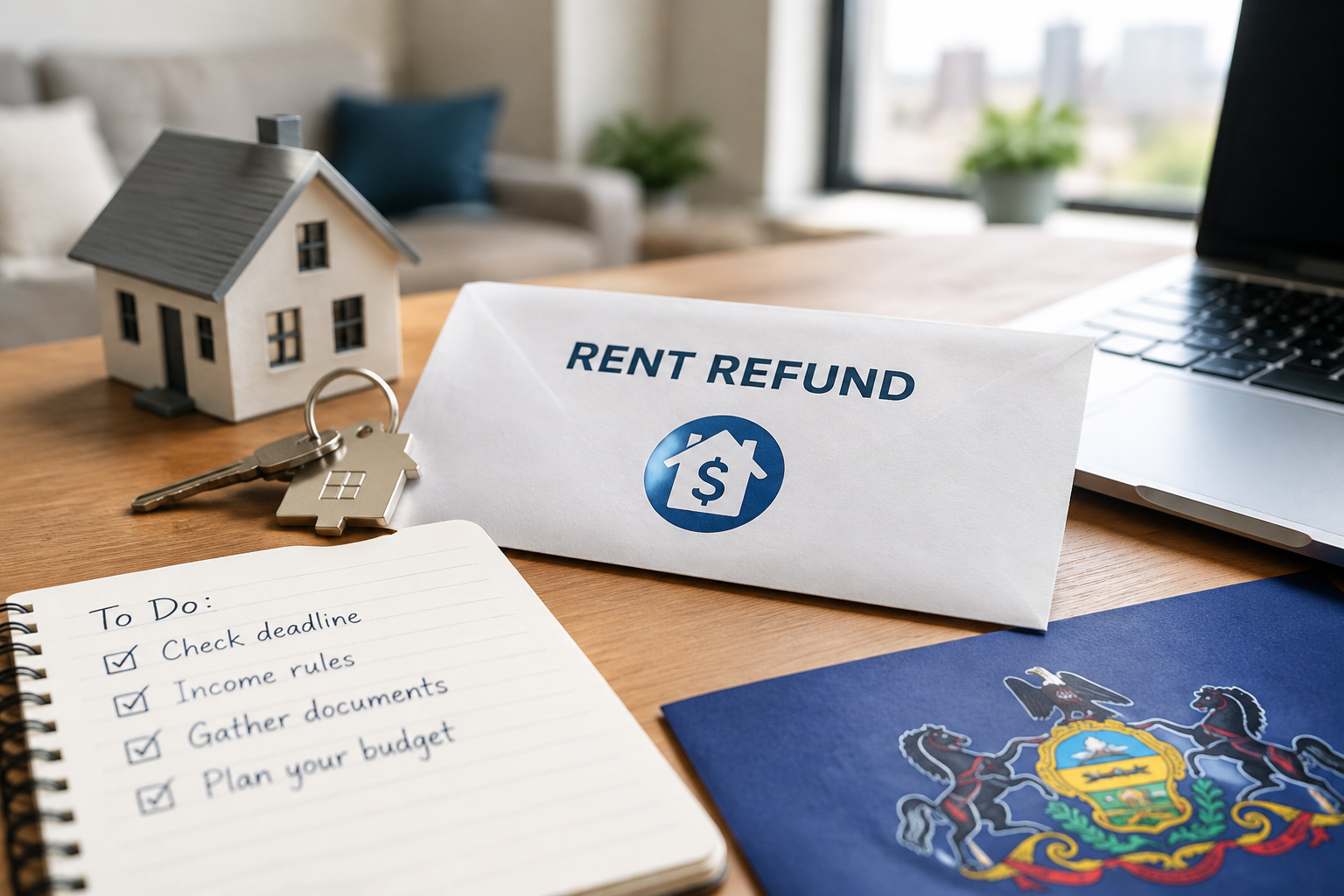
Missing a rebate application can mean leaving help with housing costs unclaimed. Eligible Pennsylvania renters can apply for a rebate on rent paid in 2025 through December 31, 2026, with a maximum standard benefit of $1,000 under the Pennsylvania Property Tax/Rent Rebate Program. Start by checking eligibility and gathering rent documentation, then decide how any approved payment could strengthen your budget.
This guide focuses on renters and the family members helping them apply. The goal is to make the application manageable without treating an expected rebate as money already available to spend.
Contents
- 1 Who should check Pennsylvania rent rebate eligibility?
- 2 Which rent year and deadline apply now?
- 3 How much could your rent rebate be?
- 4 What should you do before spending a rebate?
- 5 Your application work plan for this week
- 6 Application and budgeting mistakes to avoid
- 7 Rental situations that need an extra check
- 8 Questions renters ask before filing
- 9 Helpful resources for your rebate budget
- 10 Start with the paperwork you do not have yet
Key Takeaway
Check eligibility before ruling yourself out, document the rent you paid, and give any approved rebate a specific job in your budget.
Who should check Pennsylvania rent rebate eligibility?
Start with renters who meet the program’s age or disability requirements and whose annual eligibility income does not exceed $48,110. The state lists adults age 65 and older, widows and widowers age 50 and older, and people with disabilities age 18 and older among the eligible groups. See the Department of Revenue’s eligibility overview.
The application uses your status as of December 31, 2025, and requires permanent disability for the disability category. It also includes a filing category for someone younger than 65 whose spouse was at least 65 and lived in the same household. These details appear in the official PA-1000 instructions.
If you do not fit those categories, do not build your spending plan around this rebate. Instead, identify the bill creating the most pressure and ask the relevant provider or local assistance office about other options.
If you might qualify but have no savings cushion, consider reading our guide to starting an emergency fund with no savings while you gather paperwork. Keep the application task separate from the decision about how to use the money.
Which rent year and deadline apply now?
The current application covers rent paid in 2025, and the filing deadline is December 31, 2026. Verified as of October 6, 2026: the state’s current application page confirms that deadline.
Write the claim year on your document folder. That simple distinction helps you avoid mixing recent rent payments with the expenses covered by the application.
My recommendation is to start with the document that depends on someone else, such as your landlord’s certification. Do not leave that request until everything else is finished. Keep a note of when you asked, whom you contacted, and what remains outstanding.
How much could your rent rebate be?
Your standard rebate depends on both eligibility income and eligible rent paid, not just the advertised maximum. The official program schedule lists these income bands and maximum standard payments:
- $0–$8,550: up to $1,000.
- $8,551–$16,040: up to $770.
- $16,041–$19,240: up to $460.
- $19,241–$48,110: up to $380.
For renters, the calculation generally takes the smaller of 20% of eligible rent paid or the income-band maximum. Applicants can exclude half their Social Security income, but must include a spouse’s applicable income while living together. Follow the income categories and rent adjustments in the PA-1000 calculation instructions, rather than substituting take-home pay.
A worked example using the published rules
Suppose an otherwise eligible renter has $8,550 in eligibility income and $5,000 in eligible rent paid. Applying the state’s formula gives $5,000 × 20% = $1,000, matching that income band’s cap. This is an illustrative calculation using the published rent-rebate formula, not an approval prediction.
For your own estimate, label the result “potential rebate.” Beside it, list any unresolved questions about income, rent documentation, or household circumstances. Do not erase that label until you have the state’s decision.
What should you do before spending a rebate?
Handle the application first; make spending commitments only after you know what money is actually available. I suggest using an essentials, cushion, then extra payments framework instead of choosing a spending percentage in advance.
First, protect the next round of essential bills
Make a list of housing, utilities, food, transportation, insurance, and required debt payments due before your next reliable income arrives. Mark what your existing cash already covers. The uncovered items are the first candidates for any rebate that arrives.
If you are already short, contact the biller now. Ask what arrangements are available without promising a payment date based on an application you have not completed or a rebate you have not received.
Next, decide whether to keep cash or reduce debt
After essentials are covered, identify the expense most likely to send you back to a credit card. Consider reserving money for that need before making an extra debt payment. Our saving versus paying debt decision guide can help you weigh that choice.
Use a simple planning formula: available rebate minus uncovered essentials minus your chosen cash reserve equals the amount available for other goals. This is a budgeting recommendation, not a program requirement.
Keep the rebate out of your recurring-income total. Build ordinary monthly commitments around income you can reliably expect, and treat this payment as a separate opportunity to reduce a specific pressure point.
Your application work plan for this week
Organize the work around documents, questions, and submission. You do not need to solve every financial problem before starting; you need a clear record of what the application requires and what you have already completed.
Create a claim folder
Set aside a secure paper folder or digital location for the application. Separate income records, rent records, identity or eligibility documents, and correspondence. Use descriptive filenames so a helper can find the right document without opening everything.
Check the documentation list
The state’s application checklist calls for income documentation and the PA-1000 RC rent certificate for renters, plus proof of age and/or permanent disability for first-time filers as applicable. Compare that list against your folder and write down what is missing before contacting anyone.
Request the rent certificate
Contact your landlord or property manager and explain which claim year you are documenting. Ask who handles rebate certificates and how you should deliver the form. Review the returned document against your own records before adding it to the application packet.
Make an income inventory
Gather benefit statements, retirement statements, wage records, and other relevant income documents. Put uncertain items on a question list instead of guessing. If someone is helping you, ask them to explain how each item is treated before the application is submitted.
Choose online, mail, or in-person help
You can apply through myPATH, submit a paper application, or seek in-person assistance. For paper applications, sign the form and do not staple the documents; call ahead if arranging an appointment. The official filing-options page provides the application routes and contact information.
Save a record and assign a follow-up task
Keep a copy of what you submitted and any confirmation provided. Record the submission date in your calendar. If additional information is requested, put that request in the same folder and make responding your next application task, rather than starting a new, disconnected set of notes.
Before closing the folder, review your payment and mailing details carefully. If a family member is helping, agree on who will check correspondence so neither person assumes the other is handling it.
Application and budgeting mistakes to avoid
Rejecting yourself without reviewing the income rules
Behavior: Comparing a bank-deposit total with the eligibility limit. Consequence: You may abandon the application before completing the correct calculation. Fix: Work through the program’s income categories with your statements beside you, and ask for help on unfamiliar items.
Planning purchases around the maximum
Behavior: Choosing purchases before establishing your likely benefit. Consequence: Your spending plan may exceed the payment you receive. Fix: Keep a wish list separate from committed spending, and prioritize essentials when the actual amount is known.
Sending every available dollar to debt immediately
Behavior: Making an extra payment without checking upcoming bills. Consequence: You may leave yourself without cash for the next essential expense. Fix: Review your bill calendar and reserve what you need before choosing an extra payment.
A useful final check is to ask: “What would I do if this payment were smaller or arrived later than I hoped?” If the answer involves borrowing for groceries or rent, revise the plan before committing the money.
Rental situations that need an extra check
Do not assume every lease has the same treatment. Ask for application help when your housing arrangement or household changed during the claim year.
Bring a short description of your situation to the person helping you: who lived with you, what changed, and which documents show the change. Ask which schedule applies before entering the full lease amount.
If your problem is an immediate rent shortfall, pursue help for that problem separately. My recommendation is to continue the rebate application in parallel, rather than using it as your only plan for an urgent bill.
Questions renters ask before filing
Can I apply if my landlord will not sign?
A missing landlord signature does not automatically end the application. The state’s documentation guidance provides for a rent certificate with a notarized affidavit when the landlord’s signature cannot be obtained.
Do I need to apply again if I received a rebate before?
Yes. Eligible residents must submit a new application annually, according to the Department of Revenue’s program FAQ.
Where can I get help with the application?
Use the in-person assistance directory or call 1-888-222-9190 through the official application-help page. Have your document checklist and unanswered questions ready before calling.
Helpful resources for your rebate budget
After organizing the application, visit the My Credit Signal free tools hub to explore cash-flow and savings calculators. Use your regular income and current expenses first, then compare how an approved rebate could change your available cash.
Keep sensitive application documents with the state’s filing process, not in your general budgeting notes. Your spending plan only needs the amount available and the jobs you want that money to do.
- Check the program rules before deciding you cannot qualify.
- Gather outside documentation early.
- Keep expected money separate from available money.
- Cover essentials before committing to extra payments.
Get weekly credit tips, tool updates, and practical guides – free.
Start with the paperwork you do not have yet
A rebate is most useful when you complete the application carefully and decide its purpose before spending it. Your next step is concrete: create your claim folder, identify the missing document, and request it. Then build a spending plan that protects essential bills and preserves room for the next unexpected expense.



Want to understand your credit report?
Get plain-English explanations with our free AI Credit Analyzer →
Leave a Reply
You must be logged in to post a comment.