
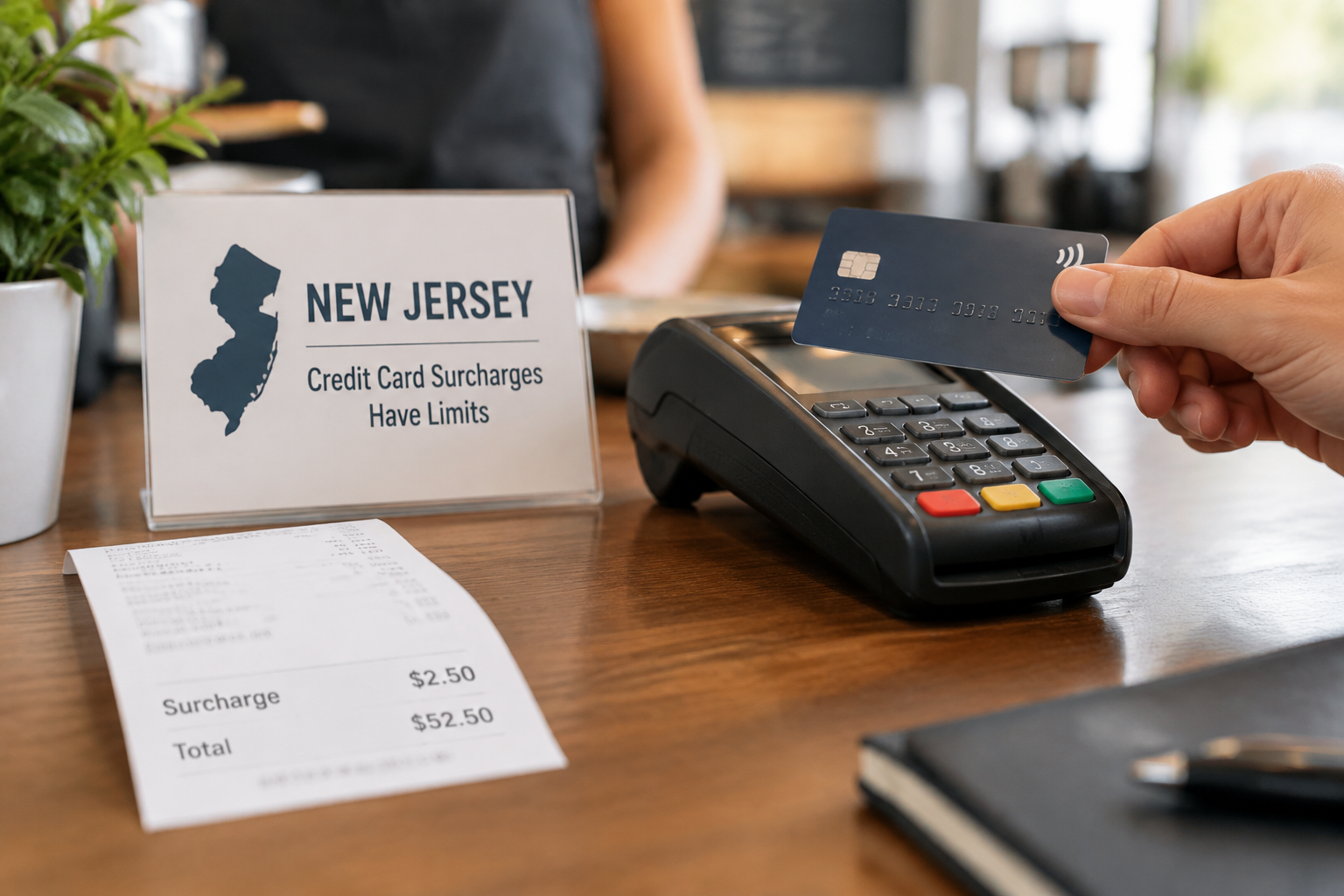
A payment fee discovered after dinner leaves little room to change your spending decision. New Jersey permits credit card surcharges, but caps them at the seller’s actual processing cost and requires advance disclosure under New Jersey’s credit card surcharge law. For residents comparing checkout totals, the practical move is to ask about the fee before ordering, then choose a payment method that fits the money available.
Contents
- 1 Who should check New Jersey credit card surcharges?
- 2 What does New Jersey require before you pay?
- 3 How much can the surcharge add to your bill?
- 4 What should you do first, and what can wait?
- 5 A checkout checklist to use this week
- 6 Mistakes that make payment fees harder to manage
- 7 What does the surcharge amount not tell you?
- 8 Questions shoppers ask about surcharge rules
- 9 Helpful resources for your next payment decision
- 10 Make the full price part of the decision
Key Takeaway
Compare the final payment totals before committing to a purchase, rather than treating the displayed price as your complete spending decision.
Who should check New Jersey credit card surcharges?
This guide is for shoppers who want to understand a merchant’s payment fee without turning every checkout into an argument. It is especially useful when planning a restaurant visit, approving a service estimate, or making a purchase large enough that a percentage-based charge deserves attention.
Use it to separate questions that are easy to blur together: What am I being charged? Was the amount explained? Is paying that amount worthwhile for me? A fee can be clearly disclosed and still be an expense you would rather avoid.
If you are already struggling to afford the underlying purchase, start there. Choosing a different payment method is not a substitute for deciding whether the purchase belongs in your budget. Likewise, this guide is not a legal determination about a particular merchant or a guide to every debit-card, government-payment, or out-of-state transaction.
For the broader borrowing decision, our guide to the real cost of financing a purchase offers a useful companion framework. Keep the checkout cost and your repayment plan on the same worksheet.
What does New Jersey require before you pay?
New Jersey requires disclosure of the surcharge amount, not merely a warning that some fee exists. The state’s credit card surcharge FAQ says a percentage can serve as that disclosure.
Rules verified as of October 6, 2026: For in-person purchases, nonrestaurant sellers must post notices at the entrance and payment location. Restaurants must provide notice in the customer service area and on the menu. These requirements are explained in the Division of Consumer Affairs’ surcharge guidance announcement.
For websites, mobile apps, and electronic kiosks, notice belongs on the checkout page before processing. Telephone transactions require verbal notice before processing. These are state requirements under P.L. 2023, chapter 146, not nationwide rules.
What should you ask before ordering?
Ask for the final total with your intended payment method before committing. A useful script is: Does this price include the credit card surcharge, and what would the total be with another accepted payment method?
At a restaurant, make the question part of ordering rather than waiting until the check arrives. For a repair or other service, ask the business to put the payment terms on the estimate. Online, pause at the final review screen and save the displayed total if you need a record.
Keep your request specific. You are trying to understand the transaction, not asking the cashier to explain the business’s entire accounting system. If the employee cannot answer, request clarification from a manager before authorizing the purchase.
How much can the surcharge add to your bill?
The dollar amount depends on the disclosed rate and the amount to which the merchant applies it. For planning, use this formula: surcharge amount = applicable purchase amount × surcharge rate expressed as a decimal.
The state’s FAQ illustrates disclosures using rates of 2% and 2.25%. Those are examples, not a universal legal ceiling or a statement about typical fees. See the official examples of surcharge disclosures.
Here is a hypothetical calculation using those example rates and an assumed $100 amount subject to the surcharge:
- At 2%: $100 × 0.02 produces a $2 surcharge.
- At 2.25%: $100 × 0.0225 produces a $2.25 surcharge.
- Total in the second example: $100 + $2.25 equals $102.25.
This illustration assumes that $100 is the entire amount subject to the fee. It does not establish how taxes, gratuities, or other charges should be treated on your particular bill. Ask the merchant which amount was used, then compare the calculation with the receipt.
For a rewards comparison, write down the actual surcharge in dollars beside the reward value you expect under your card’s terms. Do not insert an advertised maximum reward into the calculation unless it applies to that purchase. If the reward value is uncertain, leave it out rather than allowing an optimistic estimate to justify the expense.
Keep the receipt until you can compare it with the posted transaction. Our guide to reading a credit card statement can help you organize that review without confusing an individual purchase with your overall account balance.
What should you do first, and what can wait?
First establish the purchase total and whether you can afford it; investigate unclear charges before spending time optimizing rewards. That order keeps a small payment-method decision from distracting you from a larger cash-flow problem.
Use this short decision framework:
- The purchase is optional and the total exceeds your limit: Reduce the order, choose another seller, or postpone it.
- The purchase fits, but the fee is unclear: Ask for the amount and calculation before authorizing payment.
- The fee is clear and another method is cheaper: Compare the savings with your available funds and the practical value of using your card.
- You already paid and have a concern: Preserve the receipt and disclosure evidence, then request an explanation.
Avoid moving money reserved for essential bills simply to eliminate a checkout fee. Instead, consider whether delaying the purchase or choosing a less expensive option would solve the whole problem.
Later, review which businesses you use regularly. Create a short note of their payment options so the next decision is easier. The goal is a repeatable purchasing habit, not an elaborate tracking system for every small transaction.
A checkout checklist to use this week
Start with an upcoming purchase you already intend to make. These actions turn the rules into a manageable routine without requiring a new financial product or a change to your entire budget.
Find the disclosure before committing
Look at the entrance, menu, estimate, or checkout screen as appropriate. If you cannot identify the amount, ask directly. Write down the answer alongside the expected purchase price so you are not relying on memory when payment is due.
Request comparable payment totals
Ask which payment methods the business accepts and what the final charge would be for each method you are considering. Compare the same goods or services, not a card total with extras against a cash quote that leaves them out.
Check the funds behind your choice
Look at money available after scheduled essential expenses. If using a card, decide how the full purchase fits your repayment budget. If paying from your bank account, make sure the money is not already committed elsewhere.
Save a useful transaction record
Keep the itemized receipt and any written estimate. When something is unclear, save the relevant checkout screen or menu disclosure, along with the purchase date and business location. Avoid recording unnecessary personal information about employees or other customers.
Ask for a specific explanation
Describe the issue precisely: an amount you did not see disclosed, a calculation you cannot reproduce, or a total that differs from the quote. Ask the merchant to explain the difference and, where appropriate, correct the charge. Keep your request and any response together.
Escalate an unresolved concern appropriately
Prepare a brief factual summary rather than a long account of the disagreement. The Division’s consumer FAQ provides directions for obtaining a consumer complaint form. State what happened, attach relevant records, and explain the resolution you requested without assuming a particular outcome.
Mistakes that make payment fees harder to manage
Comparing percentages instead of final totals
Behavior: You focus on the surcharge rate without checking the amount being charged. Consequence: You may compare unlike prices or overlook an extra item. Fix: Ask for the final itemized total and identify the amount used in the fee calculation.
Choosing a payment method before checking your budget
Behavior: You switch methods automatically because one appears cheaper. Consequence: Your payment choice may conflict with money reserved for other obligations. Fix: Check available funds and the purchase’s timing before deciding how to pay.
Arguing without preserving the details
Behavior: You leave upset but discard the receipt or forget what the notice said. Consequence: Your follow-up request becomes harder to explain clearly. Fix: Save the relevant records, describe the exact concern, and ask for a concrete response.
What does the surcharge amount not tell you?
The rate alone does not establish whether a merchant complied with the cost limit. Under the law, the Division’s director can inspect records needed to assess compliance; the statute does not make a shopper’s estimate of processing costs the deciding evidence. See the statutory processing-cost and inspection provisions.
Also separate legal compliance from your personal buying decision. You do not need to prove a violation to decide that a purchase costs more than you want to spend. Before committing, you can ask about alternatives or shop elsewhere.
For an online seller with unclear location information, save the order confirmation and seller details rather than assuming your New Jersey mailing address settles which law applies. Present those facts when requesting guidance.
Questions shoppers ask about surcharge rules
Is a credit card surcharge required in New Jersey?
No. Sellers do not have to impose one, according to the Division of Consumer Affairs FAQ.
Can a restaurant wait until the bill to disclose its surcharge?
No. The state requires restaurant notice in the customer service area and on the menu before the customer incurs the charge, as explained in the Division’s disclosure guidance.
What should I save if I question a surcharge?
Save the itemized receipt, the disclosure you saw, and any written quote or merchant response. Include the date, location, and payment method in your notes so you can explain the concern consistently.
Helpful resources for your next payment decision
Use the free Monthly Cash Flow Calculator to review how planned spending fits alongside income and bills. Enter the total you expect to pay, including disclosed fees, rather than the advertised price alone.
You can also browse the free credit and budgeting tools library for a broader planning task. Choose a tool that answers your immediate question instead of changing several parts of your financial plan at once.
- Ask early: Find out the payment total before committing.
- Compare carefully: Use matching purchases and actual dollar amounts.
- Protect cash flow: Keep essential expenses in view when choosing how to pay.
- Keep evidence: Save clear records when something needs follow-up.
Get weekly credit tips, tool updates, and practical guides – free.
Make the full price part of the decision
A payment fee is easier to manage when you know about it before the purchase becomes a commitment. Focus on the complete total, the money available, and the records you would need if something remains unclear.
Before your next restaurant order or service booking, ask for the final price using your intended payment method. That small check gives you a better chance to choose deliberately instead of reacting at checkout.



Want to understand your credit report?
Get plain-English explanations with our free AI Credit Analyzer →
Leave a Reply
You must be logged in to post a comment.