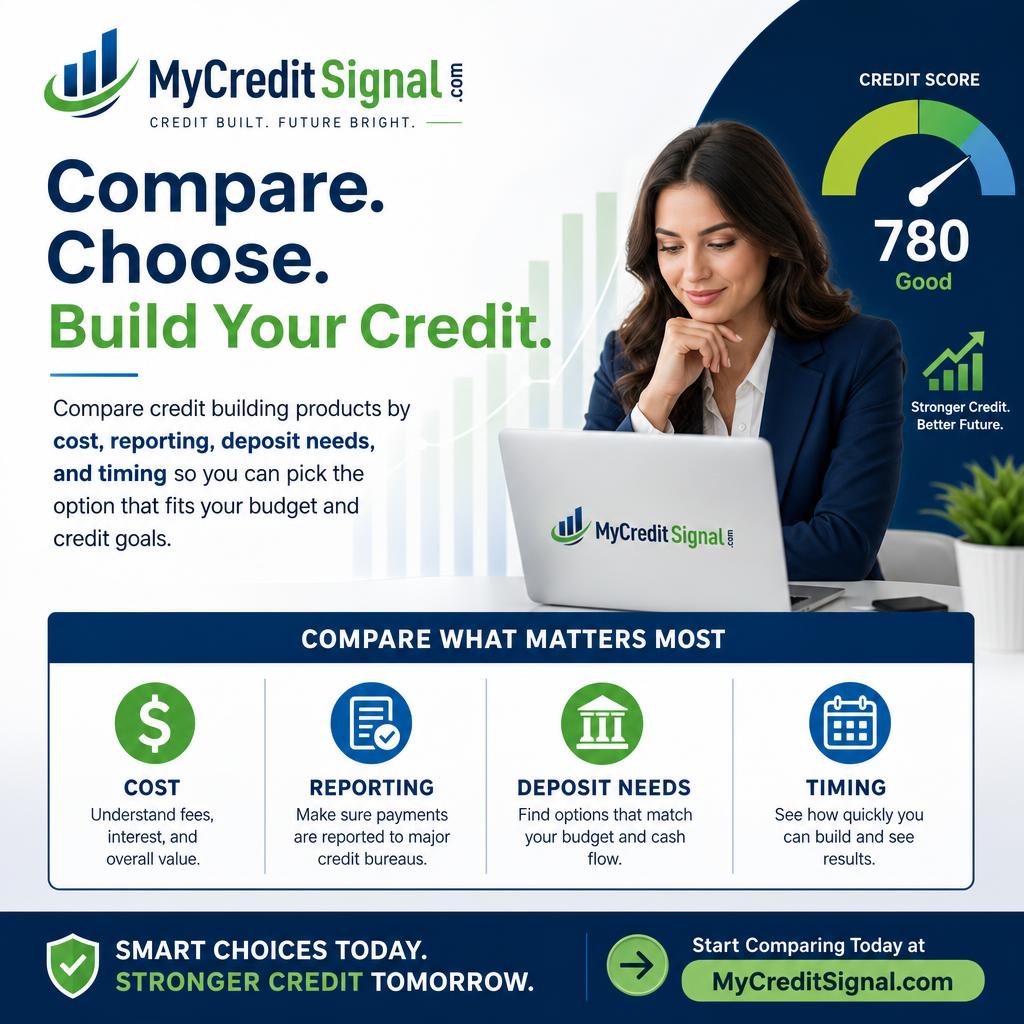
If you are trying to build credit, the wrong product can waste money for six months or longer. One option asks for a deposit but gives you flexible spending. Another locks you into fixed payments but may be easier to manage. A third may add utility or telecom payments to your profile, but the score impact is less predictable. This guide is for people with no credit, thin credit, or rebuilding credit who want to choose between credit building products without guessing. By the end, you will know what to compare, which numbers matter first, and how to pick a product that fits your cash flow instead of stressing it.
Credit-building products mainly work because lenders or program providers report your account activity to the major credit bureaus. The Federal Reserve notes that secured cards and small-dollar credit-builder loans are common tools used to help consumers establish or expand a credit history, especially among people with limited or subprime profiles. That means your choice matters, but your behavior after opening the account matters even more.
Contents
- 1 Who should compare credit building products carefully
- 2 How the main types of credit building products actually differ
- 3 The five comparison points that matter more than marketing
- 4 The numbers and thresholds worth watching
- 5 What to do first versus later
- 6 A step by step plan to choose the right product this week
- 7 Mistakes to avoid when comparing credit building products
- 8 What many comparison guides miss
- 9 FAQ
- 10 Helpful tools and related resources
- 11 Conclusion
Key Takeaway
The best credit building product is usually the one you can afford to keep open, pay on time every month, and use with low balances if it is a revolving account.
Who should compare credit building products carefully
This topic matters most if you fall into one of these groups:
- You have no score yet or a very limited file.
- You had past setbacks and now need a structured, lower-risk way to rebuild.
- You can make small monthly payments, but you cannot afford a surprise annual fee or a large deposit mistake.
- You want a product that helps you graduate to traditional credit later.
It may not be the best first move if your main issue is cash flow chaos. If you are regularly short on rent, utilities, or minimum debt payments, adding a new account can backfire. In that case, work on payment stability first and use budgeting tools before opening anything new. If you want a broader starter strategy, read these first credit card approval tips for beginners.
It also may not be the right approach if you already have open accounts but keep running high balances. For that situation, your biggest score lever may be utilization, not adding another tradeline. Review how credit utilization affects your score before applying.
How the main types of credit building products actually differ
In plain English, there are three common lanes.
Secured credit cards
You provide a refundable deposit, often equal to your credit limit. If your deposit is $200, your limit may be $200. This is a revolving account, so utilization matters. If you charge $150 on a $200 limit, you are using 75% of the limit, which is high. If you keep the statement balance around $20 on that same limit, utilization is 10%, which is much healthier.
Secured cards are often best for people who can manage spending carefully and want a product that resembles a regular card. They can also set you up for a later graduation path. If that is your goal, see how a secured to unsecured card upgrade usually works.
Credit-builder loans
Instead of borrowing a large amount upfront, you typically make fixed monthly payments into a locked account or against a small installment loan structure. Those on-time payments may be reported to the bureaus, building payment history. This format can work well for people who want a forced routine and do not want the temptation of a card balance.
Alternative payment reporting programs
These programs may add utility, telecom, rent, or similar payment data to your credit profile. The potential benefit is real, but it is less direct than a traditional tradeline. Experian discusses programs like Boost as a way for thin-file consumers to potentially improve a score with alternative payments. Still, results vary by lender, bureau, and scoring model.
That is why these products should usually be viewed as a support layer, not your whole strategy. If utilities are part of your plan, this guide on using utility bills in your credit report strategy can help you think through the tradeoffs.
The five comparison points that matter more than marketing
Most ads make the product sound simple. Your decision should come down to five filters.
1. Upfront cash requirement
A secured card may require a deposit. A builder loan may require a smaller setup cost but fixed monthly payments. If you can come up with $200 once but not comfortably make a monthly installment, a secured card may fit better. If you cannot tie up $200 but can handle a steady monthly amount, a builder loan may be easier.
2. Reporting structure
The Federal Reserve highlights that tradeline reporting is central to how these products help build credit. Ask whether the provider reports to all three major bureaus and whether it reports monthly. A low-cost product that does not report broadly may be less useful than a slightly more expensive one that does.
3. Utilization risk
This is the biggest difference between revolving and installment products. With a card, your balance can hurt you if it is too high relative to the limit. With a builder loan, there is no swipe temptation, so some people find it easier to stay consistent. If your spending tends to creep up, a card requires more discipline.
4. Total cost over 12 months
Do not focus only on the monthly price. Add every known cost: annual fee, monthly maintenance fee, interest if you may carry a balance, enrollment fee, and any required deposit you must tie up for a while. The deposit is usually refundable if the account stays in good standing, but it still affects your short-term cash.
5. Graduation potential
Some secured cards are designed to review your account for upgrade eligibility after a period of on-time payments. Some builder loans simply end when the term ends. If your goal is to move into unsecured credit, graduation policies matter.
A useful decision framework is this: pick the lowest-risk product that reports consistently and fits your weakest point. If your weak point is spending control, lean installment. If your weak point is lack of revolving history, lean secured card. If your weak point is a very thin file and you already pay utilities on time, consider adding alternative reporting as a supplement.
The numbers and thresholds worth watching
Credit scores are not one single number. A typical FICO range runs from 78 to 850, while many commonly used credit scores range from 300 to 850. Your results can vary by profile and scoring model, so focus less on a promised jump and more on the behaviors that move the file in the right direction over time.
Here are the practical thresholds to watch when choosing:
- Deposit size: If a secured card asks for more cash than you can comfortably park for several months, it may be too aggressive for your budget.
- Statement balance target: On revolving accounts, a low balance relative to the limit is usually better than a maxed card. For example, a $20 statement balance on a $200 limit equals 10% utilization. A $100 statement balance on that same card equals 50%.
- Payment streak: A clean string of on-time payments matters more than opening multiple new products fast.
- Application pace: Applying for several products in a short window can create unnecessary risk and confusion. Start with one, then review results later.
Example: suppose Maya has $250 available today and can spare $30 a month after essentials. She is choosing between a secured card with a $200 deposit and no annual fee, or a builder loan with a monthly payment she can handle but no revolving credit component. If Maya tends to overspend with cards, the builder loan may be safer. If Maya is highly organized and wants a path to an unsecured card later, the secured card may be the better fit. The better product is not the one with the flashiest app. It is the one she can manage for 6 to 12 months without a late payment.
If you want to check whether adding a new account type would actually improve your profile mix, use the credit mix analyzer. It can help you think through whether you need a new product at all.
What to do first versus later
First, solve for reliability. Later, solve for optimization.
Do first: choose one product, automate payments, keep balances low if it is a card, and verify reporting. These steps give you the biggest odds of steady progress.
Do later: worry about graduating, adding a second product, or expanding your limits. Those steps can wait until your first account is stable.
This order matters because many people sabotage progress by trying to build too fast. The Federal Reserve data shows these products are used heavily by consumers who are unscored or nonprime. That means the best strategy is usually the most durable one, not the most advanced one.
A step by step plan to choose the right product this week
List your real monthly cushion
Look at the last 30 days and write down the amount left after rent, food, transportation, insurance, and minimum debt payments. If the leftover amount is irregular, use the lower number, not the average. This tells you whether you can handle a deposit, a monthly installment, or neither right now.
Pick the account type that matches your behavior
If you spend impulsively or hate monitoring balances, lean toward a credit-builder loan. If you can treat a card like a bill payment tool and keep the statement balance low, a secured card may do more for your profile because it adds revolving history.
Verify reporting before you apply
Check whether the provider reports to the major credit bureaus and whether reporting is monthly. The FTC explains that the FCRA governs how credit information is reported and used, but consumer protection is not the same as automatic usefulness. You still need to confirm the product actually furnishes the type of data you want reported. An authoritative overview is available from the FTC.
Run a low-risk starter amount
If you choose a secured card, start with a manageable deposit rather than the maximum you can scrape together. Then set one small recurring charge and pay it automatically. If you choose a builder loan, choose the payment size that still leaves room in your budget for a bad month.
Set two reminders, not one
Create an autopay for at least the required payment and a calendar reminder a few days before the statement closes. That gives you time to lower a card balance before it reports. For extra help deciding if a secured card fits your situation, try the secured card readiness quiz.
Review after one reporting cycle, then after six months
After the first reported month, confirm the account appears correctly. After six months of clean history, decide whether you need anything else. For many people, the answer is no. One well-managed product can be enough to create forward momentum.
Add support layers only if they solve a real gap
If you already have the main account in place and you pay recurring bills on time, then consider alternative reporting or another supporting strategy. If you need ideas for building on a tight budget, read how to build credit with a low income the smart way.
Mistakes to avoid when comparing credit building products
Choosing based on approval odds alone
Behavior: You apply for the easiest approval without checking costs, reporting, or account type. Consequence: You may end up with a product that does little for your goals or becomes too expensive to keep. Fix: Compare total 12-month cost, reporting, and whether the product matches your habits before applying.
Using a secured card like extra income
Behavior: You charge most of the limit because the card is available. Consequence: High utilization can offset some of the benefit of having the account at all. Fix: Keep spending light, pay before the statement closes if needed, and treat the card as a credit tool, not a budget rescue.
Opening more than one product too fast
Behavior: You stack a secured card, a builder loan, and alternative reporting all at once. Consequence: More moving parts means more chances to miss payments or lose track of fees. Fix: Start with one anchor product, prove you can manage it, then reconsider after several months.
Ignoring consumer protections and disclosures
Behavior: You assume every provider is equally transparent. Consequence: You may miss key fee terms or reporting limits. Fix: Read disclosures and understand that the FCRA and other protections matter, but you still need to verify how the product operates. The FTC and CFPB both provide consumer guidance in this area, and the FTC also notes that debt collection and reporting practices are subject to enforcement.
What many comparison guides miss
Most articles act like every consumer has the same goal. They do not. Some people need a score from scratch. Others already have a score but need better habits. Others need a path to traditional lending later. Your choice should match the next milestone, not an abstract idea of good credit.
Another thing many articles miss is timeline realism. Positive payment history helps gradually. It does not act like an instant repair button. The strongest early wins usually come from a clean payment streak and controlled utilization, not from chasing multiple apps or expensive premium features.
For readers who want to see whether a second account type is even necessary, this article on building a better credit mix without overdoing it is worth reading before you add complexity.
FAQ
What is a credit-building product?
It is a product designed to help you establish or improve credit history, usually by reporting payment activity to the major credit bureaus. Common examples include secured credit cards and credit-builder loans.
How long does it take to see results?
There is no universal timeline. Results vary by your starting profile, the scoring model, and whether you keep payments on time and balances low. Think in terms of steady reporting over multiple months, not overnight change.
Can utility payments replace a secured card or builder loan?
Usually not by themselves. Utility or telecom reporting can be a useful supplement, especially for thin files, but a traditional tradeline is often a more direct credit-building tool.
- Secured card readiness quiz if you are deciding whether a deposit-based card fits your budget and habits.
- Credit mix analyzer if you want to know whether a new account type would actually add value.
- Secured to unsecured card upgrade guide if your long-term goal is graduating to traditional credit.
- First credit card approval tips if you are still choosing a starter card path.
- Federal Reserve overview of credit-building products for a regulator-backed explanation of how these products are used and who uses them most.
Get weekly credit tips, tool updates, and practical guides – free.
Conclusion
Choosing between credit building products gets easier when you stop asking which one is best in general and start asking which one you can manage consistently. A secured card can be powerful if you keep balances low. A builder loan can be safer if fixed payments fit you better. Alternative reporting can support a thin file, but it usually works best as an add-on rather than the entire plan.
Your next step is simple: review your monthly cushion, pick one product type, confirm reporting, and set up autopay before the first due date. A product you can keep current is far more valuable than a product that looks good in an ad but strains your budget.

Leave a Reply
You must be logged in to post a comment.