
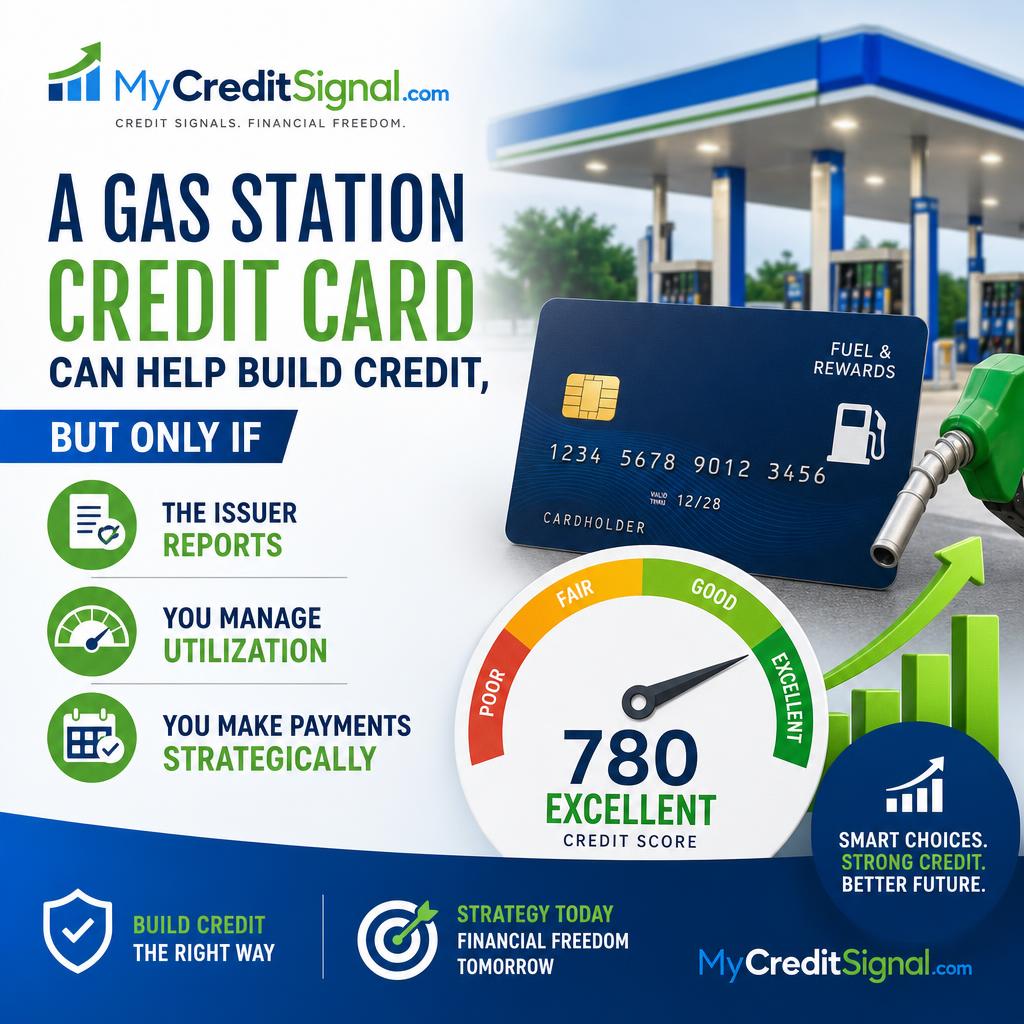
If you buy gas every week anyway, a gas station credit card can look like an easy way to start building credit. The catch is that this strategy only works when the issuer actually reports your account to the major credit bureaus and you manage the balance carefully. If you skip those two details, you can end up with another bill and little score benefit.
This guide is for people with thin credit, beginners, or rebuilders who want to know whether gas card credit building is worth trying. You will learn how the strategy works, what numbers matter, where it can go wrong, and how to use a gas card as a controlled credit-building tool instead of an expensive habit.
Contents
- 1 Who should use this strategy and who should skip it
- 2 Why gas cards work differently from regular credit cards
- 3 The numbers that matter more than the rewards sign-up pitch
- 4 A realistic example of gas card credit building
- 5 Step by step plan to make a gas card help your credit
- 5.1 Confirm issuer reporting before you apply
- 5.2 Set a hard monthly gas budget
- 5.3 Learn the statement closing date in the first week
- 5.4 Keep the reported balance low with mid-cycle payments
- 5.5 Turn on autopay for at least the minimum, then pay in full
- 5.6 Track results with a simulation mindset
- 5.7 Review the card after 90 days
- 6 Mistakes that make gas cards backfire
- 7 What most articles miss about this strategy
- 8 When a different first step is smarter
- 9 FAQ
- 10 Helpful tools and related resources
- 11 Conclusion
Key Takeaway
A gas station credit card can help build credit if the issuer reports to the bureaus and you keep payments on time with low reported utilization.
Who should use this strategy and who should skip it
Gas card credit building makes the most sense for a narrow group of people. It can work well if you already spend a predictable amount on gas each month, want a small starter line, and know you can pay the statement balance on time. It can also fit someone rebuilding after a setback who wants one tightly controlled account for recurring transportation spending.
This strategy is usually a better fit if:
- You drive regularly and already spend money on gas every month.
- You want a small, specific-use card instead of a general spending card.
- You can set up autopay and monitor your balance weekly.
- You are okay with a modest credit limit and slow, steady progress.
It may be a poor fit if:
- You do not drive much, so the card would sit unused.
- You tend to revolve balances or chase rewards you do not fully understand.
- You need a more flexible starter account, such as a traditional secured or beginner unsecured card.
- You are trying to build a broader credit profile and need more than one positive tradeline over time.
If you are starting from scratch and want to compare this option with other beginner paths, read these first credit card approval tips for beginners. If your income is tight and you need the lowest-risk approach, this guide to building credit on a low income can help you choose a more budget-friendly setup.
Why gas cards work differently from regular credit cards
A gas station credit card is often a branded retail card tied to a fuel chain or affiliated network. Some can only be used at participating stations. Others are more flexible, but many still behave like store cards in one critical way: their credit-building value depends on issuer reporting.
According to Experian, not all store-branded or gas-station cards report to all three major credit bureaus. That means you cannot assume that responsible use will help your credit. Before you apply, you need to verify whether the issuer reports to Experian, Equifax, and TransUnion. If the account is not reported, your on-time payments may do nothing for your score.
Once reporting is confirmed, the card can influence the same major score factors as other revolving accounts. FICO explains that payment history and amounts owed, including utilization, are major score factors. That means the gas card is not special because it is a gas card. It helps only because it becomes another revolving tradeline that can show on-time payments and controlled balances.
That is why the smartest way to think about a gas card is this: it is not a magic credit-builder. It is a small revolving account tied to a predictable expense. Used well, that predictability can be useful. Used poorly, it can produce high utilization on a tiny limit.
The numbers that matter more than the rewards sign-up pitch
Most marketing for gas cards highlights cents-off-per-gallon offers or introductory promotions. For credit-building, those are secondary. The real numbers you should watch are your credit limit, your monthly balance, your statement closing date, and whether your reported utilization stays manageable.
1. Your credit limit
Starter gas or store cards can come with a small line, sometimes in the $0 to $250 range based on the credit profile and issuer information cited by Experian. A low limit is not automatically bad, but it changes how carefully you must use the card.
Example: if your card has a $250 limit and you charge $90 in gas before the statement closes, your utilization on that card is 36 percent. That is above the widely cited under-30-percent guideline. If you charge $50, your utilization is 20 percent. The same spending pattern can look very different depending on timing.
2. Reported utilization
The Federal Reserve has continued to highlight utilization as a key scoring factor, with typical reported utilization for many groups sitting under 30 percent. That does not mean 30 percent is a magical safe line for everyone. It is a common benchmark, not a guarantee. Per-card utilization, overall utilization, and timing all matter, and score effects can vary by model and profile.
Here is the plain formula:
Utilization = reported balance divided by credit limit
So if your gas card limit is $200 and the reported balance is $40, utilization is 20 percent. If the reported balance is $80, utilization is 40 percent.
If you want to model how another card could affect your mix and balances, use the credit mix analyzer early in your planning process.
3. Intro APR timing
Some gas or store cards advertise promotional rates in the 0 to 2 percent APR range for a limited time, then jump to the standard APR later. The CFPB has increased scrutiny around rewards and disclosures, which matters because a flashy promo can distract from the real risk: carrying a balance after the promotion ends. A gas card can be useful for payment timing, but only if you understand the promotional window and avoid treating it like free debt. See the CFPB’s broader guidance and recent rewards oversight here.
4. Statement date versus due date
Many people pay on time and still report a high balance because they pay after the statement closes instead of before. If your goal is gas card credit building, the reporting date matters almost as much as the due date. A small payment made a few days before the statement closes can reduce the balance that gets reported.
A realistic example of gas card credit building
Suppose Maya gets a gas station card with a $250 limit. She spends about $35 a week on gas, or roughly $140 per month. If she simply uses the card and waits for the due date, the statement may report around $140, which is 56 percent utilization. Even if she pays in full and avoids interest, the reported balance could still be higher than ideal for scoring.
Now change one thing. Maya makes a $100 payment three days before the statement closes. The issuer reports a $40 balance. Her utilization drops to 16 percent. She still used the card for the same real-life spending, but the reported picture changed a lot.
That is the key decision framework for this strategy:
- First: verify bureau reporting.
- Second: estimate monthly gas spend.
- Third: compare that spend to the likely credit limit.
- Fourth: decide whether you can pay before the statement date, not just before the due date.
If your expected monthly gas spend would routinely push the card above a manageable utilization range, this may not be the best first account. In that case, a secured card or another beginner card may give you more room to breathe. If you want to understand how long progress may take, this timeline for building credit from zero sets realistic expectations.
Step by step plan to make a gas card help your credit
Confirm issuer reporting before you apply
Do not assume. Check the card terms, issuer FAQs, or customer service and verify whether the account reports to the major bureaus. The reporting check is the foundation of this whole strategy. If reporting is unclear, move on to another option.
Set a hard monthly gas budget
Pick a number based on what you already spend, not what the card makes you feel comfortable spending. If you normally buy $120 in gas each month, keep your gas card budget at $120. Do not add snacks, car washes, or convenience-store impulse buys unless that spending is already part of your budget.
Learn the statement closing date in the first week
Log in as soon as the account opens and write down the statement date and due date. Your due date protects you from late payments. Your statement date influences what balance gets reported. For credit-building, you need both on your calendar.
Keep the reported balance low with mid-cycle payments
If your limit is small, pay once during the month before the statement closes. Example: on a $250 limit, if you reach $70 in charges and want to report a lower balance, make a payment before the statement cuts. This is especially important when starter limits are low.
Turn on autopay for at least the minimum, then pay in full
The minimum autopay is your safety net against a missed payment. Then manually pay the full statement balance or the amount needed to control the reported balance. On-time payments matter heavily in major scoring models, according to FICO, so this step is non-negotiable.
Track results with a simulation mindset
Do not guess how changes might affect you. Use the credit score simulator to think through how lower utilization and on-time payments could support progress over time. Results will vary by profile and scoring model, but planning beats improvising.
Review the card after 90 days
Ask three questions. Is it reporting? Is your utilization manageable? Are you getting tempted to carry a balance? If the answer to the last question is yes, the card may be hurting your financial habits more than helping your score.
Those seven steps are practical enough to start this week. If you want a simple sequence, do this first versus later:
- This week: verify reporting, estimate monthly gas spending, set autopay, and note the statement date.
- Next month: test a mid-cycle payment and review what balance reported.
- After 2 to 3 cycles: decide whether the card is helping enough to keep.
Mistakes that make gas cards backfire
Using a tiny limit like free spending room
Behavior: Charging most of a $200 or $250 line because the purchases feel small. Consequence: High reported utilization can weigh on your score even if you pay in full later. Fix: Keep a spending cap tied to your limit and make a payment before the statement closes if needed.
Focusing on rewards instead of reporting
Behavior: Choosing the card with the best gas discount without confirming bureau reporting. Consequence: You may earn a few cents at the pump but get little to no credit-building value. Fix: Make reporting to the bureaus your first filter and rewards your second.
Relying on the promo APR to carry a balance
Behavior: Leaving fuel or store purchases unpaid because the intro APR looks low. Consequence: Once the promo period ends, the regular APR can make a small balance expensive fast. Fix: Treat the card like a charge card for your own purposes and pay in full whenever possible.
Paying on time but too late for reporting
Behavior: Waiting until the due date every month. Consequence: You avoid late fees, but a high statement balance can still be reported. Fix: Add one pre-statement payment when the balance starts creeping up.
What most articles miss about this strategy
Many articles reduce gas card credit building to a yes-or-no question. In real life, it is a fit question.
A gas card is often best used as a habit tool, not a complete credit plan. It can give you one revolving line with predictable spending, but long-term credit-building usually works better when it is paired with other positive accounts or milestones. The FDIC and other consumer guidance often emphasize combining reporting accounts with broader positive tradelines over time rather than expecting a single card to do everything.
Another nuance is that per-card utilization can matter even when your total utilization looks okay. If your only card is a gas card with a very small limit, one normal month of driving can make the card look maxed out. That does not mean the strategy is failing. It means the line may be too small for the spending pattern.
There is also a behavioral angle. Some people do better with category-specific cards because they reduce overspending. Others start adding convenience-store purchases and end up breaking the budget. Be honest about which camp you are in.
Finally, do not expect instant score jumps on a fixed schedule. Score growth depends on your starting profile, any existing negatives, total available credit, and whether the card reports consistently. The card can support better data on your reports, but it cannot override the rest of your file.
When a different first step is smarter
You should probably choose another approach first if any of these apply:
- Your expected gas spending would regularly push utilization high on a small limit.
- You need a card you can use for more than fuel and a narrow retailer network.
- You are rebuilding and already have multiple high-balance cards, so another revolving account could complicate things.
- You want the clearest upgrade path to a general unsecured card later.
For many beginners, the smarter sequence is to start with the most manageable reporting account, build 6 to 12 months of clean history, then broaden your profile. If you already have a secured card and are planning your next move, this secured to unsecured card upgrade guide can help you think about timing.
FAQ
Can a gas station credit card really help my credit?
Yes, but only if the issuer reports the account to the major credit bureaus and you manage payments and utilization well. Without reporting, responsible use may not show up on your credit file.
Do gas cards report to all three bureaus?
Not always. Experian notes that some store and branded cards may not report to all three bureaus, so you should confirm reporting before applying.
How long does it take to see improvement?
There is no universal timeline. Results vary based on your existing credit profile, whether the issuer reports consistently, and how your utilization and payment history look across all accounts.
If you want to turn this strategy into a measurable plan instead of a guess, start with the credit mix analyzer to see how another account fits your profile, then try the credit score simulator to model how lower balances and on-time payments may help over time.
For more credit-building guidance, the most relevant next reads are first credit card approval tips for beginners, how long it takes to build credit from zero, and when to move from a secured card to an unsecured card.
Get weekly credit tips, tool updates, and practical guides – free.
Conclusion
Gas card credit building can work, but only when you use the card like a precision tool. Verify reporting first. Keep the reported balance low. Pay on time every month. Ignore flashy rewards if the core credit mechanics are weak.
If you are considering this route, your next best step is simple: confirm whether the issuer reports to the bureaus and compare your monthly gas budget to the likely credit limit. If those two pieces line up, a gas card can become a practical first rung on the ladder instead of just another bill.


Leave a Reply
You must be logged in to post a comment.